Concept
Antonietta Raco (Lourdes 2009)
Antonia Raco, Antonietta Raco, Antonia Lofiego, Raco Lourdes healing, 72nd Lourdes miracle, Lourdes 72nd miracle, Lourdes ALS healingIntro
In the summer of 2009, Antonietta Raco, a wife and mother from southern Italy, went to Lourdes in a wheelchair. For several years a disease of the nerves that control movement had been taking away her strength. She could no longer walk, and breathing and swallowing had become hard. Doctors had told her there was no cure.
At the baths she says she heard a woman's voice tell her three times, "Don't be afraid," and felt a sharp pain in her legs. She told no one and went home in her wheelchair. A few days later, at home, she stood up on her own for the first time in years. Within weeks her neurologist in Turin found her symptoms gone.
The Lourdes doctors studied the case for fifteen years. In November 2024 their international committee voted that the cure was unexplained, and on 16 April 2025 her bishop declared it a miracle, the 72nd officially recognized at Lourdes. It is filed in the documented tier because it passed the full Lourdes medical process.
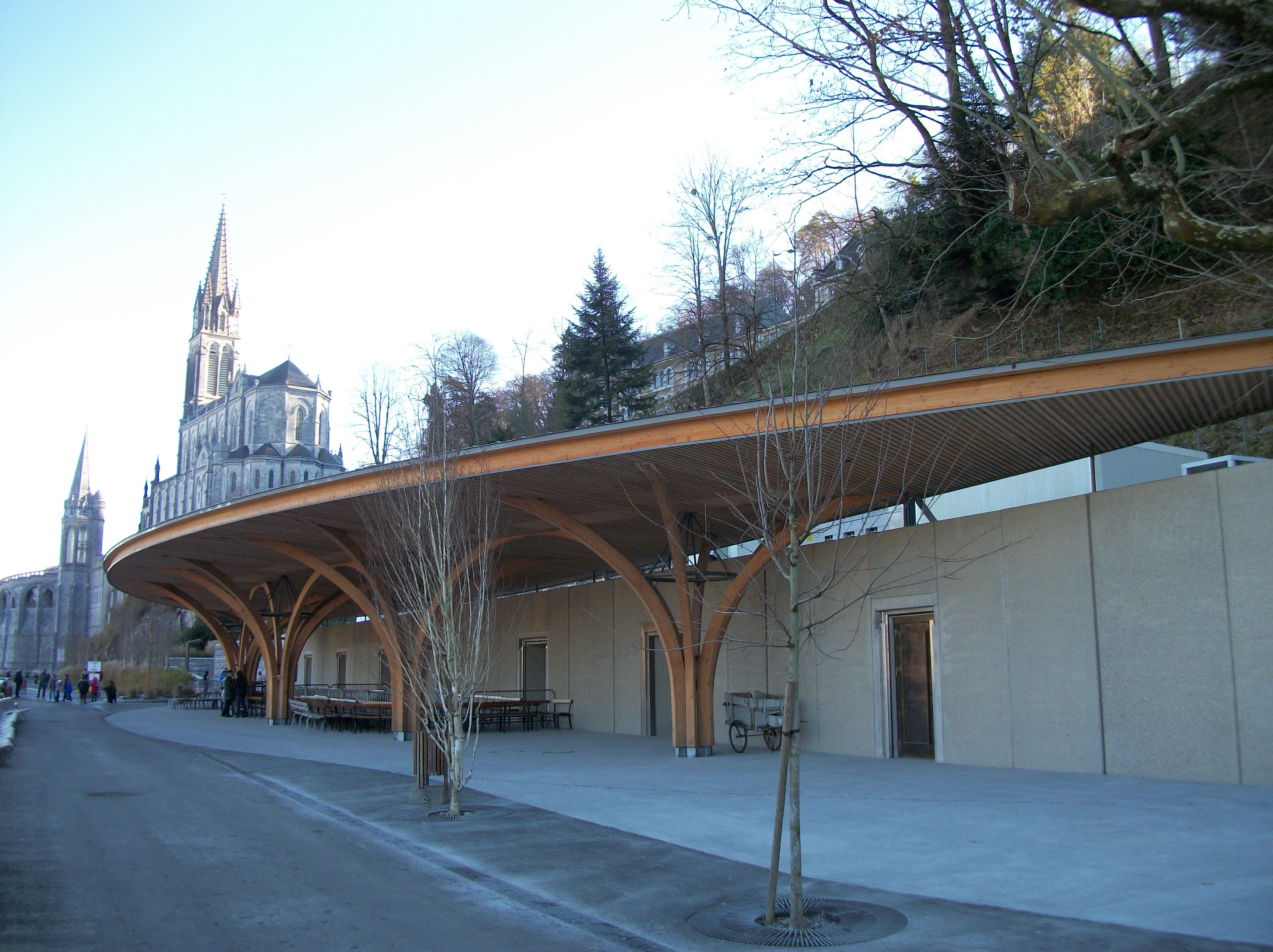
The entrance to the baths at the Sanctuary of Lourdes, photographed in 2019, with the basilica behind. Photo: Patrice Bon, CC0, via Wikimedia Commons, resized.

The 30-second version:
Antonietta Raco, an Italian woman, came to Lourdes in 2009 in a wheelchair, disabled by a progressive motor neuron disease that her doctors said could not be reversed. After the baths, and back at home, she stood and walked. Her neurologist in Turin found the symptoms gone within weeks and told reporters such a regression had never been described. Fifteen years of review followed. In November 2024 the International Medical Committee of Lourdes voted 17 to 4 that the cure was unexplained, and in April 2025 her bishop declared it the 72nd Lourdes miracle. The exact diagnosis, ALS or the rarer primary lateral sclerosis, is the one real point of dispute.
See this page's graph and discover linked topics
In full
The case of Antonietta (Antonia) Raco runs through every stage of the Lourdes process described on the Lourdes Medical Bureau page. Symptoms began around 2004 and a diagnosis of amyotrophic lateral sclerosis was made around 2006, according to the Palais du Rosaire account and the National Catholic Register; by 2009 she used a wheelchair and struggled to breathe and swallow. She went to Lourdes in the summer of 2009 on a diocesan pilgrimage organized by UNITALSI. On 31 August 2009 Le Quotidien du Médecin reported that her bishop, Francescantonio Nolè of Tursi-Lagonegro, had announced the cure on Vatican Radio, and quoted her treating neurologist in Turin, Professor Adriano Chiò, who examined her on 24 August, as saying that no regression of the disease had ever been described in the medical literature. The Lourdes Medical Bureau (Bureau des Constatations Médicales) received her declaration in March 2010, held five collegial sessions, and recorded the cure as established in 2017. The neurology department of the University of Milan, under Professor Vincenzo Silani, examined her in 2013. The International Medical Committee of Lourdes (CMIL) first left the case undecided because the diagnosis itself was uncertain; after an international diagnostic consensus on the disease (published in 2020) it voted in November 2024, 17 in favor and 4 against, a two-thirds majority being required, that the cure was unexpected, complete, lasting and unexplained. Bishop Vincenzo Carmine Orofino of Tursi-Lagonegro proclaimed the miracle on 16 April 2025. The main open question, the exact diagnosis, is recorded under Tensions below. Under the Miracles schema the case is Tier 1 on medical-bureau ratification.
Summary
Antonietta Raco, an Italian woman from the diocese of Tursi-Lagonegro, had a progressive motor neuron disease (reported as ALS in 2009, and as primary lateral sclerosis by the Sanctuary of Lourdes in 2025) and was in a wheelchair when she made a UNITALSI pilgrimage to Lourdes in the summer of 2009. After bathing at the shrine she recovered the ability to stand and walk, first noticed at home a few days later, and her Turin neurologist, Adriano Chiò, found her symptoms gone on 24 August 2009. The Lourdes Medical Bureau investigated from 2010, the International Medical Committee of Lourdes voted the cure unexplained in November 2024 (17 to 4), and Bishop Vincenzo Carmine Orofino recognized it as a miracle on 16 April 2025, the 72nd at Lourdes.
The event
- The illness. According to the Palais du Rosaire account, symptoms began in 2004 with severe headaches, cramps and general weakness. By 2005 she had trouble swallowing and speaking, lost mobility and fell often. A diagnosis was made in 2006. By 2008 she was largely confined to a wheelchair. RFI reports that she walked with crutches before that, with muscle pain and repeated falls.
- The pilgrimage. In the summer of 2009 she went to Lourdes with her husband, Antonio, on a five-day diocesan pilgrimage organized by UNITALSI, the Italian association that carries the sick to Lourdes. She arrived in a wheelchair.
- The baths. On the second day, volunteers took her to the baths and prayed with her. She has said she felt something like a caress on her neck and heard a young woman's voice say "Don't be afraid!" three times, and that during the immersion she felt a sudden, sharp pain in her legs.
- Silence. She told no one and returned home in her wheelchair.
- At home. In her living room she heard the voice again, telling her to speak and to call her husband, who had just stepped into the kitchen. She called him, told him "Something has happened," and stood up without help for the first time in years. The couple embraced and wept.
- The neurologist. Her doctors visited about twenty days after her return and found her standing and walking. On 24 August 2009 she was examined in Turin by Professor Adriano Chiò, who, as Le Quotidien du Médecin reported a week later, called it an extraordinary event.
- Afterward. In July 2025 she returned to Lourdes, now as a volunteer helper with UNITALSI, and gave her testimony at the sanctuary on 25 July.
Witnesses + documentation
- Antonietta Raco, the patient: account of the illness, the baths and the recovery, given to the Lourdes Medical Bureau and publicly in Lourdes on 25 July 2025.
- Antonio, her husband: with her on the pilgrimage and present when she first stood at home.
- Professor Adriano Chiò, University of Turin, her treating neurologist: examined her on 24 August 2009 and was quoted on the absence of any described regression of the disease.
- Bishop Francescantonio Nolè, then bishop of Tursi-Lagonegro, who had accompanied the 2009 pilgrimage: announced the cure on Vatican Radio in August 2009.
- Dr. Alessandro de Franciscis, permanent physician of the sanctuary and president of the Lourdes Medical Bureau, who began at the Bureau on 1 April 2009, months before her pilgrimage, and has headed it for about sixteen years. He has called the investigation "a medical thriller," involving specialists in Milan, Rome and Turin.
- Professor Vincenzo Silani, University of Milan, neurologist and CMIL expert: led the 2013 Milan examination, confirmed the diagnosis and the recovery, and is reported as a co-author of the diagnostic consensus the committee relied on.
- Professor Jean Pouget, University of Marseille, CMIL expert, and Professor Olivier Jonquet, University of Montpellier, president of the CMIL.
- Bishop Vincenzo Carmine Orofino of Tursi-Lagonegro: formal canonical recognition, 16 April 2025.
- Bishop Jean-Marc Micas of Tarbes and Lourdes: informed the bishop of Tursi-Lagonegro of the CMIL verdict (15 November 2024, per the Palais du Rosaire account) and attended the 2025 presentation without voting.
- Published record:
- "Une SLA guérie à Lourdes," Le Quotidien du Médecin, 31 August 2009.
- Daniel Payne, "Lourdes announces 72nd miracle: Italian pilgrim cured of degenerative disease," Catholic News Agency, 16 April 2025.
- "Easter joy as Lourdes declares new miracle after Italian woman walks again," RFI, April 2025.
- Florian Dunoguiez, "Antonietta, la 72e miraculée de Lourdes, revient comme hospitalière," Aleteia (French edition), 25 July 2025.
- Solène Tadié, "'A Voice Told Me Not to Be Afraid': The Story of Lourdes' 72nd Recognized Miracle," National Catholic Register, 26 July 2025.
- "Lourdes : un 72e miracle reconnu," FSSPX News, 28 July 2025.
Verification
What was checked:
- Contemporaneous medical attestation. The recovery was examined by her own neurologist within weeks, and a medical newspaper reported it in August 2009, long before any canonical process.
- A full bureau process. The Lourdes Medical Bureau opened its file in March 2010, held five collegial sessions with outside physicians, and recorded the cure as established in 2017. An independent neurology department in Milan examined her in 2013, and follow-up continued to 2024.
- An international vote. The CMIL, a body of specialists from several countries, voted 17 to 4 in November 2024, clearing the required two-thirds majority, that the cure was unexpected, complete, lasting and unexplained.
- Durability. Some fifteen years passed between the cure and the verdict, and she was still well enough in 2025 to serve as a volunteer helper at Lourdes.
Naturalistic explanations considered:
- Misdiagnosis. This is the strongest natural explanation, and the CMIL itself took it seriously: it declined to rule in 2019 because the diagnosis was uncertain, and voted only after an international diagnostic consensus gave a framework for reassessment. Several conditions can mimic motor neuron disease, and the reports disagree on whether the disease was ALS or primary lateral sclerosis (see Tensions). Against it, both her treating neurologist in Turin and the Milan neurology department confirmed the diagnosis.
- Spontaneous "ALS reversals." Rare documented cases exist in which patients who met diagnostic criteria for ALS later improved substantially. A 2018 study by Harrison, Bedlack and colleagues in Amyotrophic Lateral Sclerosis and Frontotemporal Degeneration described the demographics and treatments of such cases. The phenomenon is real but rare, and the CMIL's specialists, who had the full records, still judged this recovery unexplained. A skeptic can fairly press this point; the honest reply is that the committee considered the known outcomes of the disease and voted on the evidence.
- Gradual recovery or treatment effect. The Lourdes criteria exclude cures attributable to treatment or to gradual improvement. Accounts differ on how sudden the recovery was (see Tensions), which is part of why the process took so long.
Caveats and remaining uncertainties:
- Diagnosis disputed in the reports. Even the published accounts do not agree on which motor neuron disease she had. Primary lateral sclerosis usually progresses more slowly than ALS, so the label matters to how unusual the recovery was.
- Not unanimous. Four of the 21 CMIL members voted against. The records themselves are not public.
- Recovery noticed at home. The decisive change was first noticed at home, not at the shrine, and was first examined by a physician weeks later.
Tensions
The published accounts conflict on several points. They are recorded here, attributed, without choosing a winner.
- ALS or PLS. Le Quotidien du Médecin (2009), the National Catholic Register (2025) and the body of the Palais du Rosaire account report amyotrophic lateral sclerosis. The Sanctuary of Lourdes announcement, Catholic News Agency, RFI, Aleteia and FSSPX News report primary lateral sclerosis. The two are different diseases.
- Date of diagnosis. Reports give 2004 (RFI, as the onset of the illness), 2005, or 2006 (Palais du Rosaire, National Catholic Register).
- Month of the pilgrimage. The Palais du Rosaire account says July 2009; Le Quotidien du Médecin says early August 2009.
- Sudden or gradual. The National Catholic Register account describes her standing for the first time at home, in one moment. The Palais du Rosaire account says she regained feeling and then, gradually, her mobility.
- The Milan examination. FSSPX News and the Palais du Rosaire account date the Milan neurology examination to 2013. The National Catholic Register says Silani re-evaluated her in Milan in 2023 and confirmed the cure. Both may be true; the sources do not say.
- The diagnostic consensus. The National Catholic Register dates it to 2020. FSSPX News says it was published in 2020 and validated by the international scientific community in 2024.
- The announcement date. Catholic News Agency, RFI and FSSPX News place the bishop's proclamation and the sanctuary's announcement on 16 April 2025, the feast of Saint Bernadette Soubirous. The National Catholic Register says the rector, Father Michel Daubanes, announced it at the evening rosary on Holy Thursday, 17 April.
- Her name. Reports use both Antonia and Antonietta. FSSPX News gives her married name as Lofiego, née Raco.
Apologetic value
- A full modern Lourdes case. A diagnosis by named neurologists, a medical newspaper report within weeks, a fifteen-year bureau file, an independent university examination and a recorded international vote. Few modern healing claims of any kind have passed through that much review.
- Against "it's always the same kind of disease." Skeptics often say cures cluster in conditions that can resolve on their own. Motor neuron diseases are among the conditions neurologists regard as progressive and irreversible, and her treating neurologist said as much on the record in 2009.
- The bureau's own restraint. The CMIL refused to rule until the diagnosis could be settled and then voted with dissent recorded. That is the opposite of credulity, and it answers the charge that Lourdes rubber-stamps claims.
- The biblical pattern. A disabled person restored to walking echoes the man at the pool of Bethesda (John 5:1-9), Peter and the lame man at the temple gate (Acts 3:6-7), and Jesus's answer to John the Baptist, "the lame walk" (Matthew 11:5).
- How to deploy it. Lead with the facts on record: her own neurologist's statement in 2009 and the 17 to 4 vote of the international committee in 2024. Concede openly that the diagnosis is reported two ways and that rare spontaneous reversals of ALS are documented. Then press the point that the specialists with the records still judged the recovery unexplained. Remember that the recognition is Catholic and is attributed to the intercession of Mary at Lourdes; for a Protestant audience, present the medical facts and the answered prayer, and let the audience weigh the setting.
Scholarship
Published academic works this page draws on, each matched to a publisher, index or library catalog record.
- Daniel Harrison et al., "'ALS reversals': demographics, disease characteristics, treatments, and co-morbidities," Amyotrophic Lateral Sclerosis and Frontotemporal Degeneration 19 (2018). doi:10.1080/21678421.2018.1457059 PubMed 29607695
See also
- Miracles, master hub
- _schema, the vetting standard this entry follows
- Lourdes Medical Bureau, the body that investigated the case, and the CMIL above it
- Bernadette Soubirous, the visionary of Lourdes, on whose feast day the recognition was announced
- John Traynor (Lourdes 1923), the 71st Lourdes miracle, recognized a few months earlier
- Sister Bernadette Moriau (Lourdes 2018), the 70th, another cure of a disabling neurological condition
- Jean-Pierre Bely (Lourdes 1987), a recognized Lourdes cure of progressive multiple sclerosis
- Danila Castelli (Lourdes 1989), the 69th Lourdes miracle, another Italian cure followed for twenty years before recognition
- Argument from Miracles, the argument this case supports
- David Hume, whose standard for credible miracle testimony this case presses on
- Naturalism, the worldview such cases press against
Common questions this page answers
Q: What is the 72nd Lourdes miracle?
It is the cure of Antonietta Raco, an Italian woman who had a progressive motor neuron disease and was in a wheelchair when she went to Lourdes in 2009. She recovered the ability to walk after the pilgrimage. The International Medical Committee of Lourdes judged the cure unexplained in November 2024, and her bishop recognized it as a miracle on 16 April 2025.
Q: Did Antonietta Raco have ALS or primary lateral sclerosis?
The reports disagree. A French medical newspaper in 2009 and some later accounts say amyotrophic lateral sclerosis (ALS); the Sanctuary of Lourdes and most 2025 reports say primary lateral sclerosis. The Lourdes committee waited for an international diagnostic consensus before voting, because the diagnosis itself was the hard question.
Q: How did the Lourdes doctors investigate the Raco healing?
The Lourdes Medical Bureau opened a file in 2010, held five sessions with outside physicians, and recorded the cure as established in 2017. Neurologists at the University of Milan examined her in 2013. The International Medical Committee of Lourdes then voted 17 to 4 in November 2024 that the cure was unexpected, complete, lasting and unexplained.
Q: Can ALS go into remission on its own?
Rarely. Researchers including Richard Bedlack have documented a small number of "ALS reversals," patients who met the diagnostic criteria and later improved substantially. It is a real but uncommon phenomenon, and the Lourdes specialists, who had her full records, still judged her recovery unexplained.
Q: How many miracles has Lourdes officially recognized?
Antonietta Raco's cure, recognized in April 2025, is the 72nd. The 71st, John Traynor's, was recognized a few months earlier, in December 2024. Only a small fraction of the cures reported at Lourdes reach this stage.