Person
Ananias son of Nedebaeus
Ananias the high priest, Ananias son of Nebedaeus, Ananias son of Nebedaios, Ananias son of Nebedeus, Hananiah son of Nedebaeus, Ananias (high priest)Intro
Ananias son of Nedebaeus was the Jewish high priest who ordered the apostle Paul to be struck on the mouth during his hearing before the council in Jerusalem. Paul shot back, "God shall smite thee, thou whited wall." Five days after Paul was moved to Caesarea, Ananias came down himself to accuse him before the Roman governor Felix.
He is a different man from the Ananias who lied about money in Acts 5 and from the Ananias who baptized Paul in Damascus. The Jewish historian Josephus describes this high priest as wealthy and powerful, and says rebels killed him at the start of the war with Rome in AD 66.
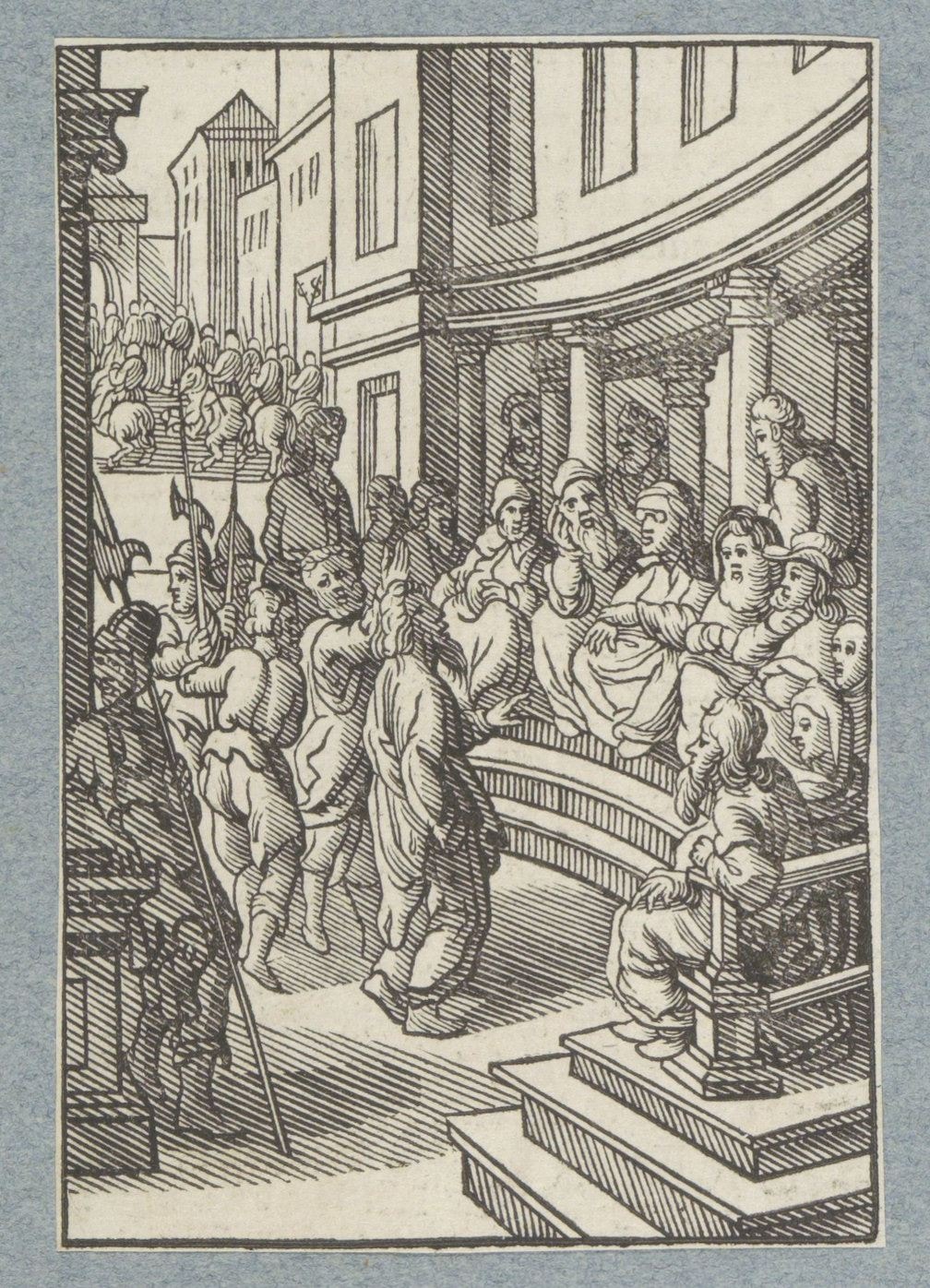
Paul before the Sanhedrin, engraved book illustration, Rijksmuseum, Amsterdam (RP-P-2015-17-27-4). CC0, via Wikimedia Commons, resized.

See this page's graph and discover linked topics
In full
Ananias (Hebrew Ḥananyah) was appointed high priest by Herod, king of Chalcis, about AD 47 or 48: Herod "made Ananias, the son of Nebedus, his successor" in the office (Josephus, Antiquities 20.103). He held it for over a decade, one of the longer tenures of the Roman period.
- Sent to Rome in chains, c. AD 52. After violence between Jews and Samaritans, the Syrian legate Ummidius Quadratus "sent away Ananias the High Priest, and Ananus the commander" of the temple to Rome to answer to Claudius (Antiquities 20.131). He returned to office.
- Replaced, c. AD 59. King Agrippa II gave the high priesthood to Ishmael son of Phabi (Antiquities 20.179), but Ananias remained the most powerful priestly figure in Jerusalem. Josephus says "he increased in glory every day," won favor with bribes, and had servants who went to the threshing floors and took by force the tithes owed to the ordinary priests, so that some of them starved (Antiquities 20.205-207).
- The Sicarii. The Sicarii kidnapped the secretary of his son Eleazar, the captain of the temple, and forced Ananias to secure the release of ten of their own men in exchange; the tactic was repeated (Antiquities 20.208-210).
- Death, AD 66. At the outbreak of the revolt the rebels "set fire to the house of Ananias the high-priest, and to the palaces of Agrippa and Bernice" (Jewish War 2.426). Ananias hid but "was caught, where he had concealed himself in an aqueduct," and was killed with his brother Hezekiah by the men of the rebel leader Menahem (Jewish War 2.441).
In the Bible
- The blow. "And the high priest Ananias commanded them that stood by him to smite him on the mouth. Then said Paul unto him, God shall smite thee, thou whited wall: and sittest thou to judge me according to the law, and commandest me to be smitten contrary to the law?" (Acts 23:2-3, ASV).
- Paul's reply. "And they that stood by said, Revilest thou God's high priest? And Paul said, I knew not, brethren, that he was high priest: for it is written, Thou shalt not speak evil of a ruler of thy people" (Acts 23:4-5, ASV), quoting Exodus 22:28.
- Before Felix. "And after five days the high priest Ananias came down with certain elders, and with an orator, one Tertullus; and they informed the governor against Paul" (Acts 24:1, ASV).
Two other men named Ananias appear in Acts: the disciple who lied with Sapphira (Acts 5:1-11) and the disciple of Damascus who laid hands on Saul (Acts 9:10-17; Acts 22:12). The name, Hebrew Ḥananyah, "YHWH has been gracious," was common.
Family and lineage
- Father: Nedebaeus (Greek Nedebaios; spelled Nebedeus or Nebedaios in some editions of Josephus). Nothing else is known of him.
- Son: Eleazar, captain of the temple, who in AD 66 persuaded the priests to stop the daily sacrifice offered for the emperor, an act Josephus treats as the beginning of the war (Jewish War 2.409). Josephus also mentions other sons.
- Brother: Hezekiah, killed with him in 66 (Jewish War 2.441).
Historical and archaeological evidence
| Source | What it says | Date | Where it is now | Grade |
|---|---|---|---|---|
| Josephus, Antiquities 20.103, 20.131, 20.179, 20.205-210 | Appointment by Herod of Chalcis; sent to Rome by Quadratus; succeeded by Ishmael; his wealth, his servants' seizure of tithes, the Sicarii kidnappings | written c. AD 93-94 | manuscript tradition | contemporary witness, strong |
| Josephus, Jewish War 2.409, 2.426, 2.441 | His son Eleazar stops the sacrifice for Rome; his house burned; his death in the aqueduct | written c. AD 75 | manuscript tradition | contemporary witness, strong |
| Masada ostracon no. 461 | Aramaic inscription on a potsherd, read "Ḥananyah the high priest, ʿAqavya his son" | AD 66-73 | Masada finds, published by Yigael Yadin, Joseph Naveh and Yaacov Meshorer, Masada I (1989) | possible but uncertain identification |
Lawrence Mykytiuk counts Ananias among the seven New Testament religious figures confirmed outside the Bible, on the strength of Josephus ("New Testament Religious Figures Confirmed," Biblical Archaeology Review, Summer 2021). The Masada ostracon is at most a possible reference: Hananiah was a common name, and Josephus names no son of Ananias called ʿAqavya. See Biblical Figures Confirmed by Archaeology.
Scholarly consensus
- Identification is secure. The Ananias of Acts 23-24 is identified by all major commentators with Josephus's Ananias son of Nedebaeus. The title, the date (Paul's arrest, c. AD 57) and his hostility to troublemakers match.
- Was he still high priest in AD 57? Acts calls him high priest. Josephus places his replacement by Ishmael late in Felix's governorship, about 59, so in 57 he was still in office. Former high priests also kept the title in common usage.
- "I knew not that he was high priest." Commentators divide over Paul's words. Some read them as irony (Paul would not recognize as high priest a man who broke the law while judging by it); others suppose Paul did not know who gave the order in an informal, crowded session; still others point to his weak eyesight, a suggestion drawn from Galatians 4:15 and Galatians 6:11. None can be proven from the text.
Theological significance
- "Thou whited wall." Paul's rebuke echoes Jesus' words against "whited sepulchres" (Matthew 23:27) and Ezekiel's picture of false prophets plastering over a flimsy wall (Ezekiel 13:10-16): a fine surface over decay. Ananias sat to judge "according to the law" while breaking it.
- Submission to the office. Paul's quick retraction, citing Exodus 22:28, shows him honoring the office of high priest even when its holder acted unjustly.
- A word fulfilled. Many readers have noticed that "God shall smite thee" came true: Ananias was killed by his own countrymen nine years later. Acts itself does not record the fulfillment.
- Josephus confirms the character. Acts shows a high priest who orders an accused man struck and travels to Caesarea to pursue him. Josephus independently describes a rich, ruthless high priest whose servants beat the poor priests for their tithes.
Church Fathers
- John Chrysostom, Homilies on Acts 48, on Acts 23:1-5: Paul's rebuke "are the words of boldness, rather than of anger," and in claiming not to know the high priest "he pretends ignorance: an ignorance which does no harm."
See also
- Paul the Apostle, whom Ananias ordered struck
- Antonius Felix, the governor before whom Ananias accused Paul
- Herod Agrippa II, who replaced him as high priest
- Josephus, the historian who records his career and death
- Olivet Discourse and AD 70, the war in which he was killed
- Biblical Figures Confirmed by Archaeology, Mykytiuk's list of confirmed persons
- People of the Bible, the hub of attested biblical people by book
Common questions this page answers
Q: Who was the high priest Ananias in Acts 23?
He was Ananias son of Nedebaeus, high priest from about AD 47 to 59. He ordered Paul to be struck on the mouth during his hearing before the council, and five days later went to Caesarea to accuse Paul before the governor Felix.
Q: Is the high priest Ananias the same as the Ananias of Acts 5 or Acts 9?
No. Ananias was a common Jewish name. The man of Acts 5 lied with his wife Sapphira, the man of Acts 9 baptized Saul in Damascus, and the high priest of Acts 23-24 is a third person.
Q: Why did Paul call Ananias a "whited wall"?
Ananias sat to judge Paul by the law yet ordered him struck without a verdict, which the law did not allow. A whitewashed wall looks clean outside but hides cracks, the same image Jesus used of hypocrites as "whited sepulchres."
Q: What happened to Ananias the high priest?
Josephus says that when the revolt against Rome began in AD 66, rebels burned his house, found him hiding in an aqueduct, and killed him together with his brother Hezekiah.