Concept
Amy Wall (Katharine Drexel 1994)
Amy Wall, Amanda Wall, Katharine Drexel miracle, Katharine Drexel canonization miracle, Saint Katharine Drexel canonization miracleIntro
Amy Wall was born in 1992 in Bucks County, Pennsylvania, and could not hear. In September 1993 hospital tests found that the nerves of hearing in both ears had failed, and the finding was described as permanent. Her family started learning sign language.
Her older brother Jack, who was getting ready for his First Communion, had learned about miracles and asked the family to pray for one. They prayed to Katharine Drexel, a Philadelphia nun who had spent her family fortune on schools for Black and Native American children, and they laid a relic of hers on Amy's ear. In March 1994 a preschool teacher noticed Amy jumping at loud sounds. Hospital tests that month showed her hearing was normal.
The Archdiocese of Philadelphia investigated. In October 1999 the Vatican's medical board found no natural explanation, and in January 2000 Pope John Paul II declared the cure a miracle. Katharine Drexel was made a saint on 1 October 2000, and Amy, then eight, was there. The case is filed in the documented tier because it passed the Vatican's formal medical and theological review.
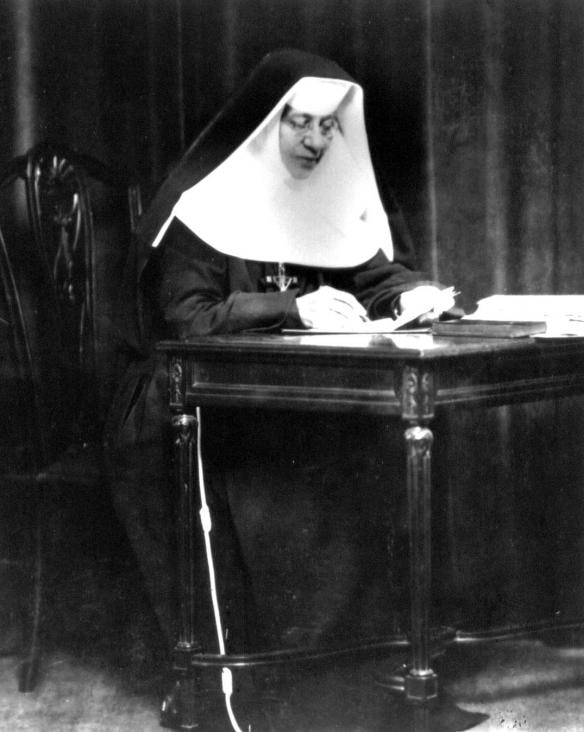
Mother Katharine Drexel at her desk, around 1915. Photo: unknown author, public domain, via Wikimedia Commons.

The 30-second version:
Amy Wall was born deaf in 1992. Hospital tests in September 1993 found "congenital and permanent failure of the auditory nerves." Her family prayed to Blessed Katharine Drexel and laid a relic on her ear. In March 1994 a preschool teacher saw her startle at loud sounds, and hospital tests that month found her hearing normal. A Vatican medical board ruled on 7 October 1999 that no natural cause explained the cure, John Paul II declared it a miracle on 27 January 2000, and Drexel was canonized on 1 October 2000. Amy was still hearing at fifteen and in her twenties.
See this page's graph and discover linked topics
In full
Katharine Drexel (1858-1955) was born into a Philadelphia banking family, founded the Sisters of the Blessed Sacrament in 1891, and gave her inheritance to missions and schools for Native Americans and African Americans (Associated Press, 2000; John Paul II, canonization homily, 2000). Her cause was opened under Cardinal John Krol. She was declared Venerable on 26 January 1987 and beatified in 1988 after the Vatican accepted a first miracle, the 1974 cure of Robert Gutherman of Bensalem (Associated Press, 2000; Katharine Drexel Shrine). Canonization required a second miracle, and the Wall case supplied it.
The clinical picture comes from the Associated Press report of the papal decree. Amy was one when doctors diagnosed incurable nerve deafness; hospital examinations in September 1993 found "congenital and permanent failure of the auditory nerves." After the family's prayers, a preschool teacher noticed in March 1994 that she startled at loud sounds, and hospital tests that month showed normal hearing. The archdiocese opened its inquiry in 1994 and kept the family's name private (AP, 2000). A Vatican medical board ruled on 7 October 1999 that there was no natural cause for the cure (National Catholic Register, October 1999). After the theologians' review, John Paul II recognized the miracle on 27 January 2000 (National Catholic Register, February 2000), and he canonized Katharine Drexel in St Peter's Square on 1 October 2000 (Vatican homily). Under the Miracles schema the case is Tier 1 on the ground of Vatican ratification. It has no published medical case report, the medical file is not public, and no treating physician is named in the published accounts.
Summary
Amanda "Amy" Wall, born in 1992 to John and Constance Wall of Bucks County, Pennsylvania, was diagnosed with congenital nerve deafness in both ears, confirmed by hospital examination in September 1993. Her family prayed for the intercession of Blessed Katharine Drexel and applied a relic to her ear. In March 1994 her preschool teacher noticed that she reacted to sound, and hospital tests that month found her hearing normal. The Archdiocese of Philadelphia investigated from 1994. The Vatican's medical board found no natural explanation on 7 October 1999, Pope John Paul II declared the cure miraculous on 27 January 2000, and Katharine Drexel was canonized on 1 October 2000.
The event
- The diagnosis. Amy was born with nerve deafness in 1992 (National Catholic Register, 1999). Hospital examinations in September 1993 found "congenital and permanent failure of the auditory nerves." Her mother said the doctors' advice was, "Get used to it" (AP, 2000).
- Adapting. Her mother first prayed simply to be able to communicate with her daughter, and the family learned sign language at a school for the deaf (Cardinal Anthony Bevilacqua, National Catholic Register, 2000).
- The prayer. The family had watched a television program on Katharine Drexel's life. Jack, preparing for his First Communion, had learned about miracles and suggested they pray. Amy's sister Jeannie said, "if Amy can't hear I want to be deaf too" (CatholicPhilly, 2015). The family prayed to Blessed Katharine Drexel and laid a relic of hers on Amy's ear (AP, 2000; National Catholic Register, 2000).
- The change. In March 1994 a preschool teacher noticed Amy startling at loud sounds (AP, 2000). As Cardinal Bevilacqua told it, the teacher said to her mother, "I don't think your daughter is one of us anymore" (National Catholic Register, 2000).
- The retest. Hospital tests that same month found her hearing normal, "perfect" in her mother's word (AP, 2000). Amy later recalled her mother's account: the doctors said, "This isn't the same child" (Philadelphia Inquirer, 2008).
- Recognition. The papal decree was announced in Philadelphia on 27 January 2000 by Cardinal Bevilacqua, with Robert Gutherman, the first miracle's beneficiary, present (AP, 2000). At the canonization in Rome Amy was presented to John Paul II, who kissed her on the head (CatholicPhilly, 2015).
- Afterward. At fifteen she was still hearing (Philadelphia Inquirer, 2008). In September 2015, in her early twenties, she read Scripture aloud at the Festival of Families on the Benjamin Franklin Parkway in Philadelphia, with Pope Francis present (CatholicPhilly, 2015).
Witnesses + documentation
- Amanda "Amy" Wall, the patient, interviewed in 2008 and 2015.
- John and Constance (Connie) Wall, her parents, quoted by the AP (2000). Connie Wall died before 2008 (Philadelphia Inquirer, 2008).
- Jack and Jeannie Wall, her brother and sister, whose part in the prayer is recounted by Cardinal Bevilacqua (2000) and by Amy (2015).
- Her preschool teacher, unnamed in the published accounts, who first noticed the change.
- The Archdiocese of Philadelphia, whose inquiry began in 1994 (AP, 2000).
- The medical board of the Congregation for the Causes of Saints, which ruled on 7 October 1999 (National Catholic Register, 1999).
- Cardinal Anthony J. Bevilacqua, Archbishop of Philadelphia, who announced the decree and described the case (AP, 2000; National Catholic Register, 2000).
- Pope John Paul II, who recognized the miracle on 27 January 2000 and canonized Katharine Drexel on 1 October 2000.
Verification
What was checked:
- The canonization. The Vatican's published homily of 1 October 2000 records the canonization of 123 new saints, among them Katharine Mary Drexel, Augustine Zhao Rong and 119 companions martyred in China, and Josephine Bakhita.
- The medical board and the decree. The National Catholic Register (17 October 1999) reports the medical board's ruling of 7 October 1999, and the Register (27 February 2000) and the AP (29 January 2000) report the papal recognition announced on Thursday, 27 January 2000. The decree text itself was not found online.
- The diagnosis and the retest. The September 1993 hospital finding and the March 1994 retest are reported by the AP (2000). The family's identity was withheld during the inquiry and published at the decree.
- Durability. Independent reports in 2008 and 2015 describe her still hearing, fourteen and twenty-one years after the cure.
Naturalistic explanations considered:
- Misdiagnosis in infancy. Hearing in very young children is harder to measure than in adults, and an early finding of profound loss is sometimes revised when a child later proves to hear better than first measured. This is the obvious natural explanation. Against it, the published account says hospital examination found failure of the auditory nerves and that the family had already turned to sign language. The Vatican board, which saw the records, judged the cure unexplained. The records themselves have not been published, so an outside reader cannot test this point directly.
- Gradual change. The account dates the change to one month, March 1994, with normal tests that month. It does not give the precise day or say whether the change was sudden.
Caveats and remaining uncertainties:
- No published medical report. The case was never written up in a medical journal, the Vatican medical file is not public, and the treating physicians are not named in any account found.
- The clinical detail is thin. No audiogram values, test type or hospital name have been published.
- Ages are reported inconsistently (see Tensions).
Tensions
The published accounts differ on some points. They are recorded here, attributed, without choosing a winner.
- Her age. The National Catholic Register (1999) speaks of a 17-month-old child, the AP (2000) says she was one when diagnosed, and the Philadelphia Inquirer (2008) says her hearing came as she neared her second birthday. A birth in 1992 and a cure in March 1994 fit the last two; the 17-month figure may refer to her age at diagnosis.
- The first miracle. For Robert Gutherman's 1974 cure, which led to the beatification, the AP (2000) describes him as born deaf and says he grew a missing bone in his ear; the National Catholic Register (2017) and the Philadelphia Inquirer (2008) say an infection at fourteen destroyed two bones in his right ear, which then regenerated. This concerns the first miracle, not the Wall case, but it shows how press summaries of these causes drift.
Apologetic value
- A sensory deficit with a clear before and after. Deafness measured by hospital tests in September 1993, then normal hearing measured by hospital tests in March 1994, is a sequence a reader can follow without medical training.
- Durable. The cure held through at least 2015. A healing that lasts twenty years is harder to wave away as suggestion or a temporary remission.
- Answered prayer, read in biblical terms. A child's deafness healed after a family's prayer echoes the signs Jesus pointed to, "the deaf hear" (Matthew 11:5), and his healing of a deaf man (Mark 7:32-37), which fulfilled the promise that "the ears of the deaf shall be unstopped" (Isaiah 35:5). Catholic recognition attributes the healing to Katharine Drexel's intercession; Protestant readers will attribute it to God answering a family's prayer, and both agree it is God who heals.
- Honest limits. The medical records are unpublished and early childhood hearing diagnoses can be revised. Deploy the case as one strand in a cumulative case. See Argument from Miracles.
- How to deploy it. Lead with the two hospital findings six months apart and the twenty-year follow-up, then concede plainly that the records are not public. The skeptic's best reply is misdiagnosis; ask what evidence would count against that reply, given a formal medical review that had the records and rejected it.
See also
- Miracles, master hub
- _schema, the vetting standard this entry follows
- Benedicta McCarthy (Edith Stein 1987), another American child whose cure was the canonization miracle for a saint of the same era
- Jake Finkbonner (Kateri Tekakwitha 2006), another American child whose canonization miracle was documented by a diocesan inquiry
- STEPP Mozambique Study (Brown 2010), measured improvements in hearing after prayer, in a Protestant setting
- Argument from Miracles, the argument this case supports
- David Hume, whose standard for credible miracle testimony this case presses on
- Naturalism, the worldview such cases press against
Common questions this page answers
Q: What was the miracle for Katharine Drexel's canonization?
It was the cure of Amy Wall, a girl from Bucks County, Pennsylvania, born deaf in 1992. After her family prayed to Blessed Katharine Drexel and laid a relic on her ear, hospital tests in March 1994 found her hearing normal. The Vatican's medical board found no natural explanation in October 1999, John Paul II declared it a miracle in January 2000, and Drexel was canonized on 1 October 2000.
Q: Who is Amy Wall?
Amanda "Amy" Wall is the daughter of John and Constance Wall of Bucks County, Pennsylvania. Born with nerve deafness, she was found to hear normally in March 1994 after her family's prayers, and her cure was accepted as the miracle for Katharine Drexel's canonization. She attended the canonization in Rome and in 2015 read Scripture at the Festival of Families in Philadelphia.
Q: What were Katharine Drexel's two miracles?
The first was the 1974 cure of Robert Gutherman of Bensalem, whose hearing in his right ear was restored after an ear infection; it led to her beatification in 1988. The second was the 1994 cure of Amy Wall's congenital deafness, which led to her canonization in 2000.
Q: Could Amy Wall's deafness have been misdiagnosed?
That is the main natural explanation, since hearing in very young children is harder to measure than in adults. The published account says hospital examination found failure of the auditory nerves and that the family was already learning sign language, and the Vatican's medical board, which reviewed the records, judged the cure unexplained. The records have not been published, so outside readers cannot check them directly.