Person
Ahaz
King Ahaz, Ahaz king of Judah, Ahaz son of Jotham, Jehoahaz of Judah, AchazIntro
Ahaz son of Jotham was king of Judah in the eighth century BC. When the kings of Damascus and Israel marched on Jerusalem to force him into their alliance against Assyria, the prophet Isaiah told him to trust God and offered him a sign. Ahaz refused, and Isaiah gave the house of David the sign anyway: "a virgin shall conceive, and bear a son, and shall call his name Immanuel." Ahaz instead sent the Temple's silver and gold to Tiglath-Pileser III of Assyria and became his vassal. Kings remembers him as one of Judah's worst kings, who even "made his son to pass through the fire."
Assyrian records list "Jehoahaz of Judah," the full form of his name, among the kings who paid Tiglath-Pileser tribute.
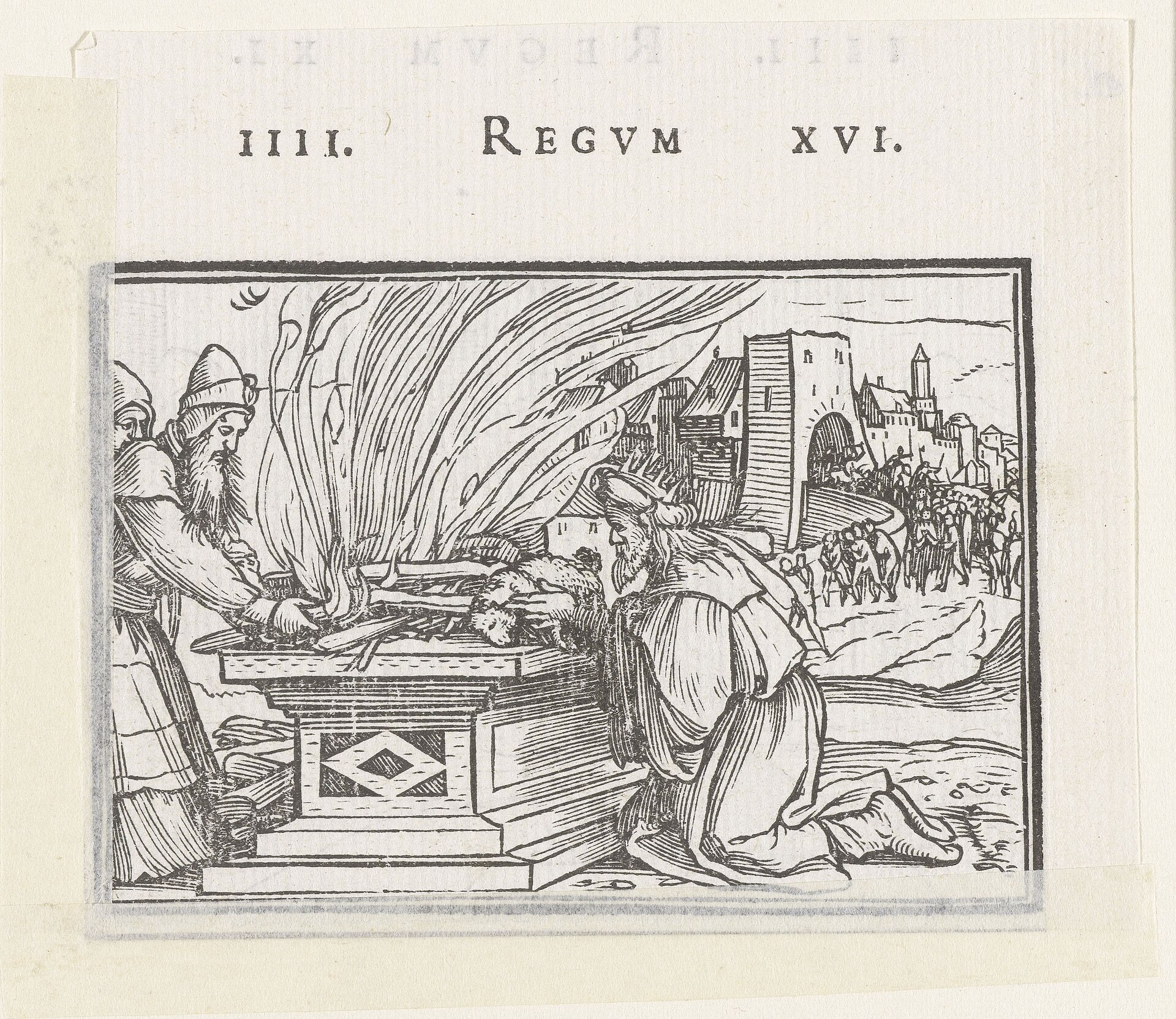
King Ahaz at the altar he had copied from Damascus (2 Kings 16:10-16), a sixteenth-century German woodcut book illustration, Rijksmuseum, Amsterdam (RP-P-OB-4511X(V)). CC0, via Wikimedia Commons, resized.

The 30-second version:
Ahaz ruled Judah when Damascus and Israel attacked Jerusalem. Isaiah urged him to trust God and offered him any sign he liked; Ahaz refused, and Isaiah announced the sign of Immanuel to the house of David. Ahaz bought Assyria's help with the Temple treasures instead, and Assyrian records list "Jehoahaz of Judah" among Tiglath-Pileser's tribute payers. He copied a pagan altar from Damascus and sacrificed his own son, and his son Hezekiah had to undo his reign.
See this page's graph and discover linked topics
In full
Ahaz's reign is fixed in the Assyrian period by Tiglath-Pileser III's tribute list, which names him as Ia-u-ha-zi of Judah, that is Jehoahaz, the longer theophoric form of the name. The shorter "Ahaz" ("he has grasped") drops the divine element, and some scholars suspect a deliberate shortening by writers who judged him harshly; that is a suggestion, not a demonstrated fact. Kings gives him sixteen years (2 Kings 16:2), and the synchronisms with Israel's last kings and with Hezekiah are among the hardest in the chronology of Kings. Mykytiuk dates him 742/741 to 726 BC; Thiele 735 (co-regent) or 732 to 715 BC.
The Syro-Ephraimite war (about 734 to 732 BC) is the central event of his reign. Pekah of Israel and Rezin of Damascus attacked Judah, planning to put "the son of Tabeel" on David's throne (Isaiah 7:6). Ahaz appealed to Assyria: "I am thy servant and thy son: come up, and save me" (2 Kings 16:7, ASV). Tiglath-Pileser destroyed Damascus and annexed northern Israel, and Judah survived as a tribute-paying vassal. Isaiah 7 frames the same crisis as a test of faith that Ahaz failed.
In the Bible
- Accession. "Jotham slept with his fathers... and Ahaz his son reigned in his stead" (2 Kings 15:38, ASV).
- Kings' verdict. "He did not that which was right in the eyes of Jehovah his God, like David his father. But he walked in the way of the kings of Israel, yea, and made his son to pass through the fire, according to the abominations of the nations" (2 Kings 16:2-3, ASV).
- The appeal to Assyria. He sent "the silver and gold that was found in the house of Jehovah" to Tiglath-Pileser as a present (16:7-8), went to Damascus to meet him, and had the priest Urijah build a copy of the Damascus altar for the Temple (16:10-16). He stripped bronze fittings from the Temple furnishings "because of the king of Assyria" (16:17-18).
- Chronicles' fuller account. 2 Chronicles 28 adds defeats by Aram, Israel, Edom and the Philistines; says he burned his children in the valley of Hinnom (28:3); and says that in his distress he sacrificed to the gods of Damascus, cut up the Temple vessels, shut the doors of the house of the LORD, and "made him altars in every corner of Jerusalem" (28:22-24, ASV).
- Isaiah 7. Isaiah met him "at the end of the conduit of the upper pool" (7:3) with the message "Take heed, and be quiet; fear not" (7:4). Offered a sign "either in the depth, or in the height above," Ahaz answered, "I will not ask, neither will I tempt Jehovah" (7:11-12, ASV). Isaiah replied to "the house of David": "Therefore the Lord himself will give you a sign: behold, a virgin shall conceive, and bear a son, and shall call his name Immanuel" (7:13-14, ASV).
- The dial of Ahaz. The sign given to Hezekiah was the shadow going back "on the dial of Ahaz" (Isaiah 38:8; 2 Kings 20:11), which suggests a stepped sundial or stairway built in his reign.
- Other mentions. Isaiah 14:28 dates an oracle to the year he died; he appears in the headings of Isaiah, Hosea and Micah, in 1 Chronicles 3:13, and in Matthew's genealogy of Jesus (Matthew 1:9).
Family and lineage
- Father: Jotham king of Judah. Grandfather: Uzziah.
- Son and successor: Hezekiah (2 Kings 16:20; 18:1). Another son was sacrificed by fire (2 Kings 16:3).
- Line of David: "Jotham begat Ahaz; and Ahaz begat Hezekiah" (Matthew 1:9, ASV).
Historical and archaeological evidence
- Tiglath-Pileser III, Summary Inscription 7 (the Nimrud Tablet, British Museum K 3751). A clay tablet summarizing Tiglath-Pileser's campaigns, written about 729 BC. Its list of tribute payers from the west includes "Jehoahaz of Judah" (Ia-u-ha-zi of the land of Judah), alongside kings of Ammon, Moab, Ashkelon, Edom and Gaza. Grade: direct. This is the attestation Mykytiuk relies on.
- The seal of Ushna, servant of Ahaz. A semi-precious stone seal from the antiquities market reading "belonging to Ushna, servant of Ahaz," with a winged sun disk. Mykytiuk cites a seal of an official of Ahaz in support; the seal is unprovenanced.
- The bulla of Ahaz son of Yehotam. A clay seal impression reading, in substance, "belonging to Ahaz (son of) Yehotam, king of Judah," published by Robert Deutsch in 1998 and held in the private Moussaieff collection. It would be the first impression of a Judahite king's own seal, but its findspot is unknown, and while most epigraphers who have examined it accept it, some scholars have reserved judgment because it comes from the market. It is not relied on here. Compare Hezekiahs Bulla, his son's seal impression, found in a controlled excavation.
Scholarly consensus
Ahaz's historicity and his vassalage to Assyria are secure. Debate concerns the chronology of his reign, the historical reliability of Chronicles' additional material (some scholars read 2 Chronicles 28 as the Chronicler's theological expansion), and the meaning of "made his son to pass through the fire," which most scholars read as child sacrifice and a minority as a dedication ritual; the Chronicler's "burnt his children in the fire" (28:3) supports the majority reading. See Molech and Human Sacrifice in the Old Testament.
Theological significance
- Faith or alliances. Isaiah's word to Ahaz turns on a wordplay: "If ye will not believe, surely ye shall not be established" (Isaiah 7:9, ASV). Ahaz chose Assyria's protection over God's promise, and the price was the Temple's treasure and Judah's independence.
- The sign of Immanuel. Ahaz's refusal is the occasion of Isaiah 7:14, which Matthew 1:22-23 reads as fulfilled in the virgin birth of Jesus. The sign is addressed to "the house of David," plural "you," and not to Ahaz alone, a detail Christian interpreters stress. For the debate over almah and the sign's near and far horizons, see Isaiah 7-14 Was Mistranslated Objection Defeater, Almah vs Bethulah Objection Defeater, H5959 - almah and Virgin Birth.
- Child sacrifice condemned. Kings names Ahaz's act as "the abominations of the nations, whom Jehovah cast out." The biblical writers record it to condemn it; see Topheth and the Valley of Hinnom.
Church Fathers
- Justin Martyr, Dialogue with Trypho 67 and 71: Trypho argues that Isaiah's prophecy "refers to Hezekiah," and Justin undertakes to prove that it referred "not, as you were taught, to Hezekiah, but to this Christ of mine" (71).
- Irenaeus, Against Heresies 3.21.1 and 3.21.4: he quotes the Lord's words to Ahaz, "Ask for yourself a sign," and Ahaz's refusal, and rejects the rendering "a young woman shall conceive" given by Theodotion and Aquila, arguing that the sign is the Virgin's conception of the Son of God.
See also
- People of the Bible, every person on the codex's list, by the book that first names them
- Biblical Figures Confirmed by Archaeology, Mykytiuk's list, where Ahaz is number 23
- Isaiah the Prophet, who confronted him
- Isaiah 7.14, the sign given in his reign
- Tiglath-Pileser III, the Assyrian king he paid
- Pekah, who attacked him
- Hezekiah, his son, who reversed his religious policy
- Molech, on the child sacrifice Kings condemns
Common questions this page answers
Q: Who was King Ahaz in the Bible?
Ahaz was a king of Judah in the eighth century BC, son of Jotham and father of Hezekiah. When Israel and Damascus attacked him he refused Isaiah's call to trust God, paid Tiglath-Pileser III of Assyria for help, copied a pagan altar for the Temple, and sacrificed his son (2 Kings 16).
Q: Why did Ahaz refuse to ask for a sign?
He said, "I will not ask, neither will I tempt Jehovah" (Isaiah 7:12), which sounds pious, but Isaiah treats it as wearying God. Ahaz had already chosen to rely on Assyria, and a sign from God would have bound him to trust God instead.
Q: Is King Ahaz mentioned in Assyrian records?
Yes. A tablet of Tiglath-Pileser III in the British Museum (K 3751) lists "Jehoahaz of Judah," the full form of Ahaz's name, among the kings who paid him tribute around 734 BC. A clay seal impression naming "Ahaz son of Yehotam, king of Judah" also exists, but it came from the antiquities market.
Q: What was the sign given to Ahaz in Isaiah 7:14?
"Behold, a virgin shall conceive, and bear a son, and shall call his name Immanuel." It was addressed to the whole house of David after Ahaz refused to ask for a sign. Matthew 1:22-23 says it was fulfilled in the birth of Jesus.
Q: What is the dial of Ahaz?
It is the stepped sundial or stairway on which the shadow went back ten steps as a sign to Hezekiah (Isaiah 38:8; 2 Kings 20:11). It was called after Ahaz because it was built in his reign.