Concept
Agrippa's Trilemma
Agrippan trilemma, Agrippa's trilemma, Münchhausen trilemma, Munchhausen trilemma, Agrippan Trilemma, regress problem, regress problem of justification, epistemic regress, Five Modes of AgrippaIntro
Ask someone why they believe something, and they give you a reason. Ask why they believe that reason, and they give you another. Keep asking, and only three things can happen. The reasons go on forever. Or they loop back and lean on something already said. Or they stop at a point where the person says, "that is just where I start."
Agrippa's trilemma is the claim that all three endings fail. Reasons that never end never finish the job. Reasons that loop prove nothing new. And reasons that simply stop look like a guess dressed up as knowledge. If that is right, nobody can fully justify anything they believe.
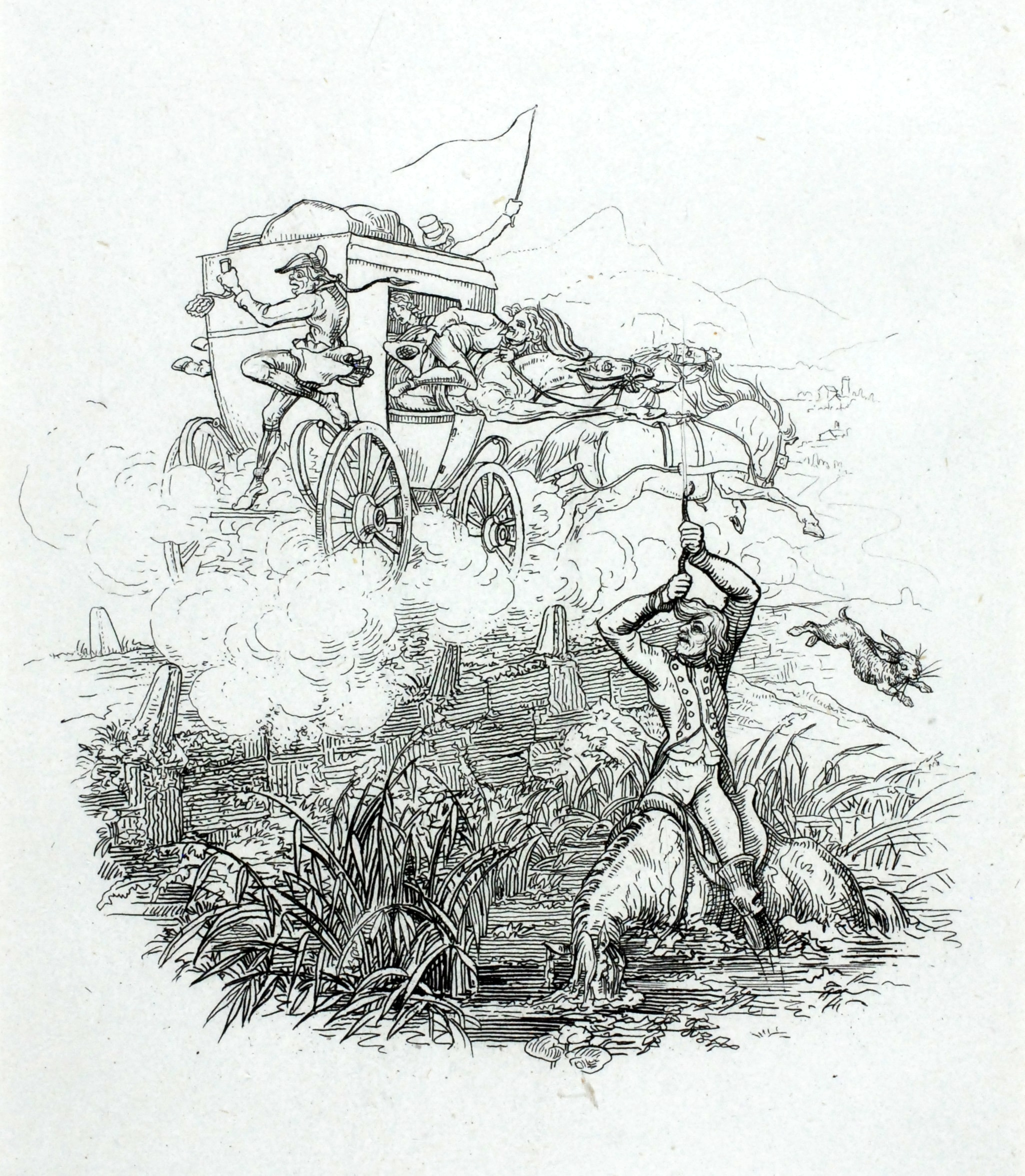
Münchhausen pulls himself out of the swamp by his own hair, the picture behind the trilemma's modern name. Martin Disteli, 1841, Zentralbibliothek Solothurn. Public domain, via Wikimedia Commons.
The puzzle is about two thousand years old, and it has a modern nickname, the Münchhausen trilemma, after the storybook baron who claimed he pulled himself out of a swamp by his own hair. It matters for the Christian faith because the trilemma does not pick sides. It presses on the atheist who says "I only believe what I have evidence for" exactly as hard as it presses on the believer. The real question it leaves is not whether you stop somewhere, but whether the place you stop can hold the weight.
See this page's graph and discover linked topics
In full
Agrippa's trilemma (the Agrippan trilemma, the regress problem of justification, or, after Hans Albert, the Münchhausen trilemma) is the argument that any attempt to justify a belief by giving reasons must end in one of three ways, each held to be epistemically unsatisfactory:
- Infinite regress. Every reason requires a further reason, without end, so justification is never completed.
- Circularity (the mode of reciprocity). The chain of reasons eventually appeals to a belief it was meant to support.
- Arbitrary stopping point (the mode of hypothesis). The chain ends at a belief accepted without reasons, which the skeptic treats as dogmatic assumption.
The argument descends from the Five Modes attributed to Agrippa the Skeptic (c. 1st century AD), preserved by Sextus Empiricus (Outlines of Pyrrhonism I.164-177) and Diogenes Laertius (Lives of Eminent Philosophers IX.88-89). In the Pyrrhonist tradition its purpose was not to establish a thesis but to induce epoche, suspension of judgment (see Pyrrhonism). In contemporary epistemology it frames the debate over the structure of justification: Foundationalism, Coherentism and infinitism are each a decision about which horn to embrace and how to defend it.
The Five Modes
Sextus lists five modes "of the later skeptics", generally credited to Agrippa:
- Dispute (diaphonia). On any question, ordinary people and philosophers disagree, and the disagreement is undecided.
- Infinite regress (eis apeiron ekballon). The proof offered needs a proof, and so on without end.
- Relativity (pros ti). The object appears one way relative to the judge and to what accompanies it, but how it is in itself is not settled.
- Hypothesis (hypothetikos). To escape the regress, the dogmatist starts from something assumed without proof.
- Reciprocity (diallelos). What should confirm the matter needs confirming by the matter itself.
Modes 2, 4 and 5 form the trilemma. Modes 1 and 3 explain why the question of justification arises at all: disagreement and relativity demand a criterion, and the demand for a criterion triggers the regress.
History of the problem
- Aristotle, Posterior Analytics I.3, already faced the regress. Some held that knowledge is impossible because demonstration would regress forever; others that demonstration could be circular. Aristotle rejected both: the first principles of a science are known, but not by demonstration.
- Agrippa and Sextus Empiricus turned the regress into a weapon for suspending judgment on every question.
- Rene Descartes answered with classical foundationalism: rebuild knowledge on beliefs that cannot be doubted.
- Hans Albert, Treatise on Critical Reason (Traktat über kritische Vernunft, 1968), renamed it the Münchhausen trilemma and argued, in the critical rationalism of Karl Popper, that no belief can be finally justified, so all knowledge is fallible and open to criticism.
- Contemporary epistemology treats it as the regress problem. The standard responses are surveyed below.
The standard responses
| Response | Horn it accepts | Core move | Representative |
|---|---|---|---|
| Classical foundationalism | Stopping point | Basic beliefs are self-evident or incorrigible, so stopping there is not arbitrary | Rene Descartes |
| Modest foundationalism | Stopping point | Basic beliefs are justified non-inferentially (perception, memory, rational insight) without being infallible | William Alston |
| Reformed Epistemology | Stopping point | Belief in God can be properly basic when produced by properly functioning faculties | Alvin Plantinga |
| Coherentism | Circularity, reinterpreted | Justification belongs to a whole system of mutually supporting beliefs, not to a linear chain | Laurence BonJour (early work) |
| Infinitism | Regress | An infinite, non-repeating series of available reasons is what justification consists in | Peter Klein |
| Critical rationalism | None; gives up final justification | Beliefs are never justified, only tested and kept until refuted | Hans Albert, Karl Popper |
| Presuppositionalism | Circularity at the level of ultimate authority | Every worldview's final standard must vouch for itself; the question is which standard makes reasoning intelligible | Cornelius Van Til, Greg Bahnsen, John Frame |
Two observations hold across the table:
- No response escapes all three horns. Each one embraces a horn and argues that, rightly understood, it is not vicious.
- The fight is over the stopping point. Even the coherentist and the critical rationalist stop somewhere: at the norms of coherence, or at the method of criticism, which they do not justify by further argument.
Why it matters for apologetics
It cuts against evidentialist atheism first
The most common popular objection to faith is some version of W. K. Clifford's principle: it is wrong always, everywhere, and for anyone, to believe anything upon insufficient evidence ("The Ethics of Belief", 1877). The trilemma applies to that principle directly:
- The principle demands evidence for every belief.
- The evidence for the principle itself must then be supplied, and that evidence needs evidence, and so on.
- So the evidentialist must regress forever, argue in a circle, or stop at a principle held without evidence, which the principle forbids.
This is a form of Self-refutation. It does not prove God exists. It shows that "I only believe what I can prove" is not a position anyone actually occupies, which removes the objection's appearance of neutral high ground. See Evidentialism.
Everyone stops somewhere
The trilemma levels the field. The naturalist stops at the reliability of sense perception, memory and logic, and cannot argue for that reliability without using it. William Alston called this epistemic circularity ("Epistemic Circularity", Philosophy and Phenomenological Research 47, 1986; The Reliability of Sense Perception, 1993): any argument that our basic belief-forming sources are reliable must rely on those same sources. The believer and the unbeliever are in the same position on this point. The apologetic question shifts from whether a person has an unargued starting point to whether that starting point can account for itself.
The Reformed epistemology answer
Alvin Plantinga (Warranted Christian Belief, 2000) takes the stopping-point horn and argues it is not arbitrary. A belief is properly basic when it is produced by cognitive faculties functioning properly, in an appropriate environment, according to a design plan aimed at truth. Perceptual and memory beliefs qualify, and so, Plantinga argues, can belief in God formed through the Sensus Divinitatis that John Calvin described (Institutes I.3.1). On this view the Christian who stops at God is no more dogmatic than the person who stops at "I see a tree."
Plantinga then presses the point in the other direction. In the evolutionary argument against naturalism, he argues that if our faculties are the product of unguided processes selecting for survival rather than truth, the naturalist has a defeater for trusting them, so the naturalist's own stopping point becomes unstable.
The presuppositional answer
Cornelius Van Til, Greg Bahnsen and John Frame take the circularity horn and argue that at the level of ultimate authority it is unavoidable for everyone. Any final standard, whether reason, experience or the God of Scripture, can only be defended by appeal to itself, because there is nothing higher to appeal to. Frame (The Doctrine of the Knowledge of God, 1987) distinguishes a narrow circle ("the Bible is true because the Bible says so") from a broad circle, in which the whole range of evidence and argument is read within the framework the ultimate commitment supplies. The Transcendental Argument for God then asks which ultimate standard makes logic, induction and moral obligation intelligible in the first place.
Scripture presents God's own testimony in this self-attesting shape:
For when God made promise to Abraham, since he could swear by none greater, he sware by himself, (Hebrews 6:13, ASV)
Jesus answered and said unto them, Even if I bear witness of myself, my witness is true; for I know whence I came, and whither I go; (John 8:14, ASV)
On this reading the regress has a natural end: not in an arbitrary assumption, but in the one witness for whom there is no higher court. "The fear of Jehovah is the beginning of knowledge" (Proverbs 1:7, ASV), and in Christ "are all the treasures of wisdom and knowledge hidden" (Colossians 2:3, ASV).
Not to be confused with
- The Lewis trilemma, "liar, lunatic or Lord," is a different argument about the identity of Jesus. See Liar Lunatic or Lord.
- Cartesian skepticism doubts that we know the external world at all. The trilemma is about the structure of justification and applies even if the external world is granted. See Skepticism.
Objections and replies
-
Objection: "Stopping at God is just the dogmatic horn with a religious label." Reply: Everyone takes a horn. The Reformed epistemologist argues that a stopping point is non-arbitrary when it comes from properly functioning faculties; the presuppositionalist argues that it is non-arbitrary when it makes reasoning itself intelligible. Either way the charge of dogmatism applies equally to the critic's own starting point unless the critic can show why theirs is better grounded.
-
Objection: "Circular reasoning is a fallacy, so the presuppositional circle is invalid." Reply: Frame and Bahnsen grant that a narrow circle persuades no one. Their claim is that circularity about an ultimate standard is unavoidable for every worldview, as Alston's epistemic circularity shows for sense perception. The comparison is then between circles: which one can account for the rules of logic it relies on.
-
Objection: "Coherentism escapes the trilemma, so faith does not need a foundation." Reply: A coherent system can be coherent and false, as a well-made novel is. Coherentists must explain why coherence tracks truth, and that explanation is itself a stopping point. BonJour, the leading coherentist of the 1980s, later abandoned coherentism for a form of foundationalism ("The Dialectic of Foundationalism and Coherentism", in The Blackwell Guide to Epistemology, 1999).
-
Objection: "Then nothing is known, and agnosticism is the only honest answer." Reply: That conclusion is itself a claim held for reasons, and it falls into the same trilemma. The ancient Pyrrhonists saw this and suspended judgment even on the claim that nothing is known. Very few modern agnostics live that way, which is the point Hume made about radical doubt not surviving outside the study.
Scholarship
Published academic works this page draws on, each matched to a publisher, index or library catalog record.
- Hans Albert, Traktat über kritische Vernunft (1968). Open Library
- William P. Alston, The Reliability of Sense Perception (Cornell University Press, 1993). Open Library
- Laurence BonJour, The structure of empirical knowledge (1985). Open Library
- John M. Frame, The doctrine of the knowledge of God (1987). Open Library
- Alvin Plantinga, Warranted Christian Belief (Oxford University Press, 2000). doi:10.1093/0195131932.001.0001
See also
- Foundationalism, the response that takes the stopping-point horn
- Coherentism, the response that reinterprets the circularity horn
- Pyrrhonism, the ancient skeptical school that preserved the Five Modes
- Reformed Epistemology, Plantinga's case that belief in God can be properly basic
- Presuppositionalism, the case that every ultimate standard is self-attesting
- Transcendental Argument for God, which asks which starting point makes reasoning possible
- Self-refutation, why "believe only what you can prove" cannot meet its own test
- Evidentialism, the view the trilemma presses hardest
- Epistemology, the master hub for theories of knowledge
Common questions this page answers
Q: What is Agrippa's trilemma?
It is the argument that every attempt to justify a belief ends in one of three ways: an infinite regress of reasons, a circle in which the reasons depend on the belief they support, or a stopping point accepted without reasons. Since each option looks unsatisfactory, the skeptic concludes that no belief can be fully justified.
Q: Why is it called the Münchhausen trilemma?
The German philosopher Hans Albert gave it that name in 1968, after Baron Münchhausen, the storybook character who claimed he pulled himself out of a swamp by his own hair. The image fits the problem: any attempt to justify all our beliefs seems to require lifting ourselves by our own reasoning.
Q: Who was Agrippa the Skeptic?
Agrippa was a Pyrrhonist philosopher of roughly the 1st century AD. Nothing he wrote survives. His Five Modes for inducing suspension of judgment are known through Sextus Empiricus's Outlines of Pyrrhonism and Diogenes Laertius's Lives of Eminent Philosophers.
Q: How do Christians answer Agrippa's trilemma?
There are two main answers. Reformed epistemologists such as Alvin Plantinga accept that reasons stop somewhere and argue that belief in God can be a properly basic stopping point, like trusting your senses. Presuppositional apologists such as Cornelius Van Til and Greg Bahnsen argue that every worldview's ultimate authority must vouch for itself, and that only the God of Scripture makes reasoning itself intelligible.
Q: Does the trilemma hurt atheism as much as theism?
Yes. The principle that one should believe nothing without sufficient evidence cannot itself be supported without regress, circularity or an unargued stopping point, and the naturalist cannot argue for the reliability of perception or logic without using them. The trilemma does not prove God, but it removes the claim that unbelief is the neutral, assumption-free position.
Q: Is Agrippa's trilemma the same as Lewis's trilemma?
No. Lewis's trilemma ("liar, lunatic or Lord") is an argument about who Jesus is, based on his claims. Agrippa's trilemma is a general problem in the theory of knowledge about how any belief can be justified.