Concept
African Traditional Religion and Christianity
ATR and Christianity, African Traditional Religion, African Traditional Religions, African Indigenous Religion and Christianity, Christianity and African Traditional Religion, Ancestors and Christianity, African High God, Contextualization and Syncretism in AfricaIntro
Before the gospel reached most of sub-Saharan Africa, its peoples already believed in a supreme Creator, in a world full of spirits, and in ancestors who still cared for the living. When Africans became Christians, they did not arrive empty-handed. They brought their names for God, their sense that the unseen world is real, and their deep respect for family and the dead.
That raises a real question every African church has had to answer: what should a Christian keep, what should be changed, and what must be left behind? Some African theologians say the old religion was a road that led toward Christ. Others say its spirits are dangerous and must be renounced. Most agree on two things. The Creator that Africans already knew is the God of the Bible, and the worship that belongs to God alone cannot be given to any spirit or ancestor.
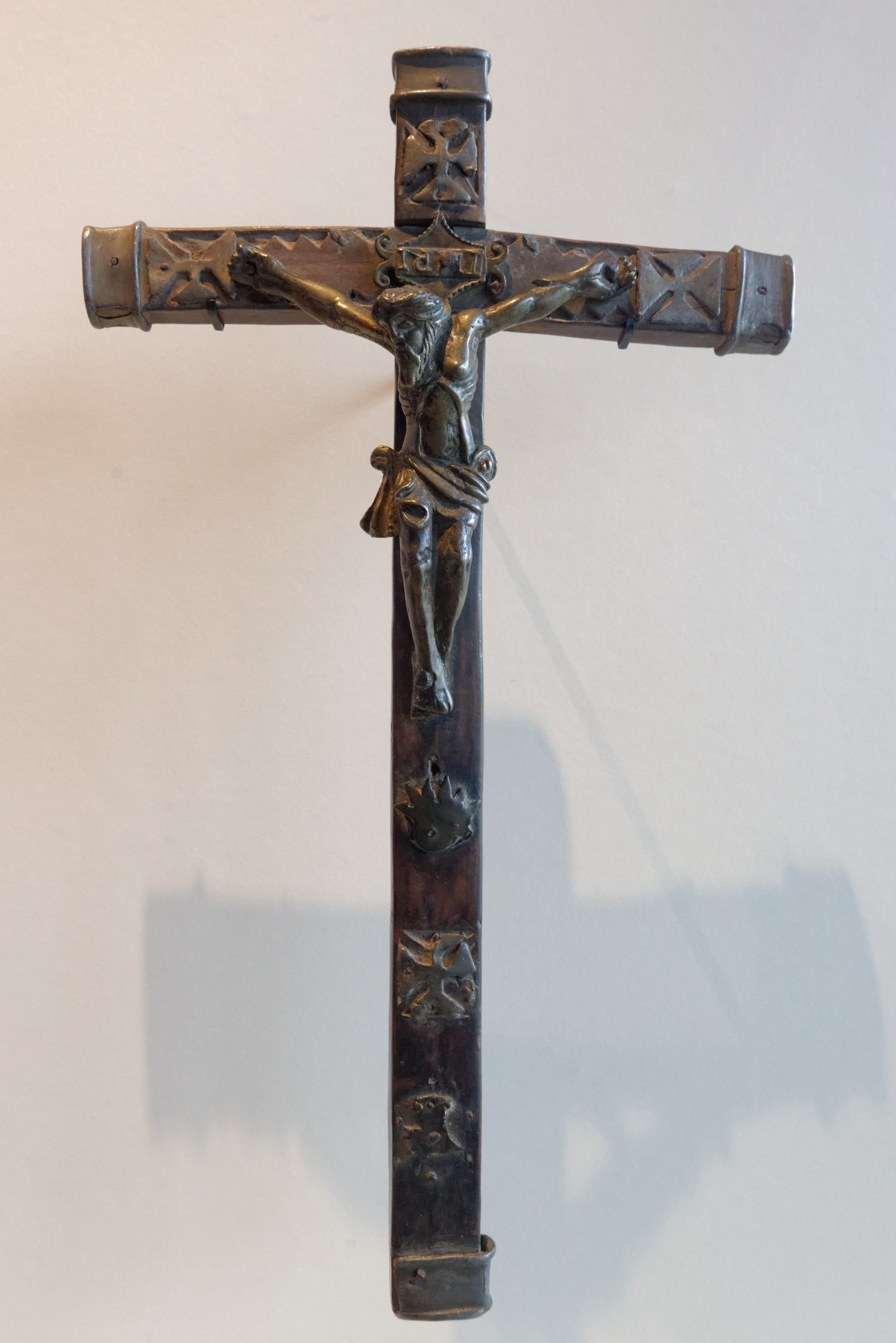 A Kongo crucifix (nkangi kiditu), wood and cast brass, Royal Museum for Central Africa, Tervuren. Kongo Christians made the cross their own for centuries, a case study in how the faith took African form. Photo: Marie-Lan Nguyen, public domain (Wikimedia Commons), resized.

See this page's graph and discover linked topics
In full
"African Traditional Religion" (ATR) is a scholarly umbrella for the indigenous religious systems of sub-Saharan Africa: hundreds of distinct traditions (Yoruba, Akan, Igbo, Kikuyu, Zulu, Kongo and many more) that share a recognizable family resemblance. Most posit a supreme Creator who is real but relatively remote, a populated middle world of divinities, nature spirits and ancestors who receive cult, a strong sense that misfortune has personal and spiritual causes, and an ethic rooted in kinship and community.
The Christian engagement with ATR turns on three questions:
- Continuity of God. Is the High God of African tradition (Olodumare, Onyame, Chukwu, Nzambi, Ngai, Mulungu) the God of Abraham under another name, partly known?
- The status of the intermediaries. Are the divinities and venerated ancestors created spirits, demons, human dead who are simply honored, or projections of the community?
- The method of contact. Where is the line between legitimate contextualization (the gospel expressed in African language, music, symbol and social form) and syncretism (the gospel absorbed into a system whose center remains elsewhere)?
African Christian scholarship has answered these questions along a spectrum. At one end, a fulfillment reading associated with John Mbiti, Kwame Bediako and Lamin Sanneh treats ATR as a real if partial preparation for the gospel. At the other, a discontinuity reading associated with Byang Kato and much African Pentecostal practice treats the cult of the intermediaries as spiritually hostile and calls for a clean break. A third, Catholic inculturation stream (Charles Nyamiti, Bénézet Bujo) seeks to baptize African categories, including ancestorhood, into theology. The codex's sharper position on the intermediaries is set out at African Traditional Deities (Demonic); this page maps the whole field and records where the two pages differ.
The shape of African Traditional Religion
The High God
Nearly every sub-Saharan people has a name for a supreme Creator. A few examples, all used for God in African Bible translations:
| People | Name for God | Common glosses |
|---|---|---|
| Yoruba (Nigeria) | Olodumare, Olorun | Supreme being; Olorun, "owner of heaven" |
| Akan (Ghana) | Onyame, Onyankopon | The Great One, the only Great One |
| Igbo (Nigeria) | Chukwu, Chineke | Great Spirit, the creating Spirit |
| Kongo (Central Africa) | Nzambi, Nzambi a Mpungu | Creator, the most high |
| Kikuyu (Kenya) | Ngai | Creator and giver of rain |
| Many Bantu peoples of East and Southern Africa | Mulungu, Modimo, uNkulunkulu | Creator, the Great-great one |
Mbiti's survey Concepts of God in Africa (1970) gathered testimony from hundreds of African peoples and argued that belief in a supreme God was effectively universal across the continent. His summary judgment in African Religions and Philosophy (1969), that Africans are "notoriously religious," became one of the most quoted sentences in African theology.
The common pattern is that the High God is acknowledged everywhere but worshipped directly in few places. Many traditions tell a myth of withdrawal: God once lived close to humanity, and some human fault (often a woman pounding grain whose pestle struck the sky, in versions told across West Africa) drove him further away. Daily religious traffic flows instead through the intermediaries.
The middle world
- Divinities and spirits: the Yoruba orisha, the Akan abosom, the Fon vodun, the Igbo alusi. Some are associated with natural forces, some with clans or crafts.
- Ancestors: the "living dead," in Mbiti's phrase, recently deceased members of the lineage who remain part of the family, guard its morals, and expect remembrance through libation, offerings and naming.
- Mystical power: belief in witchcraft and sorcery as real causes of illness, barrenness and death, and in diviners and healers who diagnose and counter them.
How widespread is it today?
Formal adherence to ATR is now small, but traditional belief and practice persist inside both Christianity and Islam. The Pew Research Center's Tolerance and Tension survey (more than 25,000 interviews in 19 sub-Saharan countries, December 2008 to April 2009, published 2010) found that large numbers of Christians and Muslims believe in witchcraft, evil spirits, the protective power of juju (charms or amulets) and the power of sacrifices to ancestors. In Tanzania, Mali, Senegal and South Africa, more than half of those surveyed said that sacrifices to ancestors or spirits can protect them from harm. This is the pastoral reality behind every debate on this page: the question is not only what African Christians should believe, but what many of them already do.
Three Christian readings
1. Fulfillment: ATR as preparation for the gospel
John Mbiti (Kenya, 1931 to 2019) argued that African peoples already knew God and that the gospel came to "fulfill" rather than abolish their religious heritage. He is widely cited for the point that the missionaries did not bring God to Africa; God was there before them.
Kwame Bediako (Ghana, 1945 to 2008) developed the argument most fully in Theology and Identity (1992) and Christianity in Africa: The Renewal of a Non-Western Religion (1995). His case:
- The early African and Greek Fathers faced the same question. Justin Martyr and Clement of Alexandria treated Greek philosophy as a partial witness to the Logos; Bediako argued that African Christians may read their own primal religion the same way.
- The African "primal imagination," with its sense of a spiritual universe, is closer to the world of the Bible than post-Enlightenment Western secularism.
- Christ fulfills the ancestors' role. In Jesus in Africa (2000) Bediako presented Christ as the true Ancestor, the one who died, lives, and mediates for the family of God, which strips the ancestor cult of its necessity rather than merely forbidding it.
Lamin Sanneh (Gambia, 1942 to 2019) added the translation argument: because missionaries translated Scripture into African languages using the indigenous name for God, they implicitly affirmed African religious vocabulary and handed Africans the tools to read the Bible for themselves. See Missionary Translation and African Languages.
Biblical warrant claimed: Paul at Lystra says God "left not himself without witness, in that he did good, and gave us rain from heaven, and fruitful seasons" (Acts 14:17, KJV). At Athens he builds on an altar "TO THE UNKNOWN GOD" (Acts 17:23, KJV) and quotes a pagan poet (Acts 17:28). Romans 1:19-20 grounds a general knowledge of God available to every people.
2. Discontinuity: a clean break with the cult
Byang Kato (Nigeria, 1936 to 1975), the first African general secretary of the Association of Evangelicals in Africa, wrote Theological Pitfalls in Africa (1975) as a direct challenge to Mbiti. Kato argued that:
- Mbiti's reading drifted toward universalism, treating adherents of ATR as already saved.
- Praising the religious past risked syncretism, an African Christianity in which Christ is added to the old system rather than replacing its center.
- Scripture, not religious experience, must be the judge of African tradition.
Kato did not reject African culture. He urged African Christians to express the faith in African forms while keeping its content biblical. His line is carried today by much African evangelical and Pentecostal teaching, which takes the spirit world seriously and classifies the worshipped intermediaries as demonic. That position, with its biblical grounding in 1 Corinthians 10:20 and Deuteronomy 32:17, is argued at length at African Traditional Deities (Demonic).
Biblical warrant claimed: "the things which the Gentiles sacrifice, they sacrifice to devils, and not to God: and I would not that ye should have fellowship with devils" (1 Corinthians 10:20, KJV); the prohibition of divination and consulting the dead (Deuteronomy 18:10-12); "there is one God, and one mediator between God and men, the man Christ Jesus" (1 Timothy 2:5, KJV).
3. Inculturation: baptizing African categories
Catholic theologians developed an "inculturation" theology after the Second Vatican Council, encouraged by Paul VI's words at Kampala in 1969 that Africans may and must have an African Christianity. Key voices:
- Charles Nyamiti (Tanzania), Christ as Our Ancestor (1984), worked out an "ancestor Christology" with Christ as Brother-Ancestor.
- Bénézet Bujo (Democratic Republic of the Congo) presented Christ as "Proto-Ancestor" and built an African Christian ethic around community and remembrance.
These theologians generally distinguish veneration of the dead (honor, remembrance, prayer for or with the faithful departed) from worship (sacrifice and cult directed to a spirit as an object of trust). Protestants tend to question whether that line holds in practice, which is part of the long Protestant and Catholic disagreement over the saints.
Contextualization and syncretism
Both words are used loosely, so it helps to define them:
- Contextualization: the gospel's unchanged content expressed in the language, music, art, social forms and thought-categories of a culture. Bible translation is the clearest example. The Kongo crucifix pictured above, made by African craftsmen in an African style from the sixteenth century onward, is another.
- Syncretism: the gospel's content altered by a rival system, so that Christ becomes one power among several, or the old system's center (the ancestor cult, the diviner, the charm) survives under Christian names.
Evangelical missiologists have proposed working tests. Paul Hiebert's "critical contextualization" (1980s) asked communities to study their own customs in the light of Scripture and decide together what to keep, modify, reject or replace with a Christian functional substitute. A practical summary of the tests African churches commonly use:
- Who receives the worship? Honor given to parents and elders is commanded (Exodus 20:12). Sacrifice, libation or vow directed to a spirit or ancestor as a power to be trusted is not.
- Who is the mediator? If a practice assumes access to God runs through the ancestors or a diviner rather than through Christ, it competes with 1 Timothy 2:5.
- What does it do with fear? Practices driven by fear of spirits or witches are answered by Christ's victory over the powers (Colossians 2:15), not by stronger charms.
- Does Scripture speak to it directly? Divination and consulting the dead are named and forbidden (Deuteronomy 18:10-12); naming customs, funeral feasts and music are not.
Ancestors: the hardest case
| Practice | Fulfillment reading | Discontinuity reading | Common pastoral middle |
|---|---|---|---|
| Remembering and naming the dead | Affirmed | Affirmed | Affirmed (Hebrews 12:1, the "cloud of witnesses") |
| Honoring elders and lineage | Affirmed | Affirmed | Affirmed (Exodus 20:12) |
| Pouring libation, offering food to the dead | Reinterpreted or replaced; Christ fulfills the ancestor role | Rejected as cult directed to spirits | Replaced with Christian memorial and thanksgiving to God |
| Consulting the dead through diviners | Rejected | Rejected | Rejected (Deuteronomy 18:10-12) |
| Christ as Ancestor | Embraced (Bediako, Nyamiti, Bujo) | Questioned as a category that may import the old cult | Used by many as a teaching bridge, not a replacement for the creeds |
Critiques from outside the church
- Okot p'Bitek (Uganda), in African Religions in Western Scholarship (1970), accused Mbiti and other Christian scholars of "Hellenizing" African gods, dressing them in attributes like omnipotence and omniscience borrowed from Greek and Christian theology. If he is right, the fulfillment reading reads Christianity into the evidence.
- Kwasi Wiredu (Ghana) argued for "conceptual decolonization," the claim that African languages and thought should be studied on their own terms before Western philosophical categories are applied. See African Christian Philosophy.
Christian scholars answer that the convergence is too widespread to be an artifact of missionary questioning. The High God names predate the missionaries, appear in proverbs and prayers recorded from people with no Christian contact, and were the names African converts themselves chose for the God of Scripture.
Apologetic relevance
- Against the "white man's religion" charge. The God African Christians worship is not a foreign import but the Creator their ancestors already named. African converts recognized in the gospel the fuller story of a God they partly knew. See Christianity Is the White Mans Religion Objection Defeater and Christianity in Africa.
- A witness to general revelation. Near-universal African belief in one supreme Creator fits Paul's claim that God has not left himself without witness, and is consistent with the evidence gathered at Natural Theology.
- The spirit world is not superstition by default. African Christianity's realism about spiritual evil is closer to the New Testament than modern Western naturalism; see Spiritual Warfare and Demons.
- Christ as the answer to real longing. The ancestors embody a longing for a mediator who has died, still lives and cares for the family. The gospel's claim is that the longing is real and is answered by the risen Christ.
Tensions
This page and African Traditional Deities (Demonic) agree on the central line: the High God names are legitimate names for the true God, cultural heritage is not demonic, and sacrifice or worship directed to spirits other than God is incompatible with Christian faith. They differ in emphasis on three points, recorded here rather than resolved:
- Is the discontinuity view "the mainstream"? The other page describes the demonic classification of the intermediaries as "the contemporary indigenous African Christian mainstream." That is a fair description of much African Pentecostal and evangelical preaching. But the most influential African academic theologians of the last half-century (Mbiti, Bediako, Sanneh, Nyamiti, Bujo) took the fulfillment or inculturation line, and the Pew survey of 2008 to 2009 shows that in practice many African Christians still take part in traditional rites. "Mainstream" depends on whether one is counting pulpits, scholars or pews.
- How Bediako is read. The other page argues that Bediako is right about culture and the High God but wrong if extended to say the intermediaries are not demonic. Bediako's own emphasis was that Christ's ancestorhood makes the ancestor cult unnecessary; he spoke of fulfillment and replacement more than of demonology. Readers should weigh his own books rather than either page's summary.
- Deliverance ministry and its harms. The other page cites Nigerian deliverance preachers, among them Helen Ukpabio, as operationalizing its position. Ukpabio's teaching on child witchcraft has been widely criticized by child-protection campaigners and by other Nigerian Christians for contributing to the stigmatization and abuse of children accused of witchcraft. Ogbu Kalu, also cited there, criticized such excesses. Whatever one concludes about the ontology of the spirits, the child-witch accusations are a pastoral and moral failure that African church leaders themselves have condemned.
Scholarship
Published academic works this page draws on, each matched to a publisher, index or library catalog record.
- Kwame Bediako, Theology and identity (1992). Open Library
- John S. Mbiti, African Religions and Philosophy (1970). Open Library
- John S. Mbiti, Concepts of God in Africa (1970). Open Library
- Charles Nyamiti, Christ as our ancestor (1984). Open Library
See also
- African Traditional Deities (Demonic), the codex's sharper position on the worshipped intermediaries
- Africa and Christianity, the master hub for the whole subject
- John Mbiti, the pioneer of the fulfillment reading
- Kwame Bediako, Christ as Ancestor and the primal imagination
- Byang Kato, the evangelical critique of syncretism
- Lamin Sanneh, translation and the vernacular name for God
- Missionary Translation and African Languages, how the High God names entered African Bibles
- African Initiated Churches, African-founded churches that negotiated these questions first
- African Pentecostal and Charismatic Christianity, the movement that takes the spirit world most seriously
- Ubuntu and Christian Ethics, the communal ethic ATR and Christianity share
- African Christian Philosophy, the philosophical side of the same debate
- Kingdom of Kongo Christianity, the oldest sustained case of contextualization south of the Sahara
- Natural Theology, general revelation and knowledge of God apart from Scripture
- Spiritual Warfare, the New Testament picture of the powers
Common questions this page answers
Q: What is African Traditional Religion?
It is the scholarly name for the indigenous religions of sub-Saharan Africa, such as Yoruba, Akan, Igbo, Kikuyu and Zulu religion. Most share belief in a supreme Creator, a middle world of divinities, spirits and ancestors who receive offerings, and a strong communal ethic.
Q: Did Africans believe in God before missionaries came?
Yes. Almost every African people had a name for a supreme Creator, such as Olodumare (Yoruba), Onyame (Akan), Chukwu (Igbo), Nzambi (Kongo) and Ngai (Kikuyu). John Mbiti's survey of hundreds of peoples found the belief practically universal, and African Bible translations use these names for the God of Scripture.
Q: Can a Christian venerate or pray to ancestors?
Christians across traditions agree that honoring parents and remembering the dead is good, and that consulting the dead through diviners is forbidden (Deuteronomy 18:10-12). They disagree on whether offerings or libations to ancestors can be reinterpreted. Evangelicals and Pentecostals generally reject them as worship owed to God alone; some Catholic inculturation theologians distinguish veneration from worship.
Q: What is the difference between contextualization and syncretism?
Contextualization expresses the unchanged gospel in a culture's language, music and forms, as Bible translation does. Syncretism changes the gospel's content by blending it with a rival system, so that Christ becomes one power among several or the old cult survives under Christian names.
Q: What does "Christ as Ancestor" mean?
It is a way of presenting Jesus in African terms, developed by Kwame Bediako, Charles Nyamiti and Bénézet Bujo. Christ is the one who died, lives, and intercedes for the family of God, so he fulfills what Africans looked for in ancestors and makes the ancestor cult unnecessary.
Q: Is African Traditional Religion demonic?
Christians distinguish its parts. The High God it names is the true God, partly known, and its cultural heritage is not demonic. Many African Christians, especially Pentecostals, hold that sacrifice and worship directed to spirits and ancestors as powers to be trusted is directed to demons (1 Corinthians 10:20); others prefer the language of incomplete revelation. See African Traditional Deities (Demonic).
Q: Do African Christians still practice traditional religion?
Many do in some form. Pew's survey of 19 sub-Saharan countries (2008 to 2009) found large numbers of Christians and Muslims believing in witchcraft, the protective power of charms and the power of sacrifices to ancestors, which is why discipleship on these questions remains a central task for African churches.