Concept
African Pentecostal and Charismatic Christianity
African Pentecostalism, African Pentecostals, African Charismatic Christianity, African Charismatics, Pentecostalism in Africa, Charismatic Churches in Africa, Neo-Pentecostalism in AfricaIntro
Walk through Lagos, Accra, Nairobi or Kinshasa on a Friday night and you will hear it: churches full of people praying aloud, singing, dancing, laying hands on the sick and praying against evil spirits until dawn. This is African Pentecostal and Charismatic Christianity, a faith that expects the Holy Spirit to act now, with power, as he did in the book of Acts.
It is the fastest-growing part of African Christianity. In 1970 Pentecostals and Charismatics were under one in twenty Africans; today they number in the hundreds of millions, and their style of prayer and worship has spread into Catholic, Anglican and Methodist churches too. It began with African prophets and revivals as much as with foreign missionaries, and Africans have led it from the start.
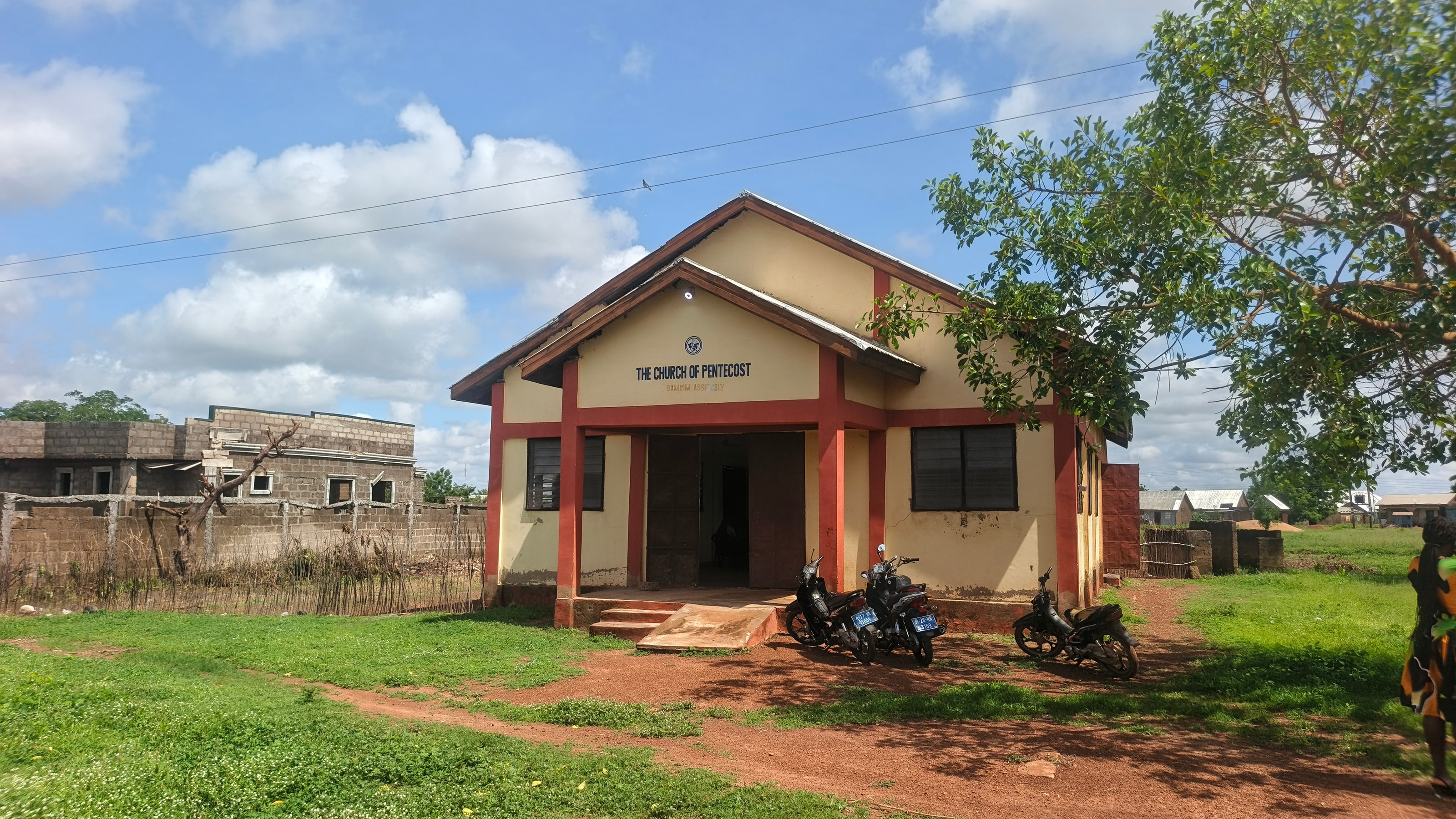 A village assembly of the Church of Pentecost at Bamvim. The Church of Pentecost, which grew from the work of the Irish missionary James McKeown in the Gold Coast (now Ghana) from 1937, is led and staffed by Africans and is among the largest Protestant churches in the country. Photo: Samaru Samaru, CC BY-SA 3.0 (Wikimedia Commons), resized.

See this page's graph and discover linked topics
In full
African Pentecostal and Charismatic Christianity names the family of African churches and movements that emphasize the present work of the Holy Spirit: conversion as being "born again," Spirit baptism and speaking in tongues, healing, prophecy, deliverance from evil powers, intense prayer and expressive worship. Scholars usually distinguish several streams that overlap in practice:
- African "Spirit churches" among the African Initiated Churches: the Aladura churches of Nigeria, the Zionist and Apostolic churches of southern Africa, the Kimbanguist church of the Congo and the prophet movements of West Africa, most founded between the 1910s and 1930s.
- Classical Pentecostal denominations: churches linked to the global Pentecostal movement that began at Azusa Street in 1906, such as the Apostolic Faith Mission of South Africa (1908), the Assemblies of God, and the Church of Pentecost in Ghana.
- Neo-Pentecostal and Charismatic ministries that multiplied from the 1970s, often urban, media-savvy and led by founder-pastors: Nigeria's Redeemed Christian Church of God (in its modern form), Deeper Life Bible Church and Living Faith Church; Ghana's International Central Gospel Church and Action Chapel; and many thousands more.
- Charismatic renewal inside the historic churches, Catholic, Anglican, Methodist, Presbyterian and Lutheran, which has carried Pentecostal-style prayer and worship into the mainline.
The movement is the African face of the global Pentecostalization of Christianity. This page covers its history, its numbers (with sources and years), its theology and practice, the leading scholarly interpretations, its critics, and its significance for apologetics.
History
The prophets: an African beginning (1910s to 1930s)
Several of the earliest Spirit-centered movements in Africa were founded by Africans with little or no contact with Western Pentecostalism:
- William Wade Harris, a Liberian Grebo evangelist, walked along the coast of Côte d'Ivoire and the Gold Coast in 1913 to 1915, preaching repentance, burning fetishes and baptizing tens of thousands.
- Garrick Sokari Braide led a revival in the Niger Delta in the 1910s.
- Simon Kimbangu began a healing ministry in the Belgian Congo in 1921 that drew such crowds the colonial authorities imprisoned him for the rest of his life; the church that bears his name became one of the largest African-founded churches.
- The Aladura ("people of prayer" in Yoruba) churches of Nigeria grew from prayer groups formed around the 1918 influenza epidemic. A revival led by Joseph Ayo Babalola from 1930 gave rise to the Christ Apostolic Church; the Cherubim and Seraphim movement began in Lagos in the 1920s.
- Zionist and Apostolic churches in South Africa, such as Isaiah Shembe's Nazareth Baptist Church and the Zion Christian Church, combined healing, prophecy and African forms of worship.
Classical Pentecostal missions (1900s to 1960s)
- The Apostolic Faith Mission of South Africa was founded in 1908 by American missionaries John G. Lake and Thomas Hezmalhalch, who had links to the Azusa Street revival.
- The Apostolic Church and Assemblies of God established missions in West Africa from the 1930s. In the Gold Coast, James McKeown's work led, after a split with the parent body, to the Church of Pentecost, so named in 1962.
- These churches stressed holiness, Spirit baptism with tongues, and evangelism, and they trained African leaders who soon outnumbered the missionaries.
The charismatic explosion (1970s onward)
- Campus revivals. In Nigeria after the civil war (1967 to 1970), revival spread through university and secondary-school Christian unions. Many of today's leading Nigerian ministers came out of these fellowships.
- New ministries. William Kumuyi's Bible study (begun 1973) became the Deeper Life Bible Church. The Redeemed Christian Church of God, founded in 1952 by Josiah Akindayomi, grew dramatically under Enoch Adeboye, its leader since 1981, whose Redemption Camp near Lagos hosts some of the largest regular Christian gatherings in the world. David Oyedepo founded the Living Faith Church (Winners' Chapel) in 1981. In Ghana, Nicholas Duncan-Williams founded Action Chapel and Mensa Otabil the International Central Gospel Church.
- Crusade evangelism. The German evangelist Reinhard Bonnke (1940 to 2019) held mass crusades across Africa for decades; his organization reported attendance in the hundreds of thousands, and over a million at some meetings, figures that cannot be independently verified.
- Mission outward. African Pentecostal churches have planted congregations across Europe and North America, often among African migrants. The Redeemed Christian Church of God has congregations in dozens of countries, and some African-led churches in Europe are among the largest congregations on that continent.
How many?
Counts depend heavily on definitions: whether charismatics inside Catholic and Protestant churches are included, and whether African initiated churches are counted as Pentecostal.
- Center for the Study of Global Christianity (CSGC), as tabulated by J. Kwabena Asamoah-Gyadu: Pentecostals and Charismatics in Africa numbered about 179 million in 2010 (17.1% of Africa's population), projected to reach about 258 million in 2025 (17.1%). This cross-cutting category includes charismatics in every tradition.
- Pew Research Center, Spirit and Power resources (2006): Pentecostals and Charismatics together were "less than 5% of Africans" as recently as 1970; by the 2000s, World Christian Database estimates put them above 20% of the national populations of Kenya, Nigeria and South Africa.
- Pew Research Center, Tolerance and Tension (2010), from surveys in 19 sub-Saharan countries in 2008 to 2009: about a quarter of all Christians in Ethiopia, Ghana, Liberia and Nigeria belonged to Pentecostal denominations, and at least one in ten did in eight other countries.
- Worldwide, CSGC counted about 664 million Pentecostals and Charismatics in 2025 (Status of Global Christianity, 2025), so Africa holds a large share of the global movement.
For the wider statistical picture see Christianity in Africa Today.
Theology and practice
| Emphasis | What it means in practice | Scriptural anchor commonly cited |
|---|---|---|
| New birth | A decisive personal conversion, often dated and testified to | John 3:3-7 |
| Spirit baptism | An experience of empowerment, usually with speaking in tongues | Acts 2:1-4; Acts 19:1-6 |
| Healing | Prayer for the sick in every service; healing testimonies | James 5:14-15; Mark 16:17-18 |
| Deliverance | Prayer against demonic oppression, witchcraft and curses | Mark 1:23-27; Ephesians 6:12 |
| Prophecy | Words of guidance, warning and encouragement in worship | 1 Corinthians 14:1-5 |
| Prayer | All-night vigils, fasting, prayer mountains and camps | Luke 6:12; Acts 12:5 |
| Worship | Expressive, participatory music in African idioms | Psalm 150 |
| Holiness | Strict moral codes in many classical and holiness churches | 1 Peter 1:15-16 |
| Blessing | Expectation of God's provision and success, sometimes in prosperity form | 3 John 2; Deuteronomy 8:18 |
The spirit world
The feature most often noted by scholars is that African Pentecostalism takes the African spirit world seriously. Where Western missions often dismissed witchcraft and spirits as superstition, Pentecostals agree that the powers are real and proclaim Christ's victory over them. Birgit Meyer called this "translating the devil": the old spirits are reclassified within biblical demonology. Opoku Onyinah of the Church of Pentecost analyzed the resulting "witchdemonology." The codex treats the theological question at African Traditional Deities (Demonic) and African Traditional Religion and Christianity.
Interpretations
- Ogbu Kalu (Nigeria), African Pentecostalism: An Introduction (2008), argued that African Pentecostalism is an African movement with African roots, answering African questions about power, healing and evil, rather than an American import.
- J. Kwabena Asamoah-Gyadu (Ghana), African Charismatics (2005), studied the new charismatic churches of Ghana, appreciating their renewal of experiential faith while criticizing their excesses. He chaired the consultations behind the Lausanne statement on the prosperity gospel.
- Allan Anderson (South Africa and Britain), African Reformation (2001), presented the African initiated and Pentecostal churches together as a reformation of African Christianity.
- Paul Gifford (Britain), Ghana's New Christianity (2004), was more critical, arguing that much charismatic preaching focuses on personal success and spiritual causes of misfortune at the expense of social and economic analysis.
- David Martin and Philip Jenkins placed African Pentecostalism within the global southward shift of Christianity; see Pentecostalization of Global Christianity.
Public life
- Politics. In Zambia, President Frederick Chiluba, a professing Pentecostal elected in 1991, declared the country a Christian nation. Pentecostal voters and leaders became significant political actors in Nigeria, Kenya, Ghana and elsewhere. Ethiopia's prime minister since 2018, Abiy Ahmed, is a Pentecostal Protestant.
- Social effects. Researchers following David Martin have documented moral discipline, family reform and entrepreneurial habits among converts, alongside concerns about the political use of churches and the concentration of wealth in leaders' hands.
Critiques and abuses
African Pentecostals are often the sharpest critics of their own movement. The main concerns:
- Prosperity teaching: the claim that faith and giving guarantee wealth and health. See Prosperity Gospel in Africa.
- Unaccountable founder-leaders who control finances and doctrine without oversight.
- Exploitative deliverance, including fee-based prayers and, at the extreme, accusations of witchcraft against children, condemned by African church leaders and child-protection campaigners.
- Celebrity prophets. The Nigerian prophet T. B. Joshua's Synagogue Church of All Nations was the scene of a guesthouse collapse in September 2014 that killed 116 people, most of them visiting South Africans; a 2024 BBC investigation published allegations of abuse by Joshua, who died in 2021.
- Thin doctrine. Critics such as the Zambian Reformed Baptist pastor Conrad Mbewe have warned that experience-centered preaching can neglect Scripture and sound teaching.
None of these abuses is unique to Pentecostalism, and none is endorsed by its leading denominations. They are reasons for the discernment Scripture commands: "Beloved, believe not every spirit, but try the spirits whether they are of God" (1 John 4:1, KJV).
Apologetic relevance
- Against "the white man's religion." The movement's earliest African forms were founded by African prophets, and its growth has been led by Africans. See Christianity Is the White Mans Religion Objection Defeater.
- Against the secularization forecast. The most supernaturalist form of Christianity is growing fastest in some of the most rapidly modernizing cities in the world. See Pentecostalization of Global Christianity.
- Religious experience and transformed lives. Hundreds of millions of testimonies of healing, deliverance and changed lives bear on the Argument from Religious Experience and the Argument from Transformed Lives, with the caution that experience must be tested.
- The promise of Pentecost. Christians read the movement against the promise that God would pour out his Spirit "upon all flesh" (Acts 2:17, KJV). See Pentecost.
Tensions
- Are African initiated churches Pentecostal? The existing Pentecostalization of Global Christianity page counts African independent and initiated churches among the "neo-charismatic" churches. Kalu and Anderson also treat many of them (the Aladura and Zionist "Spirit churches") as part of African Pentecostalism. Many classical African Pentecostals and some scholars, including Asamoah-Gyadu, distinguish them sharply, because some AICs keep practices (ritual objects, holy water, prophet-centered authority) that Pentecostal churches reject. CSGC counts them as "Independents." The classification changes every headline number.
- "The largest stream in West Africa." The African Traditional Deities (Demonic) page describes the Pentecostal and Charismatic churches as the largest stream of Christianity in West Africa. That holds if charismatics inside the mainline churches are counted with them. Counted by denomination, Pew's 2008 to 2009 surveys found Pentecostal denominations at about a quarter of Christians in Ghana, Liberia and Nigeria, a large minority rather than a majority. The two descriptions measure different things.
Scholarship
Published academic works this page draws on, each matched to a publisher, index or library catalog record.
- Allan Anderson, African Reformation (2001). Open Library
- Johnson Asamoah-Gyadu, African Charismatics: Current Developments within Independent Indigenous Pentecostalism in Ghana (Brill, 2005). doi:10.1163/9789047406303
- Paul Gifford, Ghana's new Christianity (2004). Open Library
- Ogbu Kalu, African Pentecostalism (Oxford University Press, 2008). doi:10.1093/acprof:oso/9780195340006.001.0001
See also
- Pentecostalization of Global Christianity, the global movement from Azusa Street to the Global South
- Africa and Christianity, the master hub
- African Initiated Churches, the African-founded Spirit churches
- William Wade Harris, the prophet of the Ivory Coast and Gold Coast
- Simon Kimbangu, the Congolese healer and church founder
- Prosperity Gospel in Africa, the movement's most debated teaching
- African Traditional Religion and Christianity, the spirit world Pentecostals confront
- African Traditional Deities (Demonic), the demonology African Pentecostals articulate
- Christianity in Africa Today, the numbers in context
- Tongues as Evidence of the Spirit, the initial-evidence debate
- Pneumatology, the doctrine of the Holy Spirit
- Spiritual Warfare, the biblical framework for deliverance
- Christian Discernment, testing spiritual claims by Scripture
Common questions this page answers
Q: Why is Pentecostalism so popular in Africa?
Scholars point to several reasons: it takes the African spirit world seriously and proclaims Christ's power over it, it prays directly for healing and protection, its worship is expressive and participatory, it gives ordinary members leadership roles, and it has been led by Africans from the start rather than by foreign missionaries.
Q: How many Pentecostals are there in Africa?
On Center for the Study of Global Christianity figures, about 179 million Pentecostals and Charismatics in 2010, projected to about 258 million in 2025, roughly one in six Africans. Counts vary because some researchers include charismatics in Catholic and mainline churches and African initiated churches, and others do not.
Q: What is the largest Pentecostal church in Africa?
Several bodies claim very large memberships, including the Redeemed Christian Church of God in Nigeria, the Church of Pentecost in Ghana and the Assemblies of God in several countries. Membership figures are mostly self-reported and use different definitions, so no single ranking is reliable.
Q: What are Aladura churches?
Aladura ("people of prayer" in Yoruba) churches are Nigerian independent churches that grew from prayer and healing movements around the 1918 influenza epidemic and the revival led by Joseph Ayo Babalola from 1930. They include the Christ Apostolic Church and the Cherubim and Seraphim. They emphasize prayer, healing, prophecy and visions.
Q: Did African Pentecostalism come from America?
Partly, but not mainly. Some classical Pentecostal churches, such as the Apostolic Faith Mission of South Africa (1908), had links to the Azusa Street revival. But African prophets such as William Wade Harris (1913) and Simon Kimbangu (1921) started Spirit-centered movements independently, and Africans have led the movement's growth.
Q: What is deliverance ministry in African churches?
Deliverance is prayer to free people from demonic oppression, witchcraft or curses, drawing on Jesus' casting out of demons in the Gospels and on Ephesians 6:12. Its defenders see it as taking the New Testament seriously; critics within African churches warn against fear-based teaching, fees for prayer and accusations of witchcraft against children.