Concept
African Christian Philosophy
African Philosophy of Religion, African Christian Thought, Christian Philosophy in Africa, African Philosophy and Christianity, EthnophilosophyIntro
Some of the most important thinking in the history of Christianity was done in Africa. Augustine, who shaped how the Western church thinks about God, evil, time and the human heart, was a North African bishop. Before him, teachers in Alexandria and Carthage worked out how the gospel relates to Greek philosophy. In the Ethiopian highlands, a seventeenth-century book called the Hatata reasoned its way to a wise and good Creator. Today African philosophers are asking what it means to think about God, persons and community in African languages and cultures.
This page follows that story across three eras and shows how each one bears on a live question: can faith and reason work together, and is Christian thought something Africa received or something Africa helped to make?
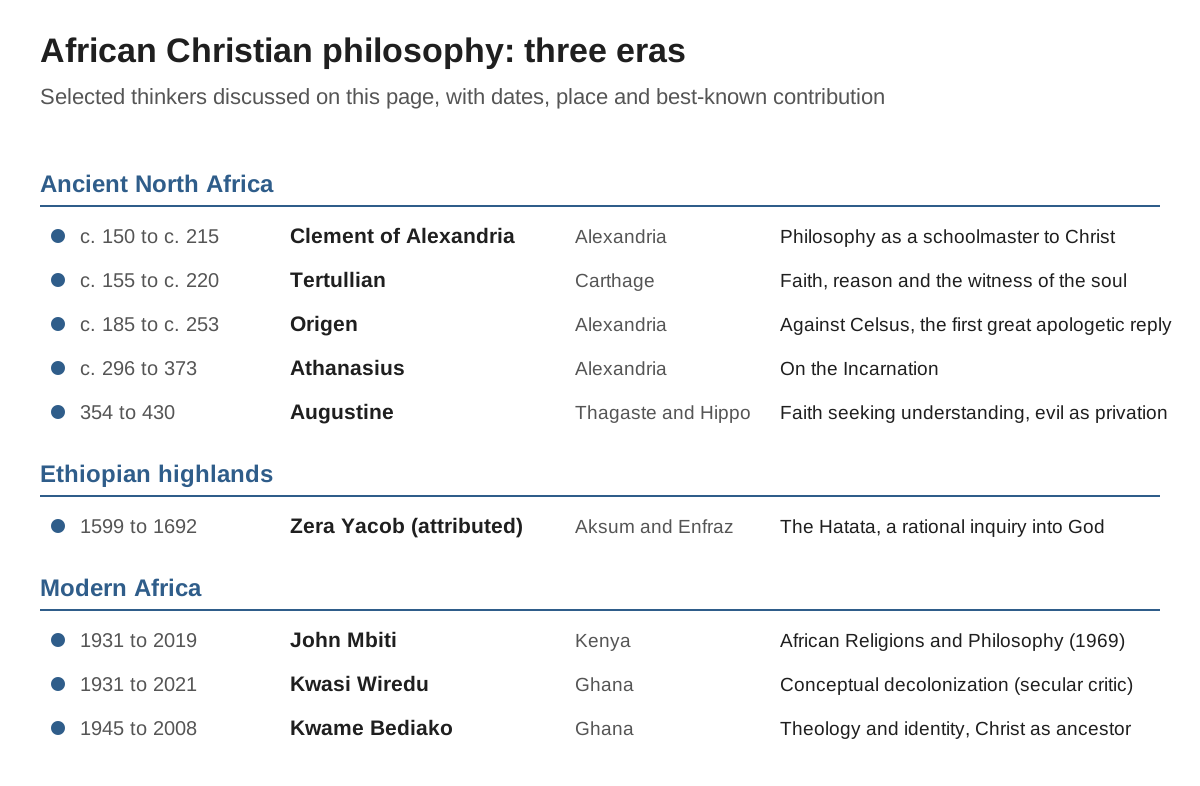 Selected thinkers discussed on this page, in three eras. Chart drawn for the codex from the dates and works given in the text.
See this page's graph and discover linked topics
In full
"African Christian philosophy" here means philosophical reflection on God, the world and the human person done by Africans, or in Africa, within or in conversation with the Christian tradition. It has three main bodies of work:
- Ancient North Africa (second to fifth centuries). Alexandria and Carthage produced the first sustained Christian engagement with Greek philosophy: Clement, Origen and Athanasius in Egypt; Tertullian, Cyprian and above all Augustine in the Latin west of the continent. Much of the Christian intellectual framework later called "Western" was forged here.
- Ethiopia (fifteenth to seventeenth centuries). Ge'ez literature preserved and adapted works of moral and natural philosophy, and produced the Hatata attributed to Zera Yacob and his student Walda Heywat, a treatise of rational theism whose authorship is disputed.
- Modern Africa (twentieth century to the present). Academic African philosophy has debated whether there is a distinctively African philosophy, how African concepts of God, personhood and community should be analyzed, and how Christian theology relates to them. Christian theologians (John Mbiti, Kwame Bediako, Byang Kato, Lamin Sanneh) and philosophers (Kwame Gyekye, Kwasi Wiredu, Ifeanyi Menkiti, Bénézet Bujo) have shaped the field from different directions.
The thread through all three is the relation of faith and reason, and the question of how the gospel meets a culture's existing wisdom.
Era 1: Ancient North Africa
Alexandria: philosophy as preparation
Alexandria was the intellectual capital of the Roman east. The Jewish philosopher Philo of Alexandria had already read Scripture alongside Plato, and the city's Christian catechetical school took up the same task. See Church at Alexandria.
- Clement of Alexandria (c. 150 to c. 215) argued in the Stromata that philosophy was given to the Greeks as a schoolmaster to bring them to Christ, as the law was given to the Hebrews. Truth wherever found belongs to God.
- Origen (c. 185 to c. 253) wrote On First Principles, the first systematic Christian theology, and Against Celsus, a point-by-point reply to the most capable pagan critic of Christianity in the second century. It is the first great work of philosophical apologetics.
- Athanasius (c. 296 to 373), in Against the Heathen and On the Incarnation, argued that the Word through whom the world was made became flesh to restore the image of God in humanity, and defended the full deity of Christ against Arius, also an Alexandrian. See Arius and the Arian Controversy.
Carthage and Hippo: faith seeking understanding
- Tertullian (c. 155 to c. 220) of Carthage is remembered for "What indeed has Athens to do with Jerusalem?" (Prescription Against Heretics 7), a warning against letting philosophy set the terms of the faith. Yet he argued philosophically throughout his work, and in his Apology (17) appealed to the testimony of the soul as "naturally Christian," an early form of the argument that human beings carry an innate awareness of God.
- Cyprian of Carthage (died 258) worked out a theology of the church's unity under persecution.
- Augustine (354 to 430), born at Thagaste and bishop of Hippo, is the most influential Christian philosopher of the first millennium. His contributions include:
- Faith and reason. Drawing on Isaiah 7:9 in the Old Latin ("unless you believe, you will not understand"), he taught that faith opens the way to understanding, the program Anselm later summed up as "faith seeking understanding."
- Evil as privation. Evil is not a substance God created but the corruption or absence of a good that should be there, the classic Christian answer to the Problem of Evil.
- The restless heart. The Confessions (c. 397 to 400) opens with the claim that God made us for himself and our hearts are restless until they rest in him, an argument from human longing that runs through later Christian thought.
- Time and creation. God created the world with time, not in time, an answer to "what was God doing before creation?" still discussed in the philosophy of time.
- History. The City of God (413 to 426) offers a Christian philosophy of history in answer to the charge that Christianity caused Rome's fall.
- Grace and will. The Augustine-Pelagius Controversy fixed the terms of the Western debate on grace and free will.
Thomas Oden argued that the Christian mind of the West was substantially formed in Africa through these figures; see How Africa Shaped the Christian Mind for the thesis and its critics.
Era 2: Ethiopia
Ge'ez literature carried a philosophical strand alongside its liturgy and Scripture. Claude Sumner's multi-volume Ethiopian Philosophy (1974 to 1978) studied, among other works, the Book of the Wise Philosophers, a Ge'ez adaptation of an Arabic anthology of sayings attributed to Greek sages, and the Ethiopian versions of the Physiologus and of the sayings of Secundus the Silent.
The high point is the Hatata (inquiry) attributed to Zera Yacob (1599 to 1692) and the companion treatise of his student Walda Heywat:
- It starts from religious disagreement: every faith claims revelation, so how can one decide?
- It appeals to reason as God's gift to every person and argues from created things to a wise, good and just Creator.
- It criticizes religious laws it judges contrary to the Creator's design, including rules on celibacy, fasting and polygamy.
- It offers a free-will theodicy and expects justice after death.
Since 1920 scholars have disputed whether the texts are genuinely seventeenth-century Ethiopian works or were composed by the Italian missionary Giusto d'Urbino, who brought them to Europe. A 2023 English translation edited by Ralph Lee, Mehari Worku and Wendy Laura Belcher defends Ethiopian authorship. The evidence on both sides is set out at Zera Yacob.
Era 3: Modern African philosophy
The ethnophilosophy debate
- Placide Tempels, a Belgian Franciscan missionary in the Congo, published Bantu Philosophy (French 1945; English 1959). He argued that Bantu thought rests on a coherent ontology of "vital force," and that missionaries must understand it to preach effectively.
- Paulin Hountondji (Benin) attacked this approach in African Philosophy: Myth and Reality (French 1976; English 1983) as "ethnophilosophy": a reconstruction of a whole people's supposed collective worldview, usually by outsiders, rather than philosophy as critical argument by individual thinkers.
- Henry Odera Oruka (Kenya) mapped the field into trends, including ethnophilosophy, "philosophic sagacity" (the critical reflection of individual traditional sages) and professional academic philosophy.
The debate matters for Christian thought because much early African theology, including Mbiti's, worked with reconstructed group worldviews. Critics asked whether those reconstructions were accurate or were shaped by Christian categories.
God-talk in African languages
- Kwasi Wiredu (Ghana) called for "conceptual decolonization": African thinkers should test philosophical problems in their own languages before accepting them. He argued that some classic Western problems in the philosophy of religion do not arise naturally in Akan, and that the Akan supreme being is better described as a cosmic architect than as a creator from nothing. Wiredu wrote as a secular philosopher.
- Kwame Gyekye (Ghana), in An Essay on African Philosophical Thought: The Akan Conceptual Scheme (1987), read the same Akan sources differently, finding in them a supreme Creator and a developed account of the person, and defended a "moderate communitarianism."
- Okot p'Bitek (Uganda) argued that Christian scholars had "Hellenized" African gods by attributing to them omnipotence and omniscience. See African Traditional Religion and Christianity.
Christian philosophers respond that the near-universal African names for a supreme Creator, recorded in proverbs and prayers, are evidence that the idea is native, and that the question whether creation from nothing is affirmed in a given tradition is a question about that tradition, not about whether creation from nothing is true.
Personhood and community
- John Mbiti: "I am, because we are; and since we are, therefore I am" (African Religions and Philosophy, 1969).
- Ifeanyi Menkiti (1984): personhood is achieved over a lifetime in community.
- Gyekye: the community is vital, but persons have intrinsic worth.
- Thaddeus Metz and others have developed ubuntu into a full normative theory.
The Christian contribution here is the image of God as the ground of a dignity no community grants or withdraws, and the Trinity as the ground of personhood-in-relation. See Ubuntu and Christian Ethics.
African Christian theologians as philosophers
- John Mbiti (Kenya, 1931 to 2019) argued that African peoples already knew God and that the gospel fulfills their religious heritage.
- Kwame Bediako (Ghana, 1945 to 2008) argued that African Christian theology faces the same task the second-century Fathers faced: relating the gospel to a pre-Christian religious and intellectual heritage. He modeled his work on Justin, Clement and Tertullian.
- Byang Kato (Nigeria, 1936 to 1975) insisted that Scripture judges every culture, African and Western alike, and warned against syncretism and universalism.
- Lamin Sanneh (Gambia, 1942 to 2019) argued that Christianity's translatability, its habit of entering every language, makes it inherently plural and non-Western in principle.
- Bénézet Bujo (Democratic Republic of the Congo) built an African Christian ethic of community and remembrance.
Themes that run through all three eras
| Theme | Ancient North Africa | Ethiopia | Modern Africa |
|---|---|---|---|
| Faith and reason | Clement's preparation; Tertullian's caution; Augustine's faith seeking understanding | The Hatata's reason as God's gift, set over contested revelation | Bediako's gospel and culture; Kato's Scripture as judge |
| Arguments for God | Augustine's argument from truth and longing; Origen against Celsus | Argument from contingency | High God names as evidence of general revelation |
| Evil | Evil as privation (Augustine) | Free-will theodicy | Misfortune, witchcraft and the spirit world |
| The person | Image of God restored in the Word (Athanasius) | Equality of men and women before the Creator | Ubuntu, personhood in community |
Apologetic relevance
- Christian philosophy is not a European export. Its foundations were laid in Alexandria, Carthage and Hippo, and Africa has continued to produce original Christian thought. See Christianity Is the White Mans Religion Objection Defeater and How Africa Shaped the Christian Mind.
- Faith and reason belong together. From Clement to Augustine to the Hatata, African thinkers modeled reasoning toward God rather than away from him. See Faith and Reason and Natural Theology.
- The questions are shared. The problem of evil, the existence of God and the nature of the person were argued in Africa long before they were argued in Paris or Oxford, and they are argued there again today.
Scholarship
Published academic works this page draws on, each matched to a publisher, index or library catalog record.
- Claude Sumner, Ethiopian philosophy (1974). Open Library
See also
- Africa and Christianity, the master hub
- Augustine, the greatest of the African Fathers
- Tertullian, Carthage, Athens and Jerusalem
- Clement of Alexandria, philosophy as preparation for the gospel
- Origen, the first systematic Christian theologian
- Athanasius, the incarnation and the defense of Nicaea
- Zera Yacob, the Hatata and its authorship dispute
- How Africa Shaped the Christian Mind, Thomas Oden's thesis
- Ubuntu and Christian Ethics, African personhood and the gospel
- African Traditional Religion and Christianity, the High God and the debate over fulfillment
- John Mbiti, Kwame Bediako, Byang Kato and Lamin Sanneh, the modern African theologians
- Faith and Reason, the relation at the center of this tradition
- Problem of Evil, Augustine's privation answer and its heirs
Common questions this page answers
Q: Was Augustine African?
Yes. Augustine was born in 354 at Thagaste, in what is now Algeria, spent nearly all his life in North Africa, and was bishop of Hippo, near modern Annaba, until his death in 430. His mother Monica was also from the region; his precise ethnicity is debated, but he was a Roman North African by birth and life.
Q: What is African Christian philosophy?
It is philosophical reflection on God, the world and the human person done by Africans, or in Africa, within or in conversation with Christianity. It includes the ancient thinkers of Alexandria and Carthage, Ethiopian works such as the Hatata, and modern African philosophers and theologians.
Q: Who are the most important African Christian philosophers?
From the ancient period: Clement of Alexandria, Origen, Tertullian, Athanasius and Augustine. From Ethiopia: Zera Yacob, the attributed author of the Hatata. In the modern period: theologians John Mbiti, Kwame Bediako, Byang Kato and Lamin Sanneh, and philosophers such as Kwame Gyekye and Bénézet Bujo.
Q: What is ethnophilosophy?
It is the reconstruction of the collective worldview of an African people, as in Placide Tempels's Bantu Philosophy (1945). Paulin Hountondji criticized it in 1976 as not real philosophy, since it attributes a single unargued system to a whole people instead of examining the arguments of individual thinkers.
Q: What did Tertullian mean by "What has Athens to do with Jerusalem?"
He was warning, in Prescription Against Heretics 7, against letting Greek philosophy set the terms of Christian doctrine, since he saw heresies arising from that mixture. He was not rejecting reason; his own works are full of philosophical argument.
Q: Is there an African philosophy of God?
Yes. Nearly every African people has a name for a supreme Creator, and African philosophers debate how to analyze those concepts. Kwasi Wiredu argued that the Akan God is more an architect than a creator from nothing; Kwame Gyekye and Christian thinkers read the sources as affirming a true Creator.