Concept
Africa in the Table of Nations
Table of Nations, Genesis 10 Africa, Sons of Ham, Cush Mizraim Put, Hamites in Genesis 10Intro
Genesis 10 is a list of the peoples who came from Noah's three sons after the Flood. It is called the Table of Nations. One of the sons, Ham, has four sons, and three of them are names the rest of the Bible uses for Africa: Cush (the lands south of Egypt, in today's Sudan), Mizraim (Egypt), and Put (most likely Libya). So Africa is on the Bible's first map of the world, near the top, and it never drops off the map again.
The list does not rank the peoples. It does not curse Africa (the curse in Genesis 9 falls on Canaan, a separate line). And it treats nations as relatives in one human family, which is why the New Testament can say God "hath made of one blood all nations of men" (Acts 17:26, KJV).
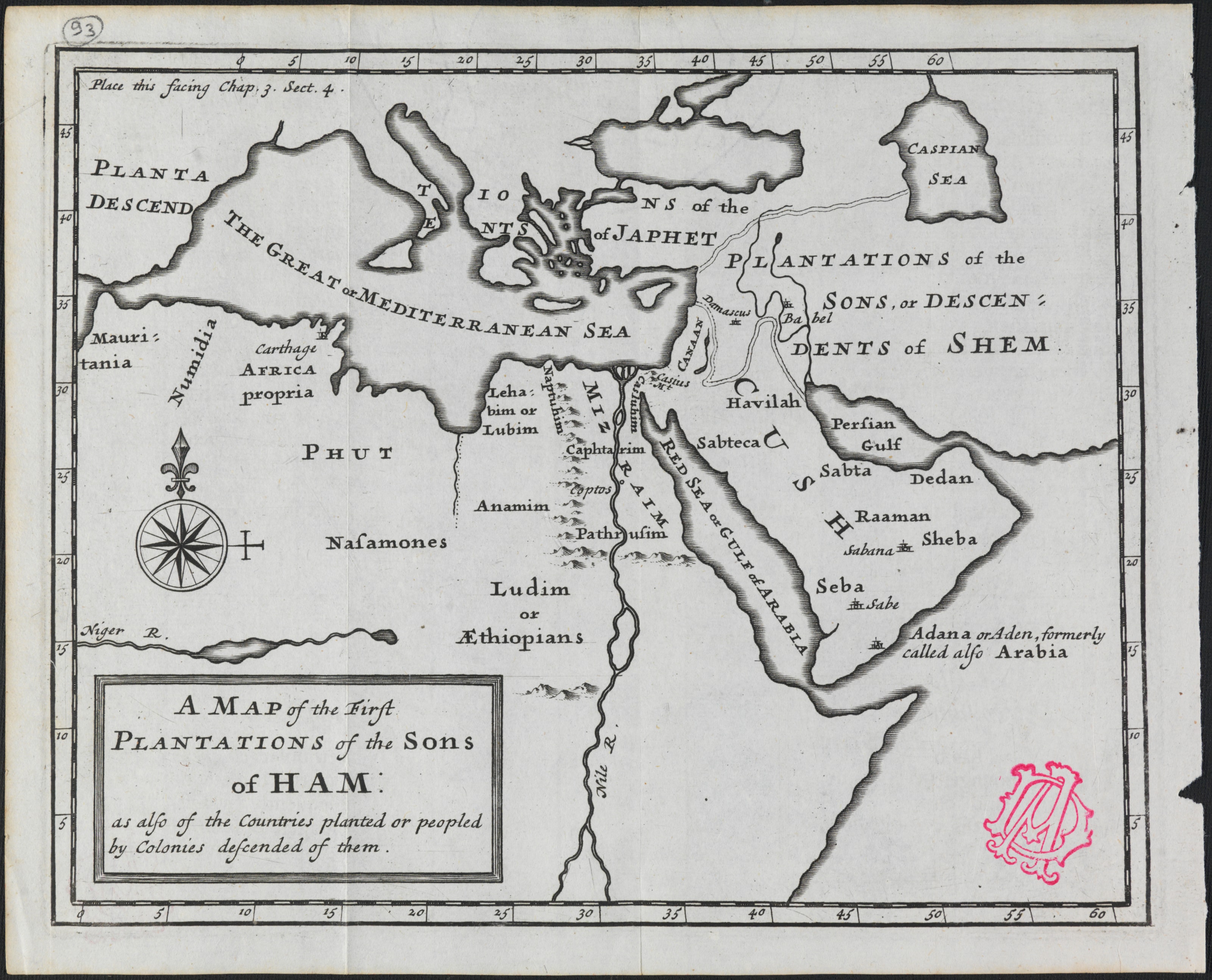 A Map of the First Plantations of the Sons of Ham, by the English geographer Edward Wells. Public domain (Wikimedia Commons), resized.

See this page's graph and discover linked topics
In full
Genesis 10:1-32 is a segmented genealogy that maps the peoples known to ancient Israel onto the family tree of Shem, Ham and Japheth. The Hamite branch (Genesis 10:6-20) lists Cush, Mizraim, Put and Canaan. Three of the four are African in the Bible's own usage:
- Cush (Hebrew Kush, Strong's H3568) is the Nile valley south of Egypt. Egyptian texts call the same region Kush, and the Greek Old Testament (the Septuagint) regularly renders it Aithiopia. In Greek usage of the period "Ethiopia" means the Nile kingdoms of Kush (Napata, later Meroe), not the highland kingdom that later took the name.
- Mizraim (Mitsrayim) is the ordinary Hebrew name for Egypt throughout the Old Testament. The form looks like a dual, and it is often explained as "the two Egypts" (Upper and Lower), though the grammar of the name is debated.
- Put is most often identified with Libya. In several prophetic texts the Septuagint renders it Libyes (for example Jeremiah 46:9 and Ezekiel 30:5). A minority of scholars connect it instead with Punt, the land Egyptian texts place down the Red Sea coast. Both locations are African.
The fourth son, Canaan, is the Levantine line. That matters for the most abused verse in the history of this chapter: the curse of Genesis 9:25 names Canaan, not Cush, Mizraim or Put. See Curse of Ham Objection Defeater.
The chapter's purpose is theological as much as geographical. It sets every nation inside one family before the call of Abraham, so that the promise to Abraham, "in thee shall all families of the earth be blessed" (Genesis 12:3, KJV), has all of Genesis 10 in view.
The African names, verse by verse
| Name in Genesis 10 | Verse | Usual identification | Notes |
|---|---|---|---|
| Cush | 10:6-8 | Kush, the Nile valley south of Egypt (Sudan) | Gentilic Kushi, "Cushite," is applied to individuals across the Old Testament (Ebed-melech, the messenger of 2 Samuel 18) |
| Seba | 10:7 | Linked with Cush and Egypt in Isaiah 43:3 and 45:14 | Location debated; often placed in the Nile region or the Red Sea coast |
| Havilah, Sabtah, Raamah, Sabteca | 10:7 | Red Sea and Arabian trading regions | Several names recur on both sides of the Red Sea |
| Sheba (son of Raamah) | 10:7 | Southwest Arabia, with links to the Horn | The same name appears in two other lines, see below |
| Mizraim | 10:6, 13 | Egypt | Fathers Ludim, Anamim, Lehabim, Naphtuhim, Pathrusim, Casluhim and Caphtorim |
| Pathrusim | 10:14 | People of Pathros, Upper (southern) Egypt | Pathros appears again in Isaiah 11:11 and Jeremiah 44:1 |
| Lehabim | 10:13 | Often taken as Libyans | Tentative identification |
| Put | 10:6 | Libya (minority view: Punt) | Paired with Cush and Egypt in Ezekiel 30:5 and Nahum 3:9 |
Sheba appears three times
The name Sheba sits in three different branches of the family tree:
- Sheba son of Raamah son of Cush (Genesis 10:7), a Hamite.
- Sheba son of Joktan (Genesis 10:28), a Shemite.
- Sheba son of Jokshan, a grandson of Abraham through Keturah (Genesis 25:3).
The simplest explanation is that the genealogies encode geography, trade and political ties, not biology. Sheba was a South Arabian trading people with links across the Red Sea to the Horn of Africa and up the incense road to the Levant, so it could be "related" to more than one neighbor. This is a caution against reading Genesis 10 as a modern racial chart in either direction. It is also the background to the Queen of Sheba debate.
Nimrod and the second Cush
Genesis 10:8-12 says Cush fathered Nimrod, whose kingdom began at Babel, Erech, Accad and Calneh in Shinar (Mesopotamia), and who built Nineveh. Two readings exist:
- One Cush. Nimrod is a son of the African Cush of verse 6, and the text places an African line at the start of Mesopotamian kingship. This is the reading the Africans in Scripture Argument uses.
- Two Cushes. E. A. Speiser and others argued that the Cush of verse 8 is a different, Mesopotamian name (connected with the city of Kish or with the Kassites), which the genealogy has joined to the African Cush. Genesis 2:13 also places a "land of Cush" by a river of Eden, which some read as Mesopotamian.
The text as it stands joins Nimrod to the line of Cush. Whether the editor meant the African Cush or merged two names is a live scholarly question, and nothing in the case for African presence depends on settling it.
Seventy nations
The Hebrew text lists seventy descendants; the Septuagint has seventy-two. Jewish tradition took "seventy nations" as shorthand for all humanity, and Deuteronomy 32:8 ties the division of the nations to the sons of Israel (Hebrew text) or the sons of God (Septuagint and a Dead Sea Scrolls manuscript). Some interpreters see the seventy (or seventy-two) whom Jesus sends out in Luke 10:1 as a deliberate echo of the Table: a mission to every nation. That connection is suggestive, not certain.
James M. Scott has argued that the Table of Nations shaped how early Jews and Christians, Paul and Luke included, pictured the geography of mission. The list of peoples at Pentecost in Acts 2:9-11 includes Egypt and "the parts of Libya about Cyrene" (Acts 2:10, KJV), which is Mizraim and the region of Put, present at the church's first day.
The rest of the Bible keeps Africa on the map
- Psalm 68:31. "Princes shall come out of Egypt; Ethiopia shall soon stretch out her hands unto God" (Psalm 68:31, KJV).
- Psalm 87:4. Cush is named with Egypt (Rahab), Babylon, Philistia and Tyre among those of whom it will be said, "this man was born there," enrolled as natives of Zion.
- Isaiah 19:24-25. Egypt and Assyria joined to Israel: "Blessed be Egypt my people" (Isaiah 19:25, KJV).
- Amos 9:7. "Are ye not as children of the Ethiopians unto me, O children of Israel? saith the LORD" (Amos 9:7, KJV).
- Zephaniah 3:10. Worshippers coming "from beyond the rivers of Ethiopia" (Zephaniah 3:10, KJV).
- Acts 8:26-40. The Ethiopian Eunuch, from the Cush of Genesis 10, is baptized.
- Revelation 7:9. A multitude "of all nations, and kindreds, and people, and tongues" (Revelation 7:9, KJV).
How the chapter has been misused
- The curse of Ham. Proslavery writers in Europe and the Americas claimed Genesis 9:25 cursed Africans through Ham. The text curses Canaan, and Genesis 10 keeps Canaan distinct from Cush, Mizraim and Put. The curse has no textual path to Africa. See Curse of Ham Objection Defeater.
- Etymological shortcuts. It is often said that "Ham" means "black" or "hot." A connection between Ham and words for heat, or with the Egyptian name for Egypt (Kemet, "the black land," named for its soil), has been proposed, but none of these is established, and the genealogy never describes anyone's skin.
- Racial exclusivism. Some Hebrew Israelite teachers use Genesis 10 to sort modern peoples into Hamite, Semite and Japhethite boxes and assign covenant status accordingly. The chapter has no covenant ranking; the call of Abraham comes after it and is a blessing "for all families of the earth." See Black Hebrew Israelite Doctrine and Israelites Were Black Racial Descriptors Objection Defeater.
Tensions
- The Africans in Scripture Argument states flatly that "Phut" is Libya. Most scholars agree, but a minority identify Put with Punt on the Red Sea coast. Both are African, so the argument is unaffected; the identification is a probability, not a certainty.
- The same page treats the Cush who fathers Nimrod (Genesis 10:8) as the African Cush and calls the Mesopotamian proposal a minority reading. That is a fair summary, but the two-Cush reading (Speiser and others) has real support and is presented above as an open question rather than a rejected one.
See also
- Africans in Scripture Argument, the cumulative case this page supports
- Curse of Ham Objection Defeater, why Genesis 9:25 does not touch Africa
- Queen of Sheba, the Sheba of Genesis 10 in the narrative of Solomon
- Ethiopian Eunuch, the Cush of Genesis 10 in the book of Acts
- Taharqa, the Cushite king the Bible names
- Hagar, the Egyptian (Mizraim) in Abraham's household
- Ziggurats and the Tower of Babel, the Babel narrative that follows the Table
- Africa and Christianity, the master hub
- Black Hebrew Israelite Doctrine
Common questions this page answers
Q: Is Africa mentioned in the Bible?
Yes, from Genesis 10 onward. The Table of Nations names Cush (the Nile kingdoms south of Egypt), Mizraim (Egypt) and Put (Libya) among the sons of Ham, and those names recur through the prophets, the Psalms and the book of Acts.
Q: Who were the sons of Ham in Genesis 10?
Cush, Mizraim, Put and Canaan (Genesis 10:6). The first three are the Bible's usual names for African lands; Canaan is the Levantine people west of the Jordan.
Q: What is Cush in the Bible?
Cush (Hebrew Kush) is the region of the Nile south of Egypt, roughly today's Sudan, home of the Kushite kingdoms of Napata and Meroe. The Greek Old Testament translates it as Aithiopia, which is why older English Bibles say "Ethiopia."
Q: Did the curse of Ham fall on Africans?
No. Genesis 9:25 curses Canaan, not Ham, and Canaan is listed separately from the African nations in Genesis 10. The idea of an African "curse of Ham" was invented much later and used to defend slavery.
Q: Why is Sheba listed under both Ham and Shem?
Sheba appears as a Cushite (Genesis 10:7), a Joktanite (Genesis 10:28) and a descendant of Abraham through Keturah (Genesis 25:3). The genealogies record geographic and trade relations, not biology, and Sheba's Red Sea trade tied it to several neighbors.
Q: What is the Table of Nations?
It is the genealogy of Genesis 10 that maps the known peoples of the ancient world onto the families of Noah's sons Shem, Ham and Japheth. It sets every nation in one human family just before God's promise to bless all families of the earth through Abraham.
Q: Was Nimrod African?
Genesis 10:8 makes Nimrod a son of Cush. Many readers take this as the African Cush; some scholars argue the verse refers to a separate Mesopotamian Cush that was joined to the African one. The text links him to Cush either way.