Concept
Africa and Christianity
Africa and the Bible, African Christianity, Christianity in Africa history, Black Christianity in Africa, History of Christianity in AfricaIntro
Christianity is not a newcomer to Africa. Africa is in the Bible from its first chapters to the book of Acts, and the faith was in Africa before it reached most of Europe. Egypt and North Africa gave the early church some of its greatest thinkers. Ethiopia's king became Christian in the 300s, and Nubia and Kongo followed with Christian kingdoms of their own. The colonial era brought real harm alongside real gospel work, and Africans themselves did most of the evangelizing. Today Africa has more Christians than any other continent.
This page is the map. Each section gives the short version and points to the page that tells the full story.
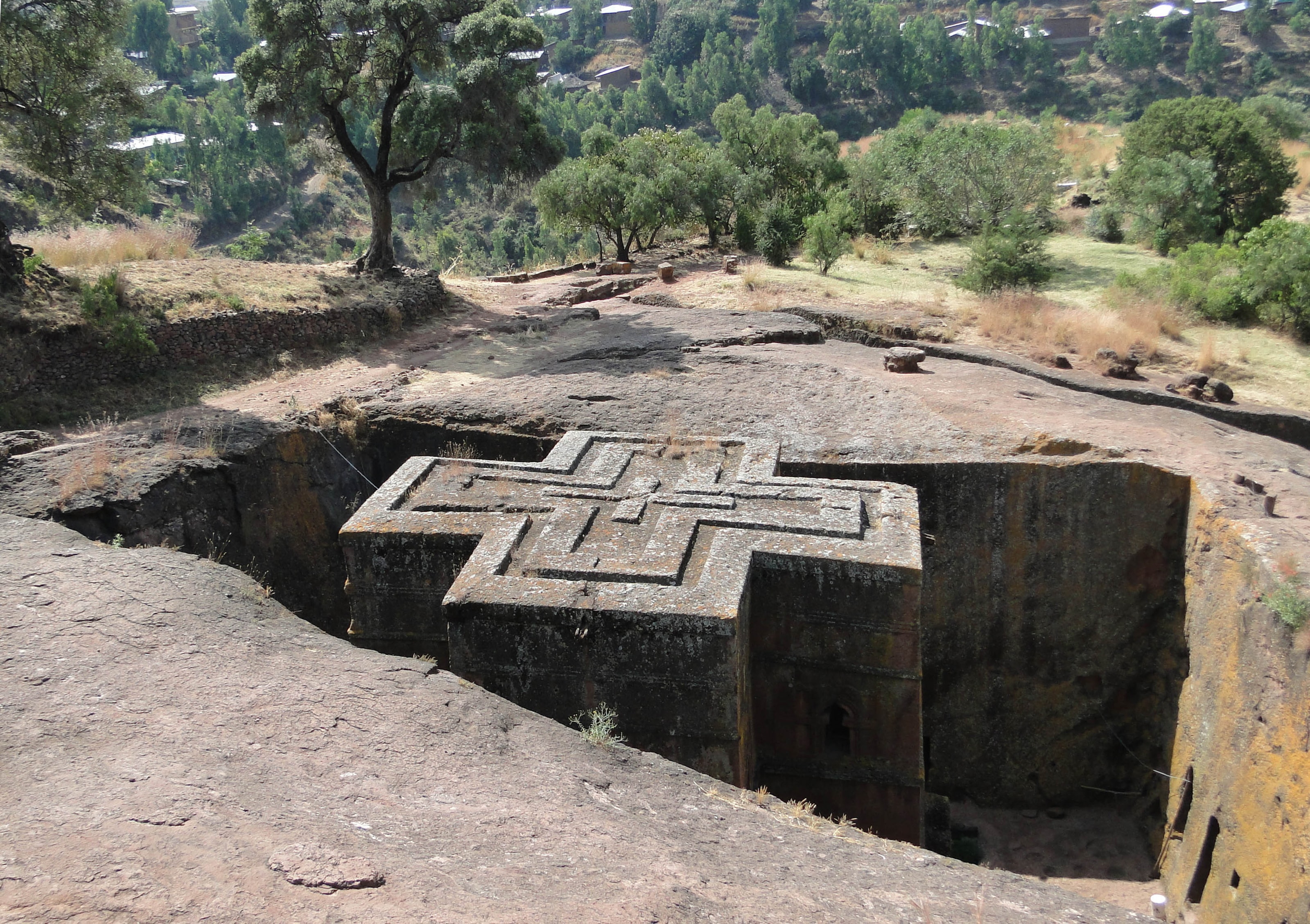 Bete Giyorgis, the Church of Saint George at Lalibela, Ethiopia, cut down into the living rock around 1200. Photo: Bernard Gagnon, CC BY-SA 3.0 (Wikimedia Commons), resized.

See this page's graph and discover linked topics
In full
African Christianity has four overlapping layers, and most confusion about "Africa and Christianity" comes from seeing only one of them:
- Africa in Scripture. African nations and people appear throughout the biblical text, from the Table of Nations in Genesis 10 to the Ethiopian official baptized in Acts 8.
- Ancient and medieval African Christianity. Egypt, North Africa, Aksum (Ethiopia and Eritrea) and Nubia (Sudan) were Christian centuries before European colonialism. The first Christian theology in Latin was written in Carthage, monasticism began in the Egyptian desert, and the Ethiopian church has been continuous since the fourth century.
- The colonial and missionary era. From the Portuguese contact with Kongo in 1483 to the Scramble for Africa after 1884, European expansion and Christian mission were entangled. Some missionaries served empire and some exposed it, and African catechists, prophets and translators carried most of the actual spread.
- The African Christian century. After independence the church grew instead of fading, and the center of gravity of world Christianity moved south. African scholars now argue that the faith is better read as an African religion with deep roots than as a European export.
The pages linked below treat each layer with its evidence, its scholarship and its disputes.
Timeline at a glance
| Date | Event | Page |
|---|---|---|
| Genesis 10 | Cush, Mizraim (Egypt) and Put listed among the nations | Africa in the Table of Nations |
| c. 10th century BC | The Queen of Sheba visits Solomon (1 Kings 10) | Queen of Sheba |
| c. 701 BC | Taharqa, Kushite pharaoh, marches against Assyria (2 Kings 19:9) | Taharqa |
| c. AD 30 | Simon of Cyrene carries the cross | Simon of Cyrene |
| c. AD 30s | Philip baptizes the Ethiopian official (Acts 8) | Ethiopian Eunuch |
| 1st century | Tradition places Mark at Alexandria | Mark the Evangelist |
| 180 | The Scillitan martyrs, first dated Christian document from Latin Africa | Historical Evidence for the Martyrs |
| 203 | Perpetua and Felicity martyred at Carthage | Perpetua and Felicity |
| c. 270 to 356 | Antony goes into the desert; monasticism begins | Antony the Great |
| 325 | Nicaea; Athanasius and the Arian controversy | Arius and the Arian Controversy |
| c. 330s to 340s | King Ezana of Aksum turns to Christ; Frumentius made bishop | Ezana of Axum, Frumentius |
| 354 to 430 | Augustine of Hippo | Augustine |
| 6th century | Nubian kingdoms become Christian | Christian Nubia |
| 7th century | Arab conquest of Egypt and North Africa begins | Decline of North African Christianity |
| c. 1200 | Rock-hewn churches of Lalibela | Rock-Hewn Churches of Lalibela |
| 1491 | Kongo's king baptized; Afonso I follows | Afonso I of Kongo |
| 1884 to 1885 | Berlin Conference and the Scramble for Africa | Christianity and Colonialism in Africa |
| 1886 | The Uganda Martyrs | Uganda Martyrs |
| 1896 | Adwa; Ethiopia stays independent | Menelik II |
| 20th century | Prophet movements and African Initiated Churches | African Initiated Churches |
| Today | Africa holds the largest share of the world's Christians | Christianity in Africa Today |
1. Africa in the Bible
Africa is not at the edge of the biblical story. Cush, Egypt and Put are among the first nations named after the Flood. Moses married a Cushite woman and God defended the marriage. An African official rescued Jeremiah. An African queen came to hear Solomon's wisdom, and Jesus held her up as an example. An African carried Jesus' cross, and an African official was the first Gentile convert whose baptism Acts narrates.
- Africa in the Table of Nations: Cush, Mizraim, Put and Sheba in Genesis 10
- Zipporah, Hagar, Moses
- Queen of Sheba, Taharqa, Ebed-melech
- Simon of Cyrene, Ethiopian Eunuch, Apollos, Simeon Called Niger
- The argument built on all of this: Africans in Scripture Argument
- Answering the racial-curse misreading: Curse of Ham Objection Defeater
- Scholarship on Cush in the Bible: J. Daniel Hays
- Answering the claim that Christianity was stolen from Egypt: Christianity Stolen From Kemet Objection Defeater
2. The early African church and the Fathers
Before Rome or Constantinople led anything, Alexandria and Carthage were the church's intellectual capitals. Africa gave the church its first Latin theologian, its greatest defender of Christ's deity, its most influential Western theologian and the monastic movement.
- Founding and centers: Mark the Evangelist, Church at Alexandria
- Theologians: Tertullian, Cyprian of Carthage, Clement of Alexandria, Origen, Athanasius, Cyril of Alexandria, Augustine, Julius Africanus
- Martyrs and saints: Perpetua and Felicity, Monica of Hippo, Moses the Black
- Monasticism: Antony the Great, Pachomius, Desert Fathers and Mothers
- Controversies that shaped doctrine: Arius and the Arian Controversy, Donatist Controversy, Augustine-Pelagius Controversy
- The big-picture argument: How Africa Shaped the Christian Mind
- What happened next: Decline of North African Christianity
- Living continuity: Coptic Orthodox Church
3. Christian kingdoms and their kings
Several African kingdoms became Christian by their rulers' own decision, with no European involvement. How each one turned to Christ is told on its page, along with the evidence: inscriptions, coins, chronicles and missionary letters.
- Aksum (Ethiopia and Eritrea): Kingdom of Aksum, Ezana of Axum, Frumentius, Kaleb of Aksum, Ethiopian Orthodox Church
- Zagwe and Solomonic Ethiopia: Lalibela, Kebra Nagast, Menelik II
- Nubia (Sudan): Christian Nubia
- Kongo and Ndongo (Angola and the Congo basin): Kingdom of Kongo Christianity, Afonso I of Kongo, Queen Njinga, Kimpa Vita
4. Artifacts and archaeology
The physical record of African Christianity is old and impressive: some of the earliest illustrated Gospel books anywhere, coins struck with the cross, whole churches cut from living rock, and a cathedral covered in medieval paintings.
- Ezana Stone and Aksumite Coins
- Garima Gospels
- Rock-Hewn Churches of Lalibela
- Faras Cathedral Frescoes
- Biblical-era archaeology: Taharqa
5. Colonialism, slavery and mission
This is where the hardest questions sit, and the codex answers them from the record, not from slogans. Some colonial powers used Christianity, and some missionaries were paternalist or worse. Others documented atrocities and opposed slavery and abuse. The faith also spread fastest through Africans themselves, and grew most after the colonial powers left.
- Christianity and Colonialism in Africa
- Missionary Translation and African Languages
- African Participation in the Atlantic Slave Trade
- Samuel Ajayi Crowther, William Wade Harris, Simon Kimbangu, Uganda Martyrs
- Answering the charge directly: Christianity Is the White Mans Religion Objection Defeater, Most of the World Was Colonized by Christians Objection Defeater, Christianity Spread Only by the Sword Objection Defeater, Christian Pre-Colonial African Heritage Argument
6. African scholarship
A generation of African and Africanist scholars reshaped how the world tells this story.
- Lamin Sanneh, Kwame Bediako, John Mbiti, Byang Kato, Thomas Oden
- ris3n's own paper: Christianity in Africa
7. Philosophy and spirituality
African Christian thought did not stop with Augustine. Ethiopia produced a rationalist philosopher in the 1600s, and modern African theologians have worked through what the gospel does with ancestors, community and the spirit world.
- African Christian Philosophy, Zera Yacob, Ubuntu and Christian Ethics
- African Traditional Religion and Christianity, African Traditional Deities (Demonic)
8. African Christianity today
- Christianity in Africa Today: growth, distribution by region and tradition, the largest national churches
- African Pentecostal and Charismatic Christianity, Pentecostalization of Global Christianity
- African Initiated Churches
- Prosperity Gospel in Africa
- Persecution of Christians in Africa
The numbers in brief. The Center for the Study of Global Christianity counts about 9.6 million Christians in Africa in 1900 and about 754 million in 2025, with roughly 1.29 billion projected for 2050. The Pew Research Center, counting differently, puts sub-Saharan Africa alone at about 697 million Christians in 2020, 30.7% of all the world's Christians and more than any other region. Most of that growth came after 1970, when most African states were already independent. Sources and the reasons they differ are on Christianity in Africa Today.
Tensions
The codex records these disputes without settling them. Each is argued on its own page.
- Christianity and colonialism. Was mission mainly a tool of empire, or mainly an African movement that empire could not control? See Christianity and Colonialism in Africa.
- Traditional religion. Are ancestral practices a preparation for the gospel to be fulfilled, or a spiritual danger to be renounced? Compare African Traditional Religion and Christianity with African Traditional Deities (Demonic).
- The Solomonic tradition. The Kebra Nagast's account of Menelik I and the Ark of the Covenant is central to Ethiopian identity, and its historical basis is contested.
- Oden's thesis. How far the early African church shaped the whole Christian mind is argued on How Africa Shaped the Christian Mind.
See also
- African Christianity Pre-Colonial, the shorter overview of the pre-colonial church
- Africans in Scripture Argument, the debate-ready case from the biblical text
- Christian Pre-Colonial African Heritage Argument, the debate-ready historical case
- Black Hebrew Israelite Doctrine, the movement many of these arguments answer
- Great Commission, the mandate behind the mission story
- Christianity in Africa, ris3n's paper
Common questions this page answers
Q: Did Christianity come to Africa through European colonizers?
No. Christianity was in Egypt and North Africa by the first and second centuries, Ethiopia's king became Christian in the 330s or 340s, and Nubia was Christian from the sixth century. All of that came more than a thousand years before the European Scramble for Africa.
Q: Where is Africa mentioned in the Bible?
From Genesis 10 on. Cush, Egypt and Put appear in the Table of Nations. Africans in the text include Moses' Cushite wife, Ebed-melech, the Queen of Sheba, Taharqa, Simon of Cyrene, the Ethiopian official of Acts 8, Apollos of Alexandria, and the African leaders of the church at Antioch in Acts 13.
Q: Who were the African Church Fathers?
The best known are Tertullian and Cyprian of Carthage, Clement, Origen, Athanasius and Cyril of Alexandria, and Augustine of Hippo. Antony and Pachomius of Egypt founded the monastic movement.
Q: Which African kings became Christian?
Ezana of Aksum in the fourth century, Kaleb of Aksum in the sixth, the Zagwe king Lalibela around 1200, and the Kongo kings from 1491, most famously Afonso I. Queen Njinga of Ndongo and Matamba was baptized in the seventeenth century, and Menelik II led Christian Ethiopia to victory at Adwa in 1896.
Q: How many Christians are in Africa today?
About 754 million in 2025, according to the Center for the Study of Global Christianity, up from about 9.6 million in 1900. The Pew Research Center counted about 697 million in sub-Saharan Africa alone in 2020, making it the region with the most Christians in the world.
Q: Is Christianity the white man's religion?
The historical record says no. The faith is Middle Eastern in origin and was African before it was European. Most African evangelism was done by Africans, and the church grew fastest after colonial rule ended.