Concept
Affirming the Consequent
affirming the consequent, fallacy of affirming the consequent, converse error, fallacy of the converse, denying the antecedent, inverse error, modus tollens, denying the consequent, conditional statement, material conditional, material implication, antecedent and consequent, truth table for if-then, does a conditional affirm its antecedentIntro
Affirming the consequent is a mistake in reasoning that runs an if-then statement backwards. It looks like this:
- If it rained, the sidewalk is wet.
- The sidewalk is wet.
- So it rained.
That does not follow. A sprinkler, a spilled bucket or a street cleaner could have wet the sidewalk. The "if" part is called the antecedent (it rained), and the "then" part is the consequent (the sidewalk is wet). Affirming the consequent means seeing that the "then" part is true and concluding that the "if" part must be true too.
The correct move goes the other way: if it rained, the sidewalk is wet; it rained; so the sidewalk is wet. That valid pattern is called Modus Ponens.
A second point matters just as much in debates: saying "if P, then Q" does not claim that P is true. It only claims that Q follows if P is true. People often confuse the two.
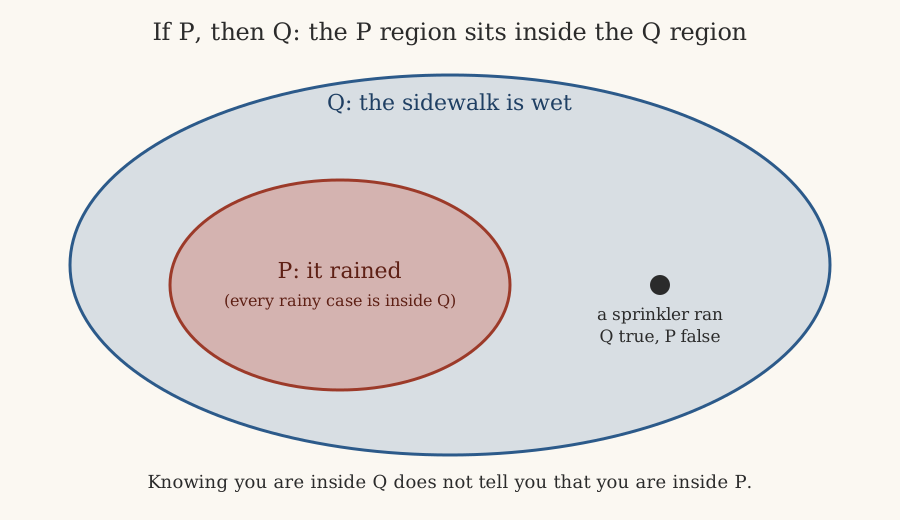
"If P, then Q" puts every P case inside the Q region. A wet sidewalk places you somewhere in Q, which does not tell you whether you are in P. Diagram drawn for the codex.
See this page's graph and discover linked topics
In full
A conditional "if P, then Q" (written P → Q) is a claim about the relation between two propositions. In classical logic it is the material conditional, false only when P is true and Q is false. Four argument forms use a conditional plus a second premise. Two are valid and two are fallacies:
| Form | Second premise | Conclusion | Status |
|---|---|---|---|
| Modus ponens (affirming the antecedent) | P | Q | Valid |
| Modus tollens (denying the consequent) | not Q | not P | Valid |
| Affirming the consequent | Q | P | Invalid |
| Denying the antecedent | not P | not Q | Invalid |
An argument form is valid when no case makes all the premises true and the conclusion false. The two fallacies fail that test, and the truth table shows exactly where.
Affirming the consequent treats "if P, then Q" as if it also meant "if Q, then P" (the converse). Denying the antecedent treats it as if it also meant "if not P, then not Q" (the inverse). Neither follows. The inference does go through when the premise is a biconditional, "P if and only if Q," but then the arguer has asserted more than a conditional and must defend the stronger claim.
The truth table
| P | Q | P → Q |
|---|---|---|
| True | True | True |
| True | False | False |
| False | True | True |
| False | False | True |
Read the rows against each form:
- Modus ponens (premises P → Q and P): only row 1 has both premises true, and Q is true there. Valid.
- Modus tollens (premises P → Q and not Q): only row 4 has both premises true, and P is false there. Valid.
- Affirming the consequent (premises P → Q and Q): rows 1 and 3 make both premises true. In row 3, P is false. That row is the counterexample. Invalid.
- Denying the antecedent (premises P → Q and not P): rows 3 and 4 make both premises true. In row 3, Q is true. Invalid.
Row 3 also shows the second lesson: a conditional can be true while its antecedent is false. Asserting P → Q commits you to the implication and to nothing about whether P or Q actually holds.
A conditional does not affirm its antecedent
There are three different claims:
- Conditional assertion: if P, then Q.
- Antecedent assertion: P is true.
- Consequent assertion: Q is true.
The first establishes neither the second nor the third. In symbols, P → Q entails neither P nor Q on its own.
Example. "If God exists, then objective moral obligations exist." Someone can assert that conditional while remaining agnostic about whether God exists. An atheist can accept it too, and conclude by modus tollens that if there are no objective obligations, there is no reason from morality to believe in God.
In debate. Suppose an opponent says: "You claim consciousness must exist for knowledge to exist, so you are already affirming that consciousness exists." The precise reply: "You are conflating a conditional with its antecedent. I can propose that knowledge requires consciousness without, in that sentence, asserting either one. Affirming the antecedent takes a separate premise." The same care matters in transcendental arguments: identifying a necessary condition for something is one step, and showing that the condition actually obtains is another. See Transcendental Argument for God.
The question to ask: "Are you asserting the antecedent as true, or only that the consequent follows if the antecedent is true?"
Necessary and sufficient conditions
Most cases of affirming the consequent come from confusing sufficient conditions with necessary ones.
- "If P, then Q" says P is sufficient for Q, and Q is necessary for P.
- Affirming the consequent treats Q as sufficient for P.
So "Q is necessary for P; P; therefore Q" is valid (it is modus ponens on "if P, then Q"). "Q is necessary for P; Q; therefore P" is the fallacy. Oxygen is necessary for fire. A room full of oxygen does not prove there is a fire.
How it shows up in debates about God
1. In a careless form of the moral argument
"If God exists, objective morality exists. Objective morality exists. Therefore God exists." As stated, that is affirming the consequent. Objective morality might, for all those premises say, have some other source. This is why William Lane Craig states the moral argument as "If God does not exist, objective moral values and duties do not exist. Objective moral values and duties do exist. Therefore, God exists." That version is valid by modus tollens, and the debate moves to whether its first premise is true. See Moral Argument.
The lesson for Christians: state arguments in a valid form, and put the weight where it belongs, on premises that can be defended.
2. In reasoning from evidence
"If the resurrection happened, the tomb would be empty. The tomb was empty. So the resurrection happened." As a deduction that is affirming the consequent, and a skeptic will say so. The reply is that historical arguments of this kind are not offered as deductions. They are inferences to the best explanation: given the empty tomb, the appearances and the disciples' transformation, the resurrection explains the data better than rival hypotheses. Such reasoning is not deductively valid, but it is how history, medicine and science work, and it can be strong. See Abductive Reasoning.
The same applies to the other side. "If common descent is true, we would see shared DNA patterns; we see them; so common descent is true" is also affirming the consequent if read as a deduction. As an abduction it is judged by explanatory criteria. Fairness requires the same standard for both.
3. Evidence still counts
In probability terms, Q is evidence for P whenever Q is more likely if P is true than if P is false. A wet sidewalk does raise the probability of rain, even though it does not prove it. So the right complaint against affirming the consequent is "that does not prove it." Claiming the observation is no evidence at all overplays the fallacy charge. See Bayesian Probability.
4. Denying the antecedent
"If the Bible is inerrant, it is historically reliable. It is not inerrant. So it is not historically reliable." This denies the antecedent. A text can be reliable without being inerrant, which is how historians treat every other ancient source. The Christian may also dispute the second premise, but the argument fails even before that.
Cross-examination questions
- "Is your premise 'if P then Q,' or 'P if and only if Q'? Your conclusion needs the second."
- "Could Q be true for some other reason than P?"
- "Are you offering this as a proof or as the best explanation? Those are judged differently."
- "When you say 'if P, then Q,' are you also claiming P is true?"
Scholarship
Published academic works this page draws on, each matched to a publisher, index or library catalog record.
- Irving M. Copi, Carl Cohen and Victor Rodych, Introduction to Logic (Routledge, 2018). doi:10.4324/9781315144016
- William Lane Craig, Reasonable Faith (2008). Open Library
- Peter Lipton, Inference to the Best Explanation (Routledge, 2003). doi:10.4324/9780203470855 open access
See also
- Modus Ponens, the valid form that affirming the consequent imitates
- Fallacies, the full catalog of formal and informal fallacies
- Deductive Reasoning and Abductive Reasoning, proof versus best explanation
- Logic and Laws of Logic, the foundations
- Reductio ad Absurdum, an application of modus tollens
- Moral Argument, where the valid form matters
- Debate Logic Toolkit, quick tools for live exchanges
- Epigenetic Homosexuality Model Objection Defeater, a worked case of the fallacy in a scientific claim
Common questions this page answers
Q: What is affirming the consequent?
It is a formal fallacy with the form "If P, then Q; Q; therefore P." For example: if it rained, the sidewalk is wet; the sidewalk is wet; so it rained. The conclusion does not follow, because the sidewalk could be wet for another reason.
Q: What is the difference between modus ponens and affirming the consequent?
Modus ponens affirms the "if" part and concludes the "then" part: if P then Q; P; therefore Q. It is valid. Affirming the consequent affirms the "then" part and concludes the "if" part: if P then Q; Q; therefore P. It is invalid.
Q: Does saying "if P, then Q" mean you believe P?
No. A conditional asserts only that Q follows if P is true. The truth table shows that "if P, then Q" can be true even when P is false. Asserting P takes a separate premise.
Q: What is denying the antecedent?
It is the other common conditional fallacy: if P, then Q; not P; therefore not Q. If it rained, the sidewalk is wet; it did not rain; so the sidewalk is not wet. That fails for the same reason: something else could have wet it.
Q: Is arguing from evidence to God affirming the consequent?
Only if the argument is presented as a strict deduction. Most evidential arguments, such as the case for the resurrection, are inferences to the best explanation, which judge competing explanations by how well they account for the facts. That form of reasoning is used throughout history and science and is not a fallacy.
Q: Is the moral argument for God a case of affirming the consequent?
It is if stated as "If God exists, morality is objective; morality is objective; so God exists." The standard form avoids this: "If God does not exist, objective moral values do not exist; they do exist; therefore God exists." That version is valid by modus tollens.