Person
Adrammelech
Arda-Mulissu, Arda-Mullissi, Urdu-Mullissu, Arad-Ninlil, Adrammelech son of Sennacherib, AdramelusIntro
Adrammelech was a son of the Assyrian king Sennacherib. The Bible says that he and his brother Sharezer murdered their father while he worshipped in the temple of his god at Nineveh, then fled to the land of Ararat (2 Kings 19:37; Isaiah 37:38). Their younger brother Esarhaddon became king.
For a long time Adrammelech was a puzzle, because no Assyrian prince of that name was known. In 1980 the Finnish Assyriologist Simo Parpola showed that a letter in the Assyrian royal archives names the conspirator as Arda-Mulissu, a son of Sennacherib whose name matches the biblical form once the Hebrew spelling is understood.
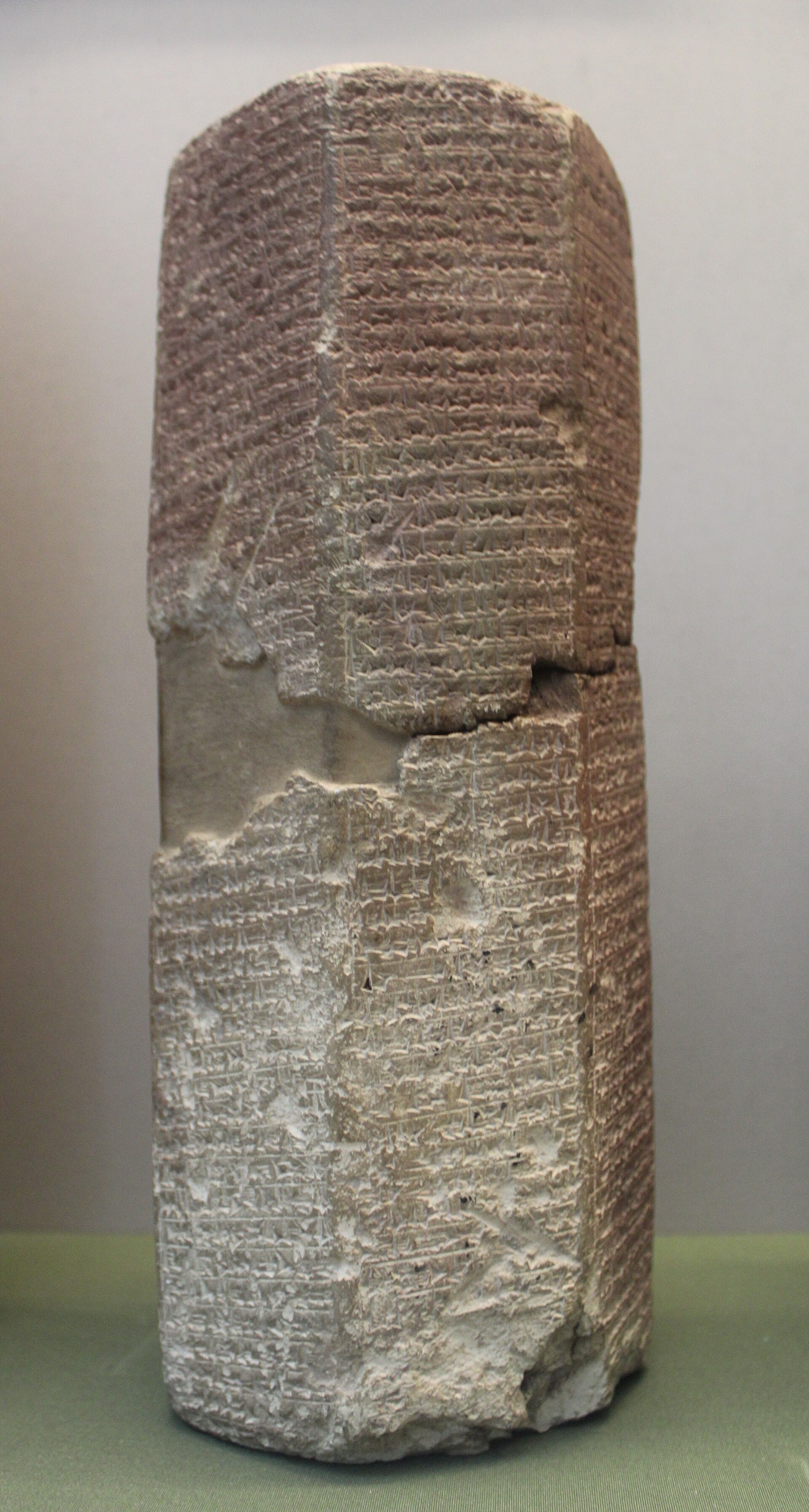 A clay prism of Esarhaddon recording his restoration of Babylon, about 670 BC, British Museum (BM 78223). Other prisms of the same king, the Nineveh A edition, give his account of the brothers' revolt after Sennacherib's murder. Photo: Zunkir, CC BY-SA 4.0, via Wikimedia Commons, resized.

The 30-second version:
The Bible says Sennacherib was killed by two of his sons, Adrammelech and Sharezer, who escaped to Ararat while Esarhaddon took the throne. The Babylonian Chronicle confirms that Sennacherib was killed by his son in a rebellion in 681 BC, and Esarhaddon's own inscriptions describe his brothers' revolt. An Assyrian letter names the leading conspirator as Arda-Mulissu, Sennacherib's son and one-time crown prince. Simo Parpola's identification of Arda-Mulissu with Adrammelech is widely accepted.
See this page's graph and discover linked topics
In full
Arda-Mulissu (Akkadian Arda-Mullissi, "servant of the goddess Mullissu") appears to have become Sennacherib's eldest surviving son and expected heir after his brother Ashur-nadin-shumi was captured by the Elamites in 694 BC. Around 683 BC Sennacherib passed him over and named the younger Esarhaddon as crown prince. Esarhaddon's own account says his brothers slandered him and turned the king against him, so that he withdrew to the western provinces. In 681 BC Sennacherib was killed. A letter in the royal archives reports a conspiracy by Arda-Mulissu, son of the king, against his father. Esarhaddon marched on Nineveh, his brothers' army deserted to him in Hanigalbat, and the rebels fled to Urartu, the kingdom the Bible calls Ararat.
In the Bible
- 2 Kings 19:37 and Isaiah 37:38. "And it came to pass, as he was worshipping in the house of Nisroch his god, that Adrammelech and Sharezer his sons smote him with the sword; and they escaped into the land of Ararat. And Esar-haddon his son reigned in his stead" (Isaiah 37:38, ASV).
- A different Adrammelech. 2 Kings 17:31 mentions "Adrammelech and Anammelech, the gods of Sepharvaim" (ASV), to whom the settlers of Samaria burned their children. That is a deity, unrelated to Sennacherib's son.
Family and lineage
- Father: Sennacherib, king of Assyria (705-681 BC).
- Brothers: Ashur-nadin-shumi, king of Babylon until 694 BC; Esarhaddon, who succeeded their father; Sharezer, his fellow conspirator in the biblical account, whose Assyrian identity is not securely established (Nabu-shar-usur has been proposed).
- Grandfather: Sargon II.
Historical and archaeological evidence
| Source | What it says | Date | Where it is now | Grade |
|---|---|---|---|---|
| Letter in the Nineveh archives (ABL 1091) | An informant reports a conspiracy led by Arda-Mulissu, son of the king, to kill his father | 681-680 BC | Royal archives of Nineveh; British Museum | Strong; the reading and interpretation are Parpola's |
| Babylonian Chronicle (ABC 1) | On the twentieth of Tebet, Sennacherib was killed by his son in a rebellion (paraphrase) | compiled later; event 681 BC | British Museum | Direct for the murder; does not name the son |
| Esarhaddon's Nineveh A prism | Esarhaddon's account of his brothers' slander, their revolt "to seize the kingship," and their flight to an unknown land | about 673 BC | Nineveh; British Museum | Direct for the brothers' revolt; does not name them |
| Berossus and Abydenus, via Eusebius | Later Greek historians preserve garbled forms of the murderer's name, including Adramelus in Abydenus | 3rd century BC and later | Literary fragments | Supporting tradition |
Grade: strong. Lawrence Mykytiuk counts Adrammelech among his 53 confirmed Hebrew Bible figures and notes that the identification rests on Simo Parpola's reading of the letter. See Simo Parpola, "The Murderer of Sennacherib," in Bendt Alster, ed., Death in Mesopotamia (Mesopotamia 8, Copenhagen 1980), 171-182, and Biblical Figures Confirmed by Archaeology.
Scholarly consensus
- The name. The Hebrew 'Adrammelek is explained as a West Semitic rendering of Arda-Mulissu; Parpola set out how the Assyrian name, as pronounced in the period, could yield the biblical spelling. Most Assyriologists and biblical historians now accept the match.
- Who was guilty? Before Parpola's study, some historians suspected that Esarhaddon himself was behind the murder, since he gained most from it. The letter naming Arda-Mulissu and the agreement of the Bible and the Babylonian Chronicle that a son of Sennacherib struck the blow have made that view a minority one.
- One son or two? The Babylonian Chronicle speaks of "his son," singular; the Bible names two. The two accounts can be read together if Arda-Mulissu was the leader and a brother joined him. Sharezer remains unidentified.
- Where it happened. The Bible places the murder in the house of Nisroch. The god Nisroch has not been securely identified; proposals include Nusku and Ninurta.
Theological significance
- Judgment in his own land. Isaiah had said God would cause Sennacherib to "fall by the sword in his own land" (Isaiah 37:7, ASV). The Bible presents the murder as the fulfillment, and as the answer to his boast against the God of Israel.
- Before his own god. The narrative notes that the king who mocked the LORD's power to save was killed while worshipping his own god, who could not protect him.
- History compressed, not invented. Kings moves from Sennacherib's return in 701 BC to his death in 681 BC in a single verse, without dates. The independent sources show the event itself was remembered accurately.
Church Fathers
No verified patristic comment on Adrammelech is cited here.
See also
- People of the Bible, every person in this series grouped by the book of first mention
- Sennacherib, his father and victim
- Esarhaddon, the brother who succeeded
- Sennacherib Prism, the annals of his father's campaign against Judah
- Biblical Figures Confirmed by Archaeology
Common questions this page answers
Q: Who killed Sennacherib?
His son. The Bible names Adrammelech and Sharezer (2 Kings 19:37). The Babylonian Chronicle says Sennacherib was killed by his son in a rebellion in 681 BC, and an Assyrian letter names the conspirator Arda-Mulissu, identified with Adrammelech.
Q: Is Adrammelech mentioned outside the Bible?
Yes, under the Assyrian name Arda-Mulissu, in a letter from the royal archives of Nineveh. Simo Parpola made the identification in 1980, and Lawrence Mykytiuk counts it as a confirmed identification resting on Parpola's reading.
Q: Where is the land of Ararat where Sennacherib's sons fled?
Ararat is the Hebrew name for Urartu, a kingdom in the highlands of eastern Turkey and Armenia, north of Assyria.
Q: Is Adrammelech also the name of a god?
Yes. 2 Kings 17:31 names Adrammelech as a god of Sepharvaim worshipped by settlers in Samaria. That deity is unrelated to Sennacherib's son.