Concept
The Unknown God
Unknown God, Altar to the Unknown God, To an Unknown God, Agnostos Theos, Who was the unknown god, Unknown god in Acts 17, Altar of the unknown god in AthensIntro
When the apostle Paul walked through Athens, he found the city packed with shrines and statues. Among them was an altar with a strange inscription: "TO AN UNKNOWN GOD." The Athenians honored many gods, and just in case they had missed one, they set up altars to gods they could not name.
Paul used that altar as his starting point. Speaking to the philosophers on the Areopagus, he said, in effect: you already sense there is a God you do not know. Let me tell you who He is. He is the Creator of everything, He gives every person life and breath, He is close to each of us, and He has proved who He is by raising a man from the dead.
The story still matters because people today feel the same pull. Most people sense that something greater stands behind the world, even when they cannot say what. The Bible calls that sense real, and it says the unknown God has a name.
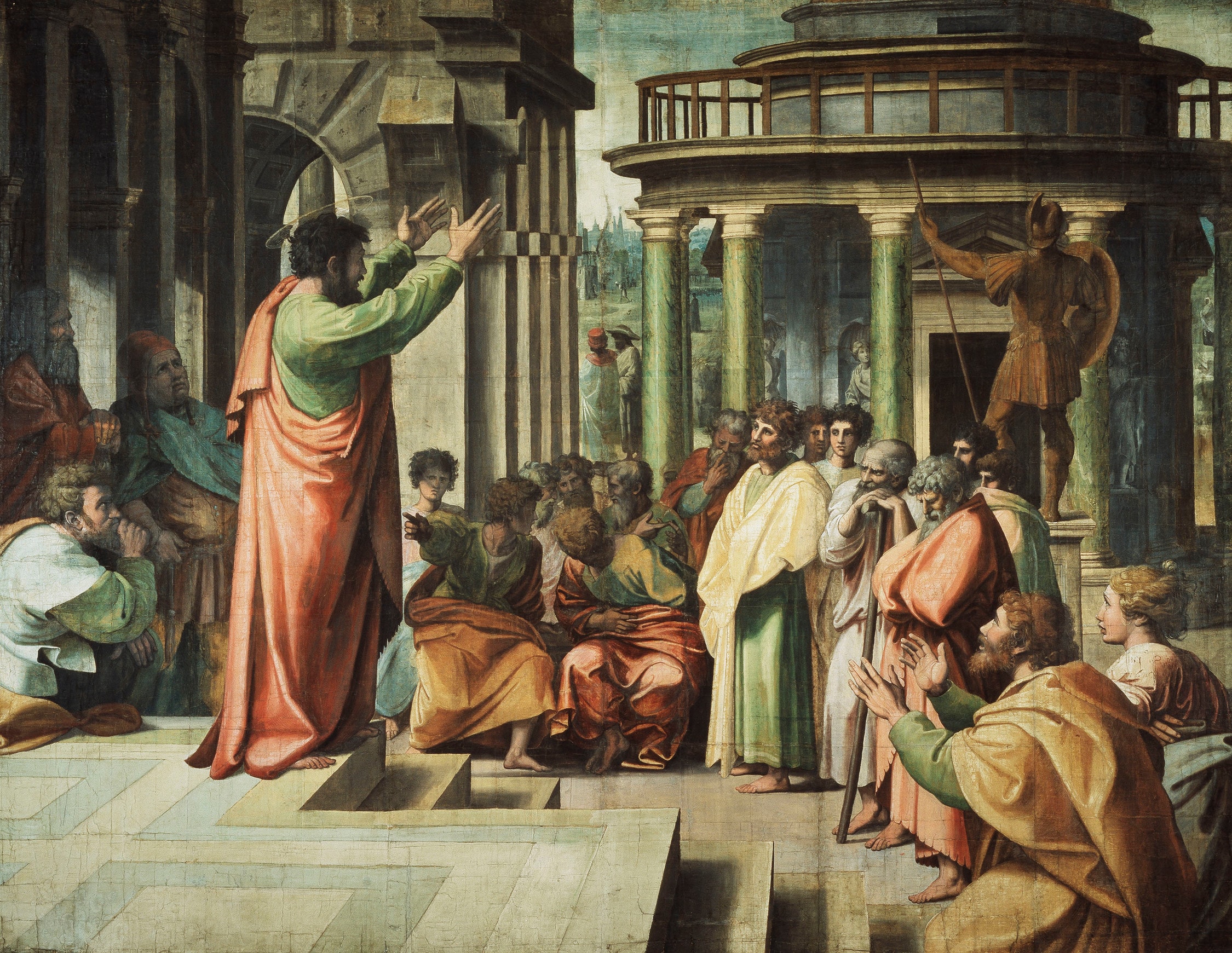
Raphael, St Paul Preaching at Athens, c. 1515, a tapestry cartoon of Acts 17, where Paul tells the Athenians, "What therefore ye worship in ignorance, this I set forth unto you." Image: public domain, via Wikimedia Commons.

See this page's graph and discover linked topics
In full
In Acts 17:22-31 Paul addresses the Areopagus, the Athenian council that took up religious and intellectual questions, after Epicurean and Stoic philosophers heard him preaching "Jesus and the resurrection" in the marketplace (Acts 17:18). He opens with an altar inscribed agnōstō theō, "to an unknown god" (Acts 17:23). Greek sources confirm that the Athenians kept altars to unnamed or unknown gods: Pausanias records "altars of the gods named Unknown" at Phalerum, the old harbor of Athens (Description of Greece 1.1.4); Philostratus has Apollonius praise Athens as a place "where altars are set up in honour even of unknown gods" (Life of Apollonius 6.3); and Diogenes Laertius tells how Epimenides of Crete ended a plague at Athens by releasing sheep from the Areopagus and sacrificing where each lay down, which explained the nameless altars still found across Attica (Lives of the Eminent Philosophers 1.110). No surviving altar carries Luke's singular wording, but the practice is well attested. Paul turns the inscription into a thesis: "What therefore ye worship in ignorance, this I set forth unto you" (ASV). He then argues from creation, providence and the shared descent of humanity to a God who made the world, needs nothing, fixes the times of nations so that people "should seek God, if haply they might feel after him and find him" (Acts 17:26-27, ASV), and in whom "we live, and move, and have our being." He supports the point from Greek poets, including Aratus, Phaenomena 5, "For we are also his offspring," and uses that premise against idolatry. The speech ends in special revelation: a command to repent, a fixed day of judgment, and a man raised from the dead (Acts 17:30-31). The unknown God is the biblical picture of General Revelation in action: nature and conscience bring people to the edge of the true God, and only God's self-disclosure in Christ tells them who He is.
The altar and the ancient evidence
- Acts 17:23. "For as I passed along, and observed the objects of your worship, I found also an altar with this inscription, TO AN UNKNOWN GOD. What therefore ye worship in ignorance, this I set forth unto you" (Acts 17:23, ASV).
- Pausanias, Description of Greece 1.1.4 (second century AD). Describing Phalerum, the old harbor of Athens, he lists "altars of the gods named Unknown, and of heroes, and of the children of Theseus and Phalerus" (trans. W. H. S. Jones).
- Philostratus, Life of Apollonius of Tyana 6.3 (third century AD). Apollonius says it is wiser to speak well of all the gods, "especially at Athens, where altars are set up in honour even of unknown gods" (trans. F. C. Conybeare).
- Diogenes Laertius, Lives of the Eminent Philosophers 1.110 (third century AD). In his life of Epimenides, Diogenes reports that during a plague the Athenians summoned Epimenides from Crete. He took black and white sheep to the Areopagus, let them go, and had sacrifices offered "to the local divinity" wherever each lay down. "Hence even to this day altars may be found in different parts of Attica with no name inscribed upon them" (trans. R. D. Hicks).
- What the evidence shows. The pagan sources mostly speak of altars to unknown gods in the plural, or altars with no name at all. Luke reports one altar with a singular dedication. That fits the evidence: an altar to "a god" whose name was unknown is a natural form of the practice the sources describe, and Luke places it in the city the sources name. The inscription Paul read has not been found.
Why Athens built such altars
Greek religion was polytheistic and transactional: each god had a name, a sphere and rites, and a god who was neglected might punish the city (Polytheism). An altar to an unknown god was insurance. If a plague or disaster came from a power no one had identified, the city could still honor it. The Epimenides story in Diogenes Laertius is exactly that situation: a plague whose divine cause was unknown, and sacrifices offered to whatever god was responsible.
That is the religious instinct Paul observed: "in all things I perceive that ye are very religious" (Acts 17:22, ASV). The Athenians were reaching toward a power they sensed but could not identify.
What Paul taught about the unknown God
| Verse | What Paul says about God |
|---|---|
| 17:24 | He made the world and everything in it and is Lord of heaven and earth |
| 17:24 | He does not live in temples made with hands |
| 17:25 | He needs nothing and gives life, breath and all things to everyone |
| 17:26 | He made every nation from one, and set their times and boundaries |
| 17:27 | He arranged history so people would seek Him, and He is not far from any of us |
| 17:28 | We live, move and exist in Him, and we are His offspring |
| 17:29 | He cannot be represented by gold, silver or stone |
| 17:30 | He now commands all people everywhere to repent |
| 17:31 | He has fixed a day of judgment by a man He appointed, and proved it by raising Him from the dead |
Three features stand out.
- Creator of all. The God Paul names stands outside the Greek pantheon altogether. He is the maker and sustainer of everything, including the materials the idols were carved from. The unknown God is the God on whom every other thing depends.
- Near to everyone. "He is not far from each one of us" (Acts 17:27, ASV). The ignorance is real, but the distance is on the human side.
- Known by revelation. Paul's sermon moves from what the Athenians could see (creation, providence, their own nature) to what they could not have discovered: a day of judgment and a resurrection. The altar is the starting point, and the risen Jesus is the destination.
The poets Paul quoted
Paul says, "as certain even of your own poets have said, For we are also his offspring" (Acts 17:28, ASV).
- Aratus of Soli, Phaenomena 5. The third-century BC poem opens with Zeus and says, "For we are also his offspring" (trans. G. R. Mair). Aratus was a Cilician like Paul and wrote under Stoic influence. A close parallel stands in the Hymn to Zeus of the Stoic Cleanthes, which is why Paul can say "poets" in the plural.
- "In him we live, and move, and have our being." This line is often traced to Epimenides of Crete, from a poem in which Minos addresses Zeus. The attribution rests on a later Syriac commentary tradition and was argued in the early twentieth century by J. Rendel Harris. Many scholars accept it and some doubt it, so the codex treats it as probable, not certain. The same Epimenides is the Cretan "prophet of their own" whom Paul quotes in Titus 1:12; Clement of Alexandria already identified that line as Epimenides's (Stromata 1.14).
How Paul uses them. He leaves the poets' Zeus behind and takes one true thing they said, that human beings come from God, and draws a conclusion they did not: "Being then the offspring of God, we ought not to think that the Godhead is like unto gold, or silver, or stone, graven by art and device of man" (Acts 17:29, ASV). If we come from God, God cannot be something we make. See Preaching to Non-Believers for the full breakdown of the speech as a model for evangelism, and Stoicism for how the speech engages Stoic physics and ethics.
The audience: Stoics and Epicureans
Luke names the two schools in the audience (Acts 17:18).
- The Stoics believed a divine reason (the logos) pervaded the cosmos, which they often identified with Zeus. Paul agrees that God is near and that humans are His offspring, then corrects the pantheism: God made the world and is not the world. See Stoicism and Pantheism vs the Christian God.
- The Epicureans believed the gods, if they existed, were remote and uninvolved, and that death is the end of the person. Paul answers with a God who gives life and breath, who governs history, and who will judge it through a risen man.
The resurrection is where the audience divided. "Now when they heard of the resurrection of the dead, some mocked; but others said, We will hear thee concerning this yet again" (Acts 17:32, ASV). Some believed, "among whom also was Dionysius the Areopagite, and a woman named Damaris" (Acts 17:34, ASV). Centuries later a Christian writer took the name of that convert for a famous body of mystical theology; see Dionysius the Areopagite.
General revelation and the unknown God
The unknown God is the clearest narrative picture of what theologians call General Revelation.
- Creation testifies. "The invisible things of him since the creation of the world are clearly seen, being perceived through the things that are made, even his everlasting power and divinity" (Romans 1:20, ASV).
- Providence testifies. At Lystra Paul says God "left not himself without witness, in that he did good and gave you from heaven rains and fruitful seasons" (Acts 14:17, ASV).
- Conscience testifies. The Gentiles "show the work of the law written in their hearts" (Romans 2:15, ASV).
- The result is real but partial. People can know that God exists and something of His power and goodness, and they can feel after Him. Without God's self-revelation they do not know His name, His plan or His remedy for sin, and the knowledge they have can be suppressed and redirected toward idols (Romans 1:18-25). The altar to an unknown god is both: an honest admission of ignorance, and worship aimed in the wrong direction.
This is why the Areopagus speech matters for Natural Theology. Paul argues from nature and reason, and he takes the Greeks' religious instinct seriously (Sensus Divinitatis). He also refuses to stop there. Natural theology brings the hearer to the altar; the gospel tells him who the altar was for.
Apologetic use
- "Your God is just one more invented deity." Ask: are you rejecting the God Paul describes, the Creator on whom all existence depends, or a finite god inside the universe like Zeus? Paul's own audience already had plenty of finite gods. He was proclaiming something of a different kind. This distinction does not prove God exists, but it makes sure the right God is being discussed.
- "Christians just borrowed from pagan religion." Paul quoted pagan poets openly and corrected them in the same breath. Using a culture's words to say something new is how communication works; it does not show the message came from that culture.
- For the spiritual-but-not-religious. Many people today live with their own altar to an unknown god: a sense that there is something more, honored but never named. Paul's approach is a model: affirm the longing, name the God it points to, and present the resurrection as His public proof. See Argument from Desire.
Scholarship
Published academic works this page draws on, each matched to a publisher, index or library catalog record.
- Pausanias, Description of Greece (1918). Open Library
See also
- General Revelation, what nature and conscience reveal about God
- Natural Theology, arguing to God from reason and the world
- Preaching to Non-Believers, the Areopagus speech as a model for evangelism
- Stoicism, the philosophy of half of Paul's audience
- Dionysius the Areopagite, the convert named in Acts 17:34 and the later writer who took his name
- Paul the Apostle, the preacher at the Areopagus
- Paul's Damascus Road Encounter, how Paul himself came to know the God he proclaimed
- Sensus Divinitatis, the inborn sense of the divine
- Polytheism and Idolatry, the religious world of Athens
- Pantheism vs the Christian God, the Creator distinct from creation
- Argument from Desire, the longing that points beyond the world
Common questions this page answers
Q: Who was the unknown god in Acts 17?
It was an altar in Athens dedicated "to an unknown god," built so the Athenians would not neglect any divine power they had failed to name. Paul told them the God they worshiped in ignorance was the Creator of heaven and earth, who had raised Jesus from the dead.
Q: Is there historical evidence for altars to unknown gods in Athens?
Yes. Pausanias mentions altars of gods named Unknown at Phalerum near Athens, Philostratus says Athens set up altars even to unknown gods, and Diogenes Laertius describes nameless altars across Attica linked to Epimenides. The specific altar Paul read has not been found.
Q: Which Greek poets did Paul quote in Acts 17:28?
"For we are also his offspring" comes from Aratus's Phaenomena, with a close parallel in Cleanthes's Hymn to Zeus. "In him we live, and move, and have our being" is often attributed to Epimenides of Crete, though that attribution is less certain.
Q: Were the Athenians already worshiping the true God?
Paul honored their religious seriousness but called their worship ignorant and commanded them to repent. They sensed a God they did not know; Paul identified Him and called them to turn from idols to Him.
Q: What does the unknown God teach about general revelation?
Creation, providence and conscience lead people to sense that God exists and to reach for Him, but they do not reveal His name or His plan of salvation. Paul built on what the Athenians already sensed and then proclaimed what only God's revelation in Christ could tell them.