Argument
Persuading People to Follow Christ Is Wrong Objection Defeater
persuading people to follow Christ is a sin, evangelism is wrong, proselytizing is wrong, Jesus never told us to convert people, it is wrong to try to convert people, you shouldn't push your religion on people, is evangelism disrespectful, is it a sin to persuade someone to become a Christian, did Jesus tell us to persuade people, we persuade menIntro
Some people say it outright: "Trying to persuade people to follow Christ is a sin. Jesus never taught you to do that." Sometimes it comes from a non-believer who is tired of being preached at. Sometimes it comes from someone who believes in God and thinks faith should be private.
The objection makes two claims, and both can be checked. The first is about what Jesus taught. The second is about whether persuasion is wrong.
On the first, the text is clear. The risen Jesus told his followers, "make disciples of all the nations" (Matthew 28:19, ASV). In the Greek, "make disciples" is a command. Jesus himself opened his preaching with "repent ye, and believe in the gospel" (Mark 1:15, ASV). And Paul, using the very word in question, wrote, "we persuade men" (2 Corinthians 5:11, ASV). The book of Acts shows him doing it week after week, reasoning in synagogues and marketplaces.
On the second, it helps to separate three things people often lump together. Persuasion gives someone reasons and leaves them free to say no. Manipulation goes around a person's reason with tricks, flattery or pressure. Coercion forces them. The New Testament forbids the last two plainly, and it commands the first. Persuasion is in fact the respectful option, because it treats the other person as someone who can think.
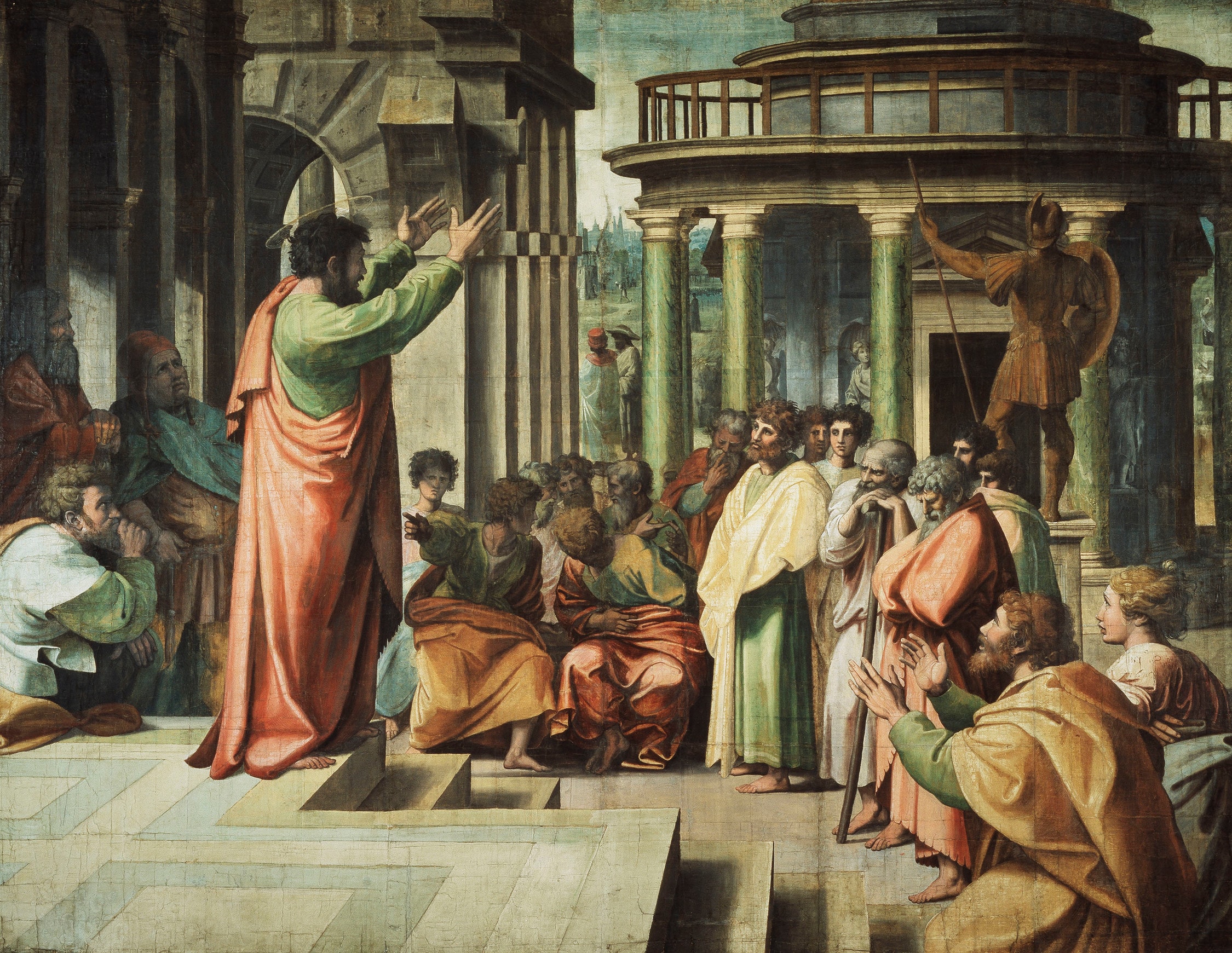
Raphael, St Paul Preaching at Athens, c. 1515, a tapestry cartoon of Acts 17. Paul "reasoned in the synagogue with the Jews and the devout persons, and in the marketplace every day with them that met him" (Acts 17:17, ASV), then answered the philosophers on the Areopagus. Image: public domain, via Wikimedia Commons.

There is a quiet irony in the objection too. Telling a Christian that persuasion is a sin is itself an attempt to persuade. Everyone who believes something important tries to share it. The real question is whether it is done honestly and kindly.
See this page's graph and discover linked topics
In full
Defeater for the objection, in two forms. (A) The textual form: "Jesus never commanded his followers to persuade anyone; evangelism is a later church invention, and the New Testament even condemns proselytizing." (B) The ethical form: "Trying to change another person's religion is disrespectful, manipulative or sinful in itself; faith is private." The objection is sometimes sincere and sometimes a way of ending an uncomfortable conversation, and it often grows out of real experiences of pushy or dishonest evangelism, which should be acknowledged.
The defeat structure has five parts. (1) Textual demonstration: the commission is a command (mathēteusate, aorist active imperative, Matthew 28:19), Jesus called people to repent and believe (Mark 1:15), and the apostles describe their work with the verb peithō, "persuade" (2 Corinthians 5:11; Acts 18:4; Acts 19:8; Acts 28:23). (2) The objector's proof texts read in context: Matthew 23:15, Galatians 1:10 and 1 Corinthians 2:4 condemn corrupt converting, people-pleasing and showy rhetoric, and leave honest persuasion standing. (3) Three things distinguished: persuasion, manipulation and coercion, with the New Testament forbidding the last two (2 Corinthians 4:2; 1 Thessalonians 2:3-5; Luke 9:54-55). (4) The consent argument: persuasion addresses a person's reason and requires their free agreement, so it is the mode of influence that most respects them. (5) Self-reference: everyone with convictions persuades, atheists included, and the objection is itself an act of persuasion.
Honest limits. This page does not defend every way Christians have evangelized. Some have used pressure, deception, bribery or force, and the church's history includes leaders who appealed to "constrain them to come in" (Luke 14:23) to justify state pressure on dissenters, as Augustine did in letters during the Donatist controversy. That was a misuse of a parable, and the New Testament's own rules condemn it. The page defends persuasion done the way the apostles describe: openly, truthfully, with gentleness, and with freedom to refuse.
Argument structure
| # | Premise |
|---|---|
| P1 | Jesus commanded his followers to make disciples of all nations and himself called people to repent and believe. |
| P2 | The apostles describe their own work as persuasion, using peithō, and Acts shows them reasoning and persuading as a regular practice. |
| P3 | The texts used against persuasion condemn corrupt converting, people-pleasing and manipulative rhetoric, not honest persuasion. |
| P4 | Persuasion differs from manipulation and coercion: it offers reasons and leaves the hearer free. The New Testament forbids manipulation and coercion and commands persuasion. |
| P5 | Persuasion respects a person as a reasoning agent, and everyone with convictions, including the objector and including atheists, practices it. |
| C | Therefore persuading people to follow Christ is neither forbidden by Jesus nor wrong in itself. It is commanded, and done rightly it is an act of honesty and love that leaves the other person free. |
Form
Defensive (a defeater). P1 and P2 are a textual demonstration grounded in the grammar of the key verses. P3 is a contextual reading of the objector's best proof texts. P4 is a conceptual distinction among three kinds of influence. P5 combines an argument from respect for persons with a performative self-reference: the objection is an attempt to persuade. Soundness is contemporary.
Cheatsheet
The 30-second reply (read aloud). I hear you, and if someone's ever pushed religion on you in a way that felt manipulative, I'm sorry. That's wrong. But can I show you what Jesus actually said? After he rose, he told his followers, "make disciples of all the nations." In the Greek that's a command. Paul wrote, "we persuade men." So persuading isn't something the church made up. What the Bible does forbid is tricking people or forcing them. Paul said he refused to use "craftiness" or "words of flattery," and Jesus rebuked his own disciples when they wanted to punish a village that turned him away. Persuasion just means giving you my reasons and leaving you free to say no. Honestly, you're trying to persuade me right now, and that's fine. That's what people do when they think something's true.
The 5 fast facts:
- It's a command. "Make disciples" in Matthew 28:19 is mathēteusate, an aorist active imperative, the one main command in the sentence.
- Paul uses the very word. "Knowing therefore the fear of the Lord, we persuade men" (2 Corinthians 5:11, ASV). The verb is peithomen, present active indicative of peithō: persuading is his ongoing practice.
- Acts shows the pattern. Paul "reasoned in the synagogue every sabbath, and persuaded Jews and Greeks" (Acts 18:4, ASV); at Ephesus he spent three months "reasoning and persuading" (Acts 19:8, ASV); in Rome he was "persuading them concerning Jesus... from morning till evening" (Acts 28:23, ASV).
- Manipulation is banned. "We have renounced the hidden things of shame, not walking in craftiness, nor handling the word of God deceitfully" (2 Corinthians 4:2, ASV); "neither at any time were we found using words of flattery" (1 Thessalonians 2:5, ASV).
- Freedom to refuse is built in. Jesus told his messengers that where people "shall not receive you, nor hear your words," they should "shake off the dust of your feet" and move on (Matthew 10:14, ASV).
The 3 strongest counter-moves:
- "Where did Jesus forbid it?" Ask for the verse. Then show Matthew 28:19 and 2 Corinthians 5:11. If persuasion is sin, Paul was sinning in the act he says he did out of reverence for God.
- "What do you mean by persuade?" Ask whether she means giving reasons or using pressure and tricks. If the second, agree with her: the Bible condemns that too. Often this is the real objection.
- "Aren't you persuading me now?" Gently note that telling a Christian not to persuade is itself persuasion. Everyone persuades; the question is how.
Reciprocal concessions (grant the small point, then collect a bigger one):
- Grant: some Christians evangelize in pushy, dishonest or disrespectful ways. Now collect: then the problem is the manner, which Scripture itself condemns (2 Corinthians 4:2; 1 Peter 3:15), not the act Scripture commands.
- Grant: faith cannot be forced, and nobody should try. Now collect: exactly, which is why the New Testament uses persuasion. Persuasion is the one approach that can only succeed if the other person freely agrees.
- Grant: Jesus condemned some people for making converts (Matthew 23:15). Now collect: read the verse to the end. The woe falls on what those converts were turned into, "twofold more a son of hell." The same Gospel ends with Jesus commanding his followers to make disciples.
The closing line. If I believed there was a cure and kept it to myself, you'd be right to call that unkind. I don't want to trick you or pressure you. I just want to tell you why I think Jesus rose from the dead, and then leave you completely free to decide.
Grammar and hermeneutics
The objection makes a claim about what the text says, so the text should settle it. Read on grammatical and literary grounds alone, before any wider theology, it does.
- Matthew 28:19, the command form. "Go ye therefore, and make disciples of all the nations" (ASV). The Greek main verb is mathēteusate (μαθητεύσατε), an aorist active imperative, second person plural. It is the only finite verb in the commission; poreuthentes, "having gone," is an aorist participle that shares the imperative's force (Daniel B. Wallace, Greek Grammar Beyond the Basics, classes it as a participle of attendant circumstance), and baptizontes and didaskontes are participles describing how disciples are made. Mood settles the first claim: an imperative is a command, so "Jesus didn't teach us to do that" is contradicted by the verb form itself. See Great Commission.
- 2 Corinthians 5:11, the vocabulary of persuasion. "Knowing therefore the fear of the Lord, we persuade men" (ASV). The verb is peithomen (πείθομεν), present active indicative, first person plural, of peithō. The present tense presents persuading as Paul's ongoing practice, and the participial clause "knowing the fear of the Lord" gives his motive: reverence for God, not ambition. The same paragraph ends in a plea, "we beseech you on behalf of Christ, be ye reconciled to God" (2 Corinthians 5:20, ASV). The word the objector calls sinful is the word Paul chooses for his ministry.
- The Acts narratives, who acts on whom. In Thessalonica Paul "reasoned with them from the scriptures, opening and alleging that it behooved the Christ to suffer, and to rise again" (Acts 17:2-3, ASV), and "some of them were persuaded" (Acts 17:4, ASV). That verb, epeisthēsan, is an aorist passive: the hearers are the ones in whom persuasion comes to rest, and the outcome belongs to them. Only "some" were persuaded; the rest were free to decline, and did. At Corinth both verbs are imperfects, dielegeto ("he was reasoning") and epeithen ("he was persuading," Acts 18:4), describing repeated action "every sabbath"; several translations render the second as "trying to persuade," since persuasion offered is not always persuasion accepted. At Rome the summary is the same: "some believed... and some disbelieved" (Acts 28:23-24, ASV). The narrative itself records the freedom of the hearers.
- Acts 26:28-29, persuasion openly named. King Agrippa says, "With but little persuasion thou wouldest fain make me a Christian" (ASV); the verb is peitheis, present active indicative, "you are persuading." Paul does not deny it. He answers that he would wish to God that "not thou only, but also all that hear me this day, might become such as I am, except these bonds" (Acts 26:29, ASV). The aim is stated in front of a king, with no concealment, and he leaves the king free.
- 1 Peter 3:15 and Jude 3, the defence of the faith. Believers are to be ready "to give answer [apologia] to every man that asketh you a reason concerning the hope that is in you, yet with meekness and fear" (ASV). Apologia is a reasoned defence; the manner clause, "with meekness [prautēs] and fear," governs how it is given. Jude urges readers "to contend earnestly for the faith which was once for all delivered unto the saints" (Jude 3, ASV), with epagōnizesthai, a present infinitive of continued effort. Reasoned advocacy is a standing duty, and the manner is part of the duty. See G0627 - apologia.
- The objector's proof texts, read in their units.
- Matthew 23:15. "Ye compass sea and land to make one proselyte; and when he is become so, ye make him twofold more a son of hell than yourselves" (ASV). The woe is pronounced on "hypocrites," and the clause that carries the charge is the second one: what the convert is made into. The chapter is a series of woes on hypocrisy (burdens laid on others, show, neglect of justice and mercy). The same Gospel closes with Jesus commanding disciple-making (28:19), so Matthew cannot be read as condemning making disciples as such.
- Galatians 1:10. "For am I now seeking the favor of men, or of God? or am I striving to please men?" (ASV). Here peithō (πείθω, present active indicative) is set in parallel with areskein, "to please," and the ASV rightly renders it "seeking the favor of." The context is Paul defending his gospel against charges of trimming it to win approval. The verse rejects currying favor, and it sits in the same letter in which Paul pleads with the Galatians to return to the gospel.
- 1 Corinthians 2:4. "My speech and my preaching were not in persuasive words of wisdom, but in demonstration of the Spirit and of power" (ASV). The contrast is between peithois sophias logois, "persuasive words of wisdom," the polished rhetoric prized in Corinth (compare 2:1, "not with excellency of speech or of wisdom"), and apodeixis, "demonstration." Paul is rejecting a method, showmanship designed to impress, so that faith "should not stand in the wisdom of men" (2:5). The same apostle, writing to the same church, says "I am become all things to all men, that I may by all means save some" (1 Corinthians 9:22, ASV).
- Luke 14:23, "constrain them to come in." The verb sits inside a parable about a banquet, spoken by the host to his servant, and its point is the urgency and breadth of the invitation to people who would assume they were not welcome. Genre controls the reading: a parable's narrative detail is not a policy for the use of force, and reading it that way contradicts Jesus' explicit rebuke of his disciples when they wanted to punish an unwelcoming village (Luke 9:54-55).
Taken on grammar and genre alone, the texts say the same thing: disciple-making is commanded, persuasion is the apostolic method, manipulation and showmanship are rejected, and the hearer is always free.
P1, Jesus commanded disciple-making and called people himself
Affirmative case
- The commission is an imperative. See the grammar above and Great Commission. It is addressed to the eleven and carries a promise "unto the end of the world," so the church has always read it as standing.
- Jesus called people directly. "Repent ye, and believe in the gospel" (Mark 1:15, ASV). "Come unto me, all ye that labor and are heavy laden, and I will give you rest" (Matthew 11:28, ASV). An invitation to come and believe is an attempt to persuade.
- The Gospels were written to persuade. "These are written, that ye may believe that Jesus is the Christ, the Son of God; and that believing ye may have life in his name" (John 20:31, ASV). A book whose stated purpose is to bring readers to belief is persuasion in written form.
Anticipated objections
- "Jesus said that to the apostles, not to ordinary Christians."
- "Mark 16:15 isn't even original."
Rebuttals
- The command includes its own continuation. The eleven are to teach new disciples "to observe all things whatsoever I commanded you," which includes the command to make disciples. And the promise of presence runs to the end of the age, far beyond the apostles' lifetimes.
- Granted, and it doesn't matter. Most textual critics treat Mark 16:9-20 as an early addition. The case does not rest on it: Matthew 28:19, Luke 24:47, John 20:21 and Acts 1:8 each carry the mission independently.
P2, The apostles persuaded and said so
Affirmative case
- Paul names his practice. "We persuade men" (2 Corinthians 5:11).
- Luke records it as routine. Thessalonica (Acts 17:2-4), Athens in synagogue and marketplace (Acts 17:17), Corinth "every sabbath" (Acts 18:4), Ephesus for three months (Acts 19:8), Rome "from morning till evening" (Acts 28:23).
- The early church kept the method. Justin Martyr addressed his First Apology to the emperor and asked that the charges against Christians be investigated rather than assumed. He argued; he did not threaten. The church grew for nearly three centuries with no power to compel anyone (see Christianity Spread Only by the Sword Objection Defeater).
Anticipated objections
- "Acts describes what Paul did. Description isn't command."
Rebuttals
- True, and the command is elsewhere. The command is Matthew 28:19; Acts shows how its first hearers understood it, and the letters teach the same practice (2 Corinthians 5:11, 5:20; Colossians 4:6). And the objection claims persuasion is forbidden; for that, one would need a text that condemns it, and the narratives present it with approval.
P3, Persuasion, manipulation and coercion are different things
Affirmative case
- Persuasion offers reasons and evidence to someone's mind and asks for their free agreement. It can fail, and when it fails the person is left where they were.
- Manipulation bypasses reason: deception, flattery, exploiting fear or loneliness, hiding one's aims, manufacturing pressure. Paul rejects all of it: "not walking in craftiness, nor handling the word of God deceitfully; but by the manifestation of the truth commending ourselves to every man's conscience" (2 Corinthians 4:2, ASV), and "our exhortation is not of error, nor of uncleanness, nor in guile... neither at any time were we found using words of flattery" (1 Thessalonians 2:3-5, ASV).
- Coercion overrides the will by force or threat. Jesus forbade it in practice: when James and John wanted fire on a Samaritan village that refused him, "he turned, and rebuked them. And they went to another village" (Luke 9:55-56, ASV). Faith produced by force is not the faith the New Testament asks for.
- The New Testament's line falls exactly here. It commands the first and forbids the second and third. "Let your speech be always with grace, seasoned with salt, that ye may know how ye ought to answer each one" (Colossians 4:6, ASV).
Anticipated objections
- "Any attempt to change someone's beliefs is manipulation."
- "Talking about hell is coercion by fear."
Rebuttals
- Then every teacher, scientist and journalist manipulates. Giving someone evidence and arguments in the open, and letting them weigh it, is the ordinary way reasonable people share what they think is true. Manipulation is defined by its methods: concealment and bypassing reason. Honest persuasion is defined by the opposite.
- Telling someone about a real danger is warning. If a friend believes a bridge is out, telling you is care, even though the news is frightening. What matters is whether the warning is honest and the person is left free. Inventing or exaggerating threats to pressure someone would be manipulation, and is forbidden.
P4, Persuasion respects the person
Affirmative case
- It treats the hearer as a thinker. Persuasion can only succeed by convincing a person's own mind. It addresses them as someone able to weigh reasons, which is a form of respect.
- It requires consent. Unlike coercion, persuasion leaves the decision with the hearer. Agrippa heard Paul out and declined (Acts 26:28); Paul was still in chains, and the king was still free.
- Silence can be the unkind option. The atheist magician Penn Jillette, after a man gave him a Bible following a show in 2008, said he did not respect people who believe in eternal life and do not share it, and asked, "How much do you have to hate somebody to not proselytize?" His point: if a Christian really believes the gospel, keeping quiet about it is a form of indifference.
Anticipated objections
- "People have a right not to be bothered."
Rebuttals
- They do, and the New Testament honors it. Where a hearer does not want to listen, the instruction is to leave: "shake off the dust of your feet" (Matthew 10:14, ASV). Persuasion offered and declined ends there. That is the opposite of harassment.
P5, Everyone persuades, the objector included
Affirmative case
- The objection is itself persuasion. Telling a Christian that evangelism is sinful is an attempt to change the Christian's belief and behavior by giving reasons. If persuasion were wrong, the objection would be wrong to make.
- Atheists persuade for atheism. Richard Dawkins wrote in the preface to The God Delusion (2006) that he hoped religious readers would finish the book as atheists. That is an open attempt to change people's beliefs about God, and there is nothing wrong with it as long as it is done honestly. The same freedom belongs to Christians. See Richard Dawkins.
- So the real question is how. People who hold convictions share them. The fair standard, for everyone, is honesty, gentleness, and freedom to refuse.
Anticipated objections
- "I'm not trying to convert you to anything. I just want you to keep your faith to yourself."
Rebuttals
- That is a view about religion you want me to adopt. "Faith should be private" is itself a belief, and asking a Christian to accept it is asking them to change. That's fine to argue for, but it can't be the neutral ground it presents itself as.
Master objections to the defeater
MO1: "Christians have a terrible record. Crusades, forced baptisms, colonial missions."
- Some of that history is real and shameful, and it should be said plainly. But every one of those methods breaks the New Testament's own rules: no deceit (2 Corinthians 4:2), no force (Luke 9:54-55), freedom to refuse (Matthew 10:14). Coercion done in Christ's name condemns the coercers by his own words. See Forced Conversion By Sword Objection Defeater and Christianity Spread Only by the Sword Objection Defeater.
MO2: "All religions are paths to God, so converting anyone is pointless and arrogant."
- That is itself a strong religious claim, and it contradicts what most religions teach about themselves. It also has to be argued for, which means persuading. Christianity claims Jesus rose from the dead; if that is true, it matters for everyone, and saying so is honesty. See Christians Cannot Judge Objection Defeater.
MO3: "Only God can save, so human persuasion is pointless or even presumptuous."
- Scripture holds both together. "I planted, Apollos watered; but God gave the increase" (1 Corinthians 3:6, ASV). God gives the growth, and he uses people to plant and water. Refusing to persuade because God saves would make Paul's whole ministry presumptuous. See Great Commission.
MO4: "Evangelism exploits vulnerable people in hard moments."
- Targeting someone's grief or loneliness to pressure a decision would be manipulation, and it is wrong. Offering hope to someone who is suffering, honestly and without pressure, is something else, and it is what friends do. The test is whether the person is left free and told the truth.
Tactical opening / closing
Opening. Can I ask what you mean by persuading? If you mean pressuring people, tricking them or making them feel trapped, I'm with you. That's wrong, and the Bible says so too. But if you mean telling someone why you believe something and letting them decide, I'd love to show you what Jesus and Paul actually said about that.
Closing. I'm not going to force anything on anyone, and I couldn't if I tried. Faith that's forced isn't faith. But Jesus told his followers to make disciples, and Paul said "we persuade men." So I'll keep doing what they did: tell people what I believe and why, as kindly and honestly as I can, and then leave them free. If you ever want to hear why I think Jesus rose from the dead, I'd be glad to tell you. And if you don't, that's okay too.
Closing conversations
- "Thank you for telling me this bothers you. If I ever come across as pushy, would you tell me?"
- "You're free to say no, and I'll still be your friend."
- "I'm not trying to win. I just didn't want to keep something I think is true and good to myself."
Live-cite kit
Scripture:
- Matthew 28:19, "Go ye therefore, and make disciples of all the nations." (ASV)
- Mark 1:15, "repent ye, and believe in the gospel." (ASV)
- 2 Corinthians 5:11, "Knowing therefore the fear of the Lord, we persuade men." (ASV)
- 2 Corinthians 5:20, "we beseech you on behalf of Christ, be ye reconciled to God." (ASV)
- Acts 18:4, "he reasoned in the synagogue every sabbath, and persuaded Jews and Greeks." (ASV)
- Acts 26:28, "With but little persuasion thou wouldest fain make me a Christian." (ASV)
- 2 Corinthians 4:2, "not walking in craftiness, nor handling the word of God deceitfully." (ASV)
- 1 Peter 3:15, "being ready always to give answer to every man that asketh you a reason concerning the hope that is in you, yet with meekness and fear." (ASV)
- Matthew 10:14, "whosoever shall not receive you, nor hear your words, as ye go forth out of that house or that city, shake off the dust of your feet." (ASV)
- John 20:31, "these are written, that ye may believe that Jesus is the Christ." (ASV)
Patristic: Justin Martyr, First Apology, a reasoned appeal to the emperor asking that Christians be judged on evidence.
Scholarly: Daniel B. Wallace, Greek Grammar Beyond the Basics (1996), on poreuthentes as attendant circumstance with mathēteusate; Richard Dawkins, The God Delusion (2006), preface, an atheist's openly stated hope to persuade.
Aphorism: "Persuasion is the only kind of influence that only works if you're free."
Aphorism: "You're persuading me not to persuade. We're both doing it. Let's both do it honestly."
Connection to Scripture
- Matthew 28:18-20, the commission.
- 2 Corinthians 5:11-20, persuasion and the ministry of reconciliation.
- Acts 17:2-4, 18:4, 19:8, 26:28-29, 28:23-24, persuasion in practice.
- 2 Corinthians 4:2 and 1 Thessalonians 2:3-5, the ban on manipulation.
- Luke 9:54-56 and Matthew 10:14, no force and freedom to refuse.
- 1 Peter 3:15, Colossians 4:6 and Jude 3, reasoned defence with gentleness.
Scholarship
Published academic works this page draws on, each matched to a publisher, index or library catalog record.
- Daniel B. Wallace, Greek grammar beyond the basics (1996). Open Library
See also
- Great Commission, the command and its grammar in full.
- Evangelism, the practice this page defends.
- I Can Live Fine Without Christ Objection Defeater, the dismissal that often comes first.
- Christianity Is Brainwashing Objection Defeater, the charge that Christian belief is installed rather than reasoned.
- Forced Conversion By Sword Objection Defeater and Christianity Spread Only by the Sword Objection Defeater, on coercion in Christian history.
- Christians Cannot Judge Objection Defeater, the related charge that Christians have no right to call anything wrong.
- G0627 - apologia, the word behind "give answer" in 1 Peter 3:15.
- Paul the Apostle, the persuader of Acts.
- Closing Conversations, ending the exchange with the door open.
- Atheism, the master hub.
Common questions this page answers
Q: Is it a sin to try to persuade someone to become a Christian?
No. Jesus commanded his followers to "make disciples of all the nations" (Matthew 28:19), and Paul described his own ministry with the words "we persuade men" (2 Corinthians 5:11). What the Bible forbids is deceiving, flattering or forcing people. Honest persuasion that leaves the other person free is commanded.
Q: Did Jesus tell his followers to persuade people?
Yes. In Matthew 28:19 "make disciples" is a command in the Greek (an aorist imperative), Jesus himself called people to "repent ye, and believe in the gospel" (Mark 1:15), and John says his Gospel was written "that ye may believe" (John 20:31). The apostles understood this as a call to reason with people and persuade them, which is what Acts shows them doing.
Q: What is the difference between evangelism and manipulation?
Evangelism done rightly gives reasons openly and leaves the person free to say no. Manipulation goes around a person's reason with deception, flattery or pressure. Paul says he renounced "craftiness" and never used "words of flattery" (2 Corinthians 4:2; 1 Thessalonians 2:5), so the Bible condemns manipulation as clearly as its critics do.
Q: Didn't Jesus condemn the Pharisees for making converts?
In Matthew 23:15 Jesus condemns hypocrites who travel far to make one convert and then make him "twofold more a son of hell." The woe falls on what they made the convert into, not on sharing faith as such. The same Gospel ends with Jesus commanding his followers to make disciples of all nations.
Q: Does "compel them to come in" in Luke 14:23 mean forcing people to convert?
No. The line comes from a parable about a banquet and expresses the urgency of an invitation to people who would not expect to be welcome. It was later misused to justify pressure on dissenters, but Jesus explicitly rebuked his disciples when they wanted to punish a village that rejected him (Luke 9:54-55).
Q: Do atheists try to persuade people too?
Yes, and there is nothing wrong with that when it is done honestly. Richard Dawkins wrote in the preface to The God Delusion that he hoped religious readers would finish it as atheists. Everyone who holds a conviction they think is true tends to share it; the fair standard for all sides is honesty, gentleness and freedom to refuse.
Q: Isn't it disrespectful to try to change someone's religion?
Persuasion is actually a form of respect, because it treats the other person as someone who can weigh reasons and decide for themselves. The atheist Penn Jillette argued that a Christian who believes in eternal life and never shares it is showing indifference. What is disrespectful is pressure, deception or refusing to take no for an answer.