Person
John Whitmore
John H. Whitmore, Dr. John Whitmore, WhitmoreAmerican geologist and paleontologist at Cedarville University, where he chairs the Department of Geology. A young-earth creationist, he is best known for research arguing that the Coconino Sandstone of the Grand Canyon, usually read as an ancient desert dune field, was deposited underwater.
The 30-second version:
John Whitmore teaches geology at Cedarville University. He holds a B.S. in geology from Kent State, an M.S. in geology from the Institute for Creation Research and a PhD in biology with a paleontology emphasis from Loma Linda University. His team's detailed study of the Coconino Sandstone (2014) argues that its giant cross-beds and grain features fit underwater sand waves better than wind-blown dunes, which matters because desert dunes in the middle of the rock column are a classic argument against Flood Geology. Mainstream geologists still read the Coconino as a dune deposit.
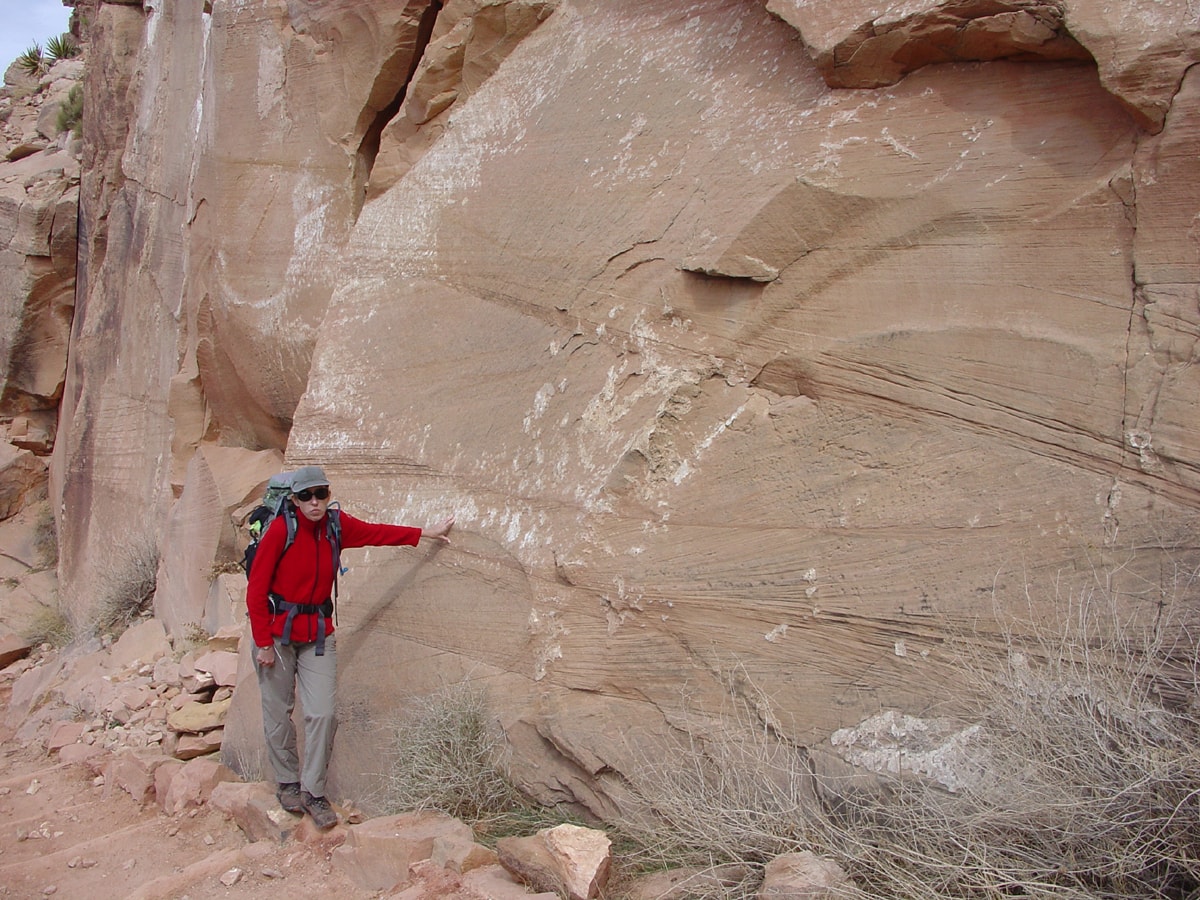
Large-scale cross-beds in the Coconino Sandstone, South Kaibab Trail, Grand Canyon. Photo: National Park Service, public domain, via Wikimedia Commons, resized.
Career
- Training. B.S. in geology (Kent State University), M.S. in geology (Institute for Creation Research), PhD in biology with an emphasis in paleontology (Loma Linda University).
- Position. Chair of the Department of Geology and Distinguished Professor of Geology at Cedarville University, Ohio.
- Research. The geology of Noah's Flood, the Coconino Sandstone, the Green River Formation, and sand injectites in the Grand Canyon.
See this page's graph and discover linked topics
The Coconino Sandstone
- Why it matters. The Coconino sits high in the Grand Canyon's walls. Since Edwin McKee's 1934 study it has been read as a field of desert dunes, with sloping cross-beds and fossil trackways. Dry desert dunes in the middle of a stack of supposed Flood deposits are a long-standing objection to Flood geology.
- The study. Whitmore and co-authors Strom, Cheung and Garner published "The petrology of the Coconino Sandstone (Permian), Arizona, USA" (Answers Research Journal 7, 2014), describing samples from across Arizona, including the Grand Canyon.
- The argument. The authors report features such as mica in nearly every thin section and dolomite ooids, and argue that the sandstone as a whole fits large underwater sand waves better than desert dunes.
- The response. The wind-blown dune interpretation remains the standard view in mainstream geology, which reads the cross-bed geometry and trackways as desert features. See Grand Canyon Formation.
See also
- Grand Canyon Formation, the full comparison of the competing accounts
- Flood Geology, the framework his work develops
- Global Flood Evidence, which lists the Coconino among the cross-continental formations Flood geologists cite
- Andrew Snelling, fellow Flood geologist
- Steven A. Austin, fellow Flood geologist