Argument
Ignorance Is Innocence Objection Defeater
Why Tell Them Objection, Better Not to Know Objection, Ignorance Is Bliss Objection, Why did you tell me objection, If I never told my kids about God would they be innocent, Does evangelism make people more guilty, Luke 12:48 ignorance objectionIntro
The objection usually comes from a worried parent or a clever skeptic. Jesus said the servant who knew his master's will and ignored it gets "many stripes," and the one who did not know gets "few stripes" (Luke 12:47-48). So, the argument goes, knowing about God only makes things worse. If I never tell my children about God, they won't be held guilty for rejecting Him. Telling them is the dangerous part. The writer Annie Dillard tells of a man who asked a missionary whether he would go to hell if he had never heard of God and sin. "No," said the priest, "not if you did not know." "Then why," the man asked, "did you tell me?"
The answer is in the same verse. The servant who did not know still "did things worthy of stripes." He got few, not none. Not knowing made his punishment lighter. It did not make him innocent. And nobody is really in the dark: Paul says everyone sees God's power in creation and carries His law in their conscience (Romans 1:20; 2:15). So keeping a child from hearing about Jesus does not keep them innocent. It only keeps them from the one thing that can actually rescue them. The gospel is not just bad news about guilt. It is the cure.
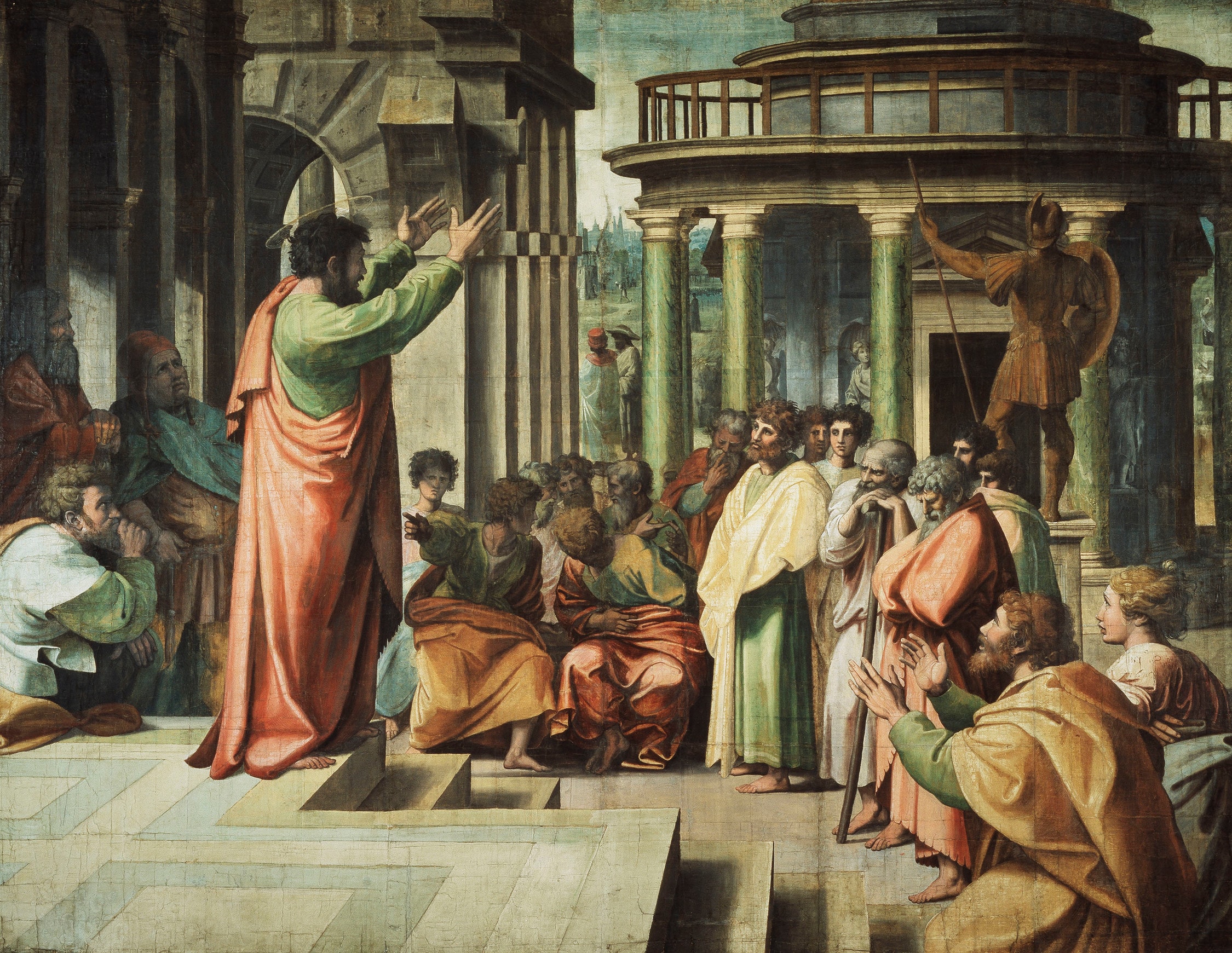
St Paul Preaching at Athens, by Raphael, c. 1515, a tapestry cartoon of Acts 17, where Paul says "the times of ignorance therefore God overlooked; but now he commandeth men that they should all everywhere repent." Image: public domain, via Wikimedia Commons.

See this page's graph and discover linked topics
Cheatsheet
The 30-second reply:
Read the next clause. The servant who "knew not" still "did things worthy of stripes" and is still beaten, with few stripes instead of many (Luke 12:48). Ignorance lowers the penalty; it never removes it. And no one is truly ignorant: creation leaves everyone "without excuse" and conscience writes the law on every heart (Romans 1:20; 2:15). So silence doesn't protect your child from judgment. It only withholds the one thing that rescues from it, because "how shall they believe in him whom they have not heard?" (Romans 10:14). The gospel isn't the diagnosis that makes you sick. It's the medicine.
The fast facts:
- Few stripes are still stripes. Luke 12:48: "he that knew not, and did things worthy of stripes, shall be beaten with few stripes."
- The Law said it first. "Though he knew it not, yet is he guilty, and shall bear his iniquity" (Leviticus 5:17).
- Everyone has light already. Creation (Romans 1:20) and conscience (Romans 2:14-15). "As many as have sinned without the law shall also perish without the law" (Romans 2:12).
- Hearing is how rescue comes. "Belief cometh of hearing, and hearing by the word of Christ" (Romans 10:17).
- Silence is the messenger's guilt, not the hearer's safety. If the watchman gives no warning, "the same wicked man shall die in his iniquity; but his blood will I require at thy hand" (Ezekiel 3:18).
The 3 strongest counter-moves:
- "In Luke 12:48, is the servant who didn't know punished or not?" He is. That ends "ignorance is innocence."
- "Has your child ever done something they knew was wrong?" Then they are not in a state of ignorance about right and wrong, and Romans 2:15 is already true of them.
- "Would you withhold a cure from your child because learning about the disease is frightening?" That is what the objection proposes.
Reciprocal concessions (grant the small point, then collect a bigger one):
- Grant: knowledge does raise accountability; Jesus says so plainly ("to whomsoever much is given, of him shall much be required"). Now collect: the same sentence says the ignorant servant is still judged, so knowledge changes the measure, not the fact, of judgment.
- Grant: God takes ignorance into account; "the times of ignorance therefore God overlooked" (Acts 17:30). Now collect: Paul finishes the sentence, "but now he commandeth men that they should all everywhere repent," so God's patience with ignorance is the reason to proclaim, not a reason to stay silent.
- Grant: the fate of those who never hear is a real and hard question. Now collect: however one answers it, no Christian position teaches that ignorance saves, and every position agrees that the safe place is knowing Christ, not not-knowing Him.
The closing line:
Keeping someone in the dark doesn't make them innocent. It just keeps them from the light.
In full
The objection is a reductio aimed at Christian evangelism: (1) culpability before God scales with knowledge (Luke 12:47-48); (2) therefore increasing someone's knowledge of God increases their potential culpability; (3) therefore withholding knowledge of God minimises the risk of condemnation, and evangelism, including teaching one's own children, does more harm than good. In its strong form it adds: (4) those who never hear are innocent.
The defeat targets premises 2 to 4. Luke 12:48 itself asserts that the ignorant servant has done "things worthy of stripes" and receives a penalty, so ignorance mitigates but does not exculpate (with Leviticus 5:17 and Romans 2:12 as corroboration). Scripture denies that any person is in a state of moral or theological ignorance sufficient for innocence, since general revelation and conscience render all "without excuse" (Romans 1:20; 2:14-15). The proposal also misdescribes the gospel as information that only raises liability, when Scripture presents it as the power of God unto salvation (Romans 1:16) and the necessary means of faith (Romans 10:14-17). Finally, Scripture inverts the moral accounting of silence: the unwarned still die in their iniquity, and the guilt of silence falls on the one who withheld the warning (Ezekiel 3:18). Withholding the gospel therefore removes the remedy while leaving the condition, which is the opposite of protection.
Grammar and hermeneutics
The objection quotes Luke 12:47-48 and stops one clause short. The grammar of the verse defeats it on its own.
- The ignorant servant has two participles, not one. Luke 12:48 opens ho de mē gnous, poiēsas de axia plēgōn, "but he that knew not, and did things worthy of stripes." The first participle negates his knowledge; the second affirms his deeds. Both describe the same man. The verse does not present an innocent ignorant servant; it presents a guilty one who lacked knowledge.
- "Worthy" is a verdict word. Axia (Strong's G514) means deserving or fitting. His deeds merited stripes before any question of his knowledge was raised.
- Both servants receive the same future passive verb. "Shall be beaten" (darēsetai, G1194) governs both the "many" of verse 47 and the "few" (oligas, G3641) of verse 48. The contrast is in the adjective of quantity, not in the verb. Jesus distinguishes how much, not whether.
- The general rule is about measure. "To whomsoever much is given, of him shall much be required" (12:48b) sets the scale of what is required. It does not say "of him to whom little is given, nothing is required."
- The parable's setting is the steward who knew best. Luke 12:42-46 addresses the "faithful and wise steward" set over the household, and Peter's question in 12:41 shows the warning is aimed at disciples and leaders. The saying raises the stakes for those with knowledge; it is not a charter for the ignorant.
- The Torah category of unknowing sin agrees. Leviticus 5:17: "though he knew it not, yet is he guilty, and shall bear his iniquity." Unknowing sin required atonement, which presupposes guilt.
- John 15:22 is about one specific sin. "If I had not come and spoken unto them, they had not had sin: but now they have no excuse for their sin." Verse 24 names it: "now have they both seen and hated both me and my Father." The sin in view is the rejection of Christ in person, not sin in general. Paul's universal "all have sinned" (Romans 3:23) stands.
On the paired participles of 12:48, the shared verb of punishment, the measure-language of the general rule, and the Torah's category of unknowing guilt, Luke 12:47-48 teaches mitigation by ignorance, never exemption by it.
Argument structure
| Premise | Notes | |
|---|---|---|
| P1 | Ignorance reduces culpability but does not remove it. The servant who "knew not" is still beaten. | Luke 12:48; Leviticus 5:17 |
| P2 | No one is in the kind of ignorance the objection imagines. Creation and conscience give every person real knowledge of God and of right and wrong. | Romans 1:20; 2:14-15 |
| P3 | The gospel is not mere information that raises liability. It is the means of rescue, and it comes by hearing. | Romans 1:16; 10:14-17 |
| P4 | Scripture treats withholding the message as the messenger's guilt, not the hearer's protection, and commands parents to teach their children. | Ezekiel 3:18; Deuteronomy 6:7 |
| C | Withholding knowledge of God does not make anyone innocent. It leaves the guilt and removes the cure. |
Master objections to the whole argument
MO1: "Then what happens to people who genuinely never hear?"
- A real question, and Christian traditions answer it differently. Some hold that explicit faith in Christ is necessary; others that God may save through Christ some who respond to the light they have; all agree that whoever is saved is saved by Christ alone (Acts 4:12). The relevant point for this objection is shared by every position: Scripture says those without the law "perish without the law" (Romans 2:12), judged by the light they had, and Luke 12:48 says the ignorant are still judged. No position makes ignorance the safe option. Degrees of Punishment sets out the proportion principle.
MO2: "A good God wouldn't make salvation depend on whether a missionary shows up."
- God's concern runs the other way: "God sent not the Son into the world to judge the world; but that the world should be saved through him" (John 3:17). The person is not condemned by the arrival of the message; "he that believeth not hath been judged already" (3:18). The messenger brings an offer to people already under judgment, and God commands that the offer reach "all the nations" (Matthew 28:19). The objection pictures evangelism as condemnation arriving. Scripture pictures it as rescue arriving.
MO3: "Small children don't understand anything. Surely they're innocent."
- That is a different question, about infants and those unable to understand, and the codex treats it on Children in OT Theology. The objection here is about deliberately keeping children who will grow up from ever hearing of God. A child who reaches the age of telling right from wrong has conscience (Romans 2:15), and Scripture's instruction to parents is the opposite of silence: "thou shalt teach them diligently unto thy children" (Deuteronomy 6:7), so that, like Timothy, "from a babe thou hast known the sacred writings which are able to make thee wise unto salvation" (2 Timothy 3:15).
Premise 1, Ignorance mitigates but does not exempt
Affirmative case
- Luke 12:48 punishes the ignorant servant. "Shall be beaten with few stripes." Few is not zero.
- The deeds are what merit the stripes. "Did things worthy of stripes." The servant is judged for what he did, with his ignorance weighed in the measure.
- The Law's sin offering for unknowing sin. "Though he knew it not, yet is he guilty, and shall bear his iniquity" (Leviticus 5:17). Israel needed atonement even for sins committed in ignorance.
- Paul's "perish without the law." Romans 2:12: those who sinned without the written law are not exempt; they are judged without it.
Anticipated objections
- "Jesus said 'If ye were blind, ye would have no sin' (John 9:41)."
- "Few stripes for ignorance is still unfair. They didn't know."
Rebuttals
- John 9:41 is ironic and specific. Jesus speaks to Pharisees who claimed to see and rejected Him: "but now ye say, We see: your sin remaineth." The point is that their claimed knowledge made their rejection of Him culpable. It is not a general rule that all ignorant people are sinless, which would contradict Luke 12:48 and Romans 3:23. Failure mode: turning an ironic rebuke into a universal principle.
- They did know something. The servant did "things worthy of stripes," which means he did what he could recognise as wrong. That is the role of conscience (Romans 2:15). The penalty is fitted to what he knew, which is exactly what fairness requires. See P2.
Live-cite kit
- Scripture: Luke 12:47-48; Leviticus 5:17; Romans 2:12
- Scholarly: Darrell Bock, Luke (BECNT, 1996), on graded responsibility in 12:47-48
- Aphorism: "Few stripes are still stripes."
Tactical notes
- Read Luke 12:48 aloud, all of it. Most people who raise this objection have never noticed the words "did things worthy of stripes."
- What not to defend: do not claim the ignorant are judged as harshly as the knowing. They are not. Grant that and win the real point.
Premise 2, No one is truly in the dark
Affirmative case
- Creation. "The invisible things of him since the creation of the world are clearly seen ... that they may be without excuse" (Romans 1:20).
- Conscience. Gentiles without the written law "show the work of the law written in their hearts, their conscience bearing witness therewith" (Romans 2:15).
- Universal sin. "All have sinned, and fall short of the glory of God" (Romans 3:23). Every person who reaches moral awareness has done things they knew were wrong.
Anticipated objections
- "Knowing that there's a creator isn't knowing about Jesus."
- "Conscience is just upbringing."
Rebuttals
- Agreed, and that is the point. General revelation is enough to make a person accountable ("without excuse") and not enough to tell them how to be forgiven. That is precisely why the gospel must be heard. Withholding it leaves the accountability in place and removes the answer. Failure mode: treating the gap between accountability and remedy as an argument for leaving the gap open.
- Upbringing shapes conscience; it does not create the sense of ought. Every culture recognises obligation, guilt and fairness, and the apologetic for this is on General Revelation. Even on the objector's view, a child raised without God still learns that lying and cruelty are wrong, and so is not in the ignorance the objection needs.
Live-cite kit
- Scripture: Romans 1:20; 2:14-15; 3:23
- Aphorism: "Your child will have creation and a conscience whether you mention God or not. The only thing silence removes is Jesus."
Tactical notes
- Ask the parent: "Will your child ever lie, and know it was wrong?" The answer settles P2 without a theology lecture.
Premise 3, The gospel is the cure, not just the diagnosis
Affirmative case
- It is power for salvation. "It is the power of God unto salvation to every one that believeth" (Romans 1:16).
- It comes by hearing. "How shall they believe in him whom they have not heard? and how shall they hear without a preacher?" (Romans 10:14); "belief cometh of hearing" (10:17).
- The verdict precedes the message. "He that believeth not hath been judged already" (John 3:18). The gospel does not create the condemnation it offers rescue from.
Anticipated objections
- "But hearing and rejecting is worse than never hearing."
- "My kids might reject it, so I'd be raising their risk."
Rebuttals
- True, and it does not follow that silence is safer. Someone who never hears receives fewer stripes; someone who hears and believes receives none, because "there is therefore now no condemnation to them that are in Christ Jesus" (Romans 8:1). The objection compares "never hear" against "hear and reject" and ignores the only outcome that actually rescues. Failure mode: a decision analysis that leaves out the best option.
- Apply that logic anywhere else and it collapses. No parent refuses to tell a child about a cure because the child might refuse to take it. The loving act is to offer the cure as clearly and winsomely as possible.
Live-cite kit
- Scripture: Romans 1:16; Romans 10:14-17; John 3:17-18; Romans 8:1
- Aphorism: "The gospel isn't the diagnosis that makes you sick. It's the medicine."
Tactical notes
- Use the medical analogy early. It reframes the whole objection in a sentence.
- What not to defend: do not say every person who never hears is certainly lost. Christians disagree on that, and the argument does not need it.
Premise 4, Silence is the messenger's guilt, not the hearer's safety
Affirmative case
- The watchman. "If thou givest him not warning ... the same wicked man shall die in his iniquity; but his blood will I require at thy hand" (Ezekiel 3:18). The unwarned man still dies. The silence protects no one and makes the watchman guilty.
- Parents are commanded to teach. "Thou shalt teach them diligently unto thy children" (Deuteronomy 6:7).
- The church is commanded to go. "Make disciples of all the nations" (Matthew 28:19); "woe is unto me, if I preach not the gospel" (1 Corinthians 9:16).
- God's patience with ignorance is a summons, not a shelter. "The times of ignorance therefore God overlooked; but now he commandeth men that they should all everywhere repent" (Acts 17:30).
Anticipated objections
- "Ezekiel is about Israel's prophets, not parents."
- "Commands don't answer the moral question. Maybe the commands are wrong."
Rebuttals
- The principle is general even if the office is specific. The watchman passage states the logic of warning: withholding it does not save the one who needed it. That logic is exactly what the objection denies. Failure mode: dodging a principle by narrowing its original addressee.
- Then the objector has left Luke 12. The objection started from Jesus' words about judgment. If it accepts His teaching that the ignorant are judged by a measure, it cannot reject His teaching that the remedy must be proclaimed. And on its own terms, the command makes sense: rescue requires hearing (P3), and silence leaves people "without excuse" (P2) and without help.
Live-cite kit
- Scripture: Ezekiel 3:18; Deuteronomy 6:6-7; Acts 17:30; Matthew 28:19
- Aphorism: "When the watchman stays silent, the city still burns. The only difference is whose hands the blood is on."
Tactical notes
- Close here with a parent: "You'd tell them about the fire, wouldn't you? Even knowing they might ignore you?"
- Pastoral pivot: the fear behind this objection is love for a child. Honour it. Then show that the most loving thing is to give that child Jesus, early and gladly.
Live-cite kit
Scripture:
- Luke 12:47-48, few stripes are still stripes
- Romans 1:20; 2:14-15, everyone has creation and conscience
- Romans 10:14-17, faith comes by hearing
- Ezekiel 3:18, the unwarned still die
- Acts 17:30, God overlooked ignorance and now commands all to repent
Scholarly:
- Justin Martyr, First Apology 17, each judged "according to the merit of his deed" and the power received from God
- Augustine, Enchiridion 93, the mildest punishment for those who added no personal sin
- Darrell Bock, Luke (BECNT, 1996), on Luke 12:47-48
Aphorism:
- "Ignorance lowers the sentence. It doesn't cancel it."
- "Keeping someone in the dark doesn't make them innocent. It just keeps them from the light."
- "Evangelism isn't informing innocent people so God can condemn them. It's bringing rescue to people already in danger."
Tactical notes
- Order: Luke 12:48 in full (P1), the conscience question (P2), the cure analogy (P3), the watchman (P4).
- Force-commit: "In the verse you quoted, is the servant who didn't know punished or not?"
- Tone: this objection often comes from a parent's fear, not hostility. Be tender with the person and firm with the argument.
- What not to defend: do not pretend there is no tension about the unevangelized. Say plainly that the safe place is knowing Christ, which every Christian view agrees on.
See also
- Degrees of Punishment, the doctrine that judgment is proportioned
- General Revelation, what everyone already knows of God
- Evangelism, the call to proclaim
- Children in OT Theology, infants and accountability
- Argument for Heaven and Hell, judgment and justice
- Divine Hiddenness Objection Defeater, why God does not make Himself unmistakable to all
- G0627 - apologia, the "answer" every believer is to be ready to give (1 Peter 3:15)
- Arguments, master index
Common questions this page answers
Q: If people who never hear about God are judged less, isn't it better not to tell them?
No. In Luke 12:48 the servant who did not know is still punished, with few stripes rather than many, because he "did things worthy of stripes." Not knowing lowers the penalty; it does not remove it. Telling someone the gospel is the only thing that offers them full rescue (Romans 10:14).
Q: If I never told my children about God, would they be innocent?
No. Paul says everyone sees God in creation and has His law written on their conscience, so all are "without excuse" (Romans 1:20; 2:15). Your children will know right from wrong and will sometimes choose wrong. Silence would not keep them innocent; it would only keep them from Jesus. Scripture tells parents to "teach them diligently unto thy children" (Deuteronomy 6:7).
Q: Does hearing the gospel make people more accountable?
Yes, "to whomsoever much is given, of him shall much be required" (Luke 12:48). But that is only half of it. Hearing also makes salvation possible, because "belief cometh of hearing" (Romans 10:17), and those in Christ face "no condemnation" (Romans 8:1).
Q: What does "the times of ignorance God overlooked" mean in Acts 17:30?
Paul means God was patient with nations that had not yet heard. He finishes the sentence: "but now he commandeth men that they should all everywhere repent." God's patience with ignorance is the reason the message is now going out, not a reason to keep it back.
Q: What about people who never had any chance to hear about Jesus?
Christians answer this differently, but they agree on two things: anyone who is saved is saved through Christ (Acts 4:12), and God judges everyone fairly by the light they had (Romans 2:12; Luke 12:48). No Christian view teaches that ignorance itself saves.