# How Do I Know If I Am Truly Following Jesus
## Intro
Some people worry they are not really Christians. Others never wonder and probably should. Jesus spoke to both. He warned that saying "Lord, Lord" is not enough, and He described real followers in simple terms: they hear His words and do them, they stay connected to Him like branches to a vine, and they love one another.
## In full
The question concerns the marks of genuine discipleship and the ground of a believer's assurance. The primary text is [Matthew 7:21-27](/codex/matthew-7-21-27/), the close of the Sermon on the Mount, where Jesus warns that confession and even spectacular ministry without obedience to the Father's will end in "I never knew you," and then contrasts two builders whose houses stand or fall by whether they do His words. [John 14:15](/codex/john-14-15/) ties love for Jesus to keeping His commandments, [John 15:1-8](/codex/john-15-1-8/) grounds fruitfulness in remaining in the vine, and [John 13:35](/codex/john-13-35/) names mutual love as the public sign of His disciples. The page argues that following Jesus is a living relationship that shows itself in obedience and love, and that the warnings are meant to wake the careless and to turn the anxious toward Christ Himself. Christian traditions agree on much of this and weigh it differently. Reformed teaching grounds assurance first in Christ's finished work and God's promise, with fruit as confirming evidence and true believers kept to the end. Wesleyan and Arminian teaching stresses the direct witness of the Spirit to present salvation, with a real possibility of falling away through persistent unbelief. Pentecostal teaching, drawing on both streams, emphasizes the Spirit's inner witness and empowering presence. See [Assurance of Salvation](/codex/assurance-of-salvation/) and [Perseverance and Apostasy](/codex/perseverance-and-apostasy/).
## The struggle
You sit in church and wonder if you are only going through the motions. You remember a prayer you prayed years ago, and you are not sure it changed anything. You read "I never knew you" and your stomach drops. Or the opposite: you have been a church member for years, but if you are honest, Jesus has little say over your money, your time or how you treat people.
Both kinds of reader are in the right place.
If fear about your salvation has become constant, keeps you from sleep, or has turned into despair, please talk to a pastor and a counselor. If you have thoughts of harming yourself, call or text the 988 Suicide and Crisis Lifeline at 988 in the US.
## What Jesus said
> Not everyone who says to me, 'Lord, Lord,' will enter into the Kingdom of Heaven; but he who does the will of my Father who is in heaven. Many will tell me in that day, 'Lord, Lord, didn't we prophesy in your name, in your name cast out demons, and in your name do many mighty works?' Then I will tell them, 'I never knew you. Depart from me, you who work iniquity.' ([Matthew 7:21-23](/codex/matthew-7-21-23/), WEB)
> Every one therefore that heareth these words of mine, and doeth them, shall be likened unto a wise man, who built his house upon the rock: and the rain descended, and the floods came, and the winds blew, and beat upon that house; and it fell not: for it was founded upon the rock. And every one that heareth these words of mine, and doeth them not, shall be likened unto a foolish man, who built his house upon the sand: and the rain descended, and the floods came, and the winds blew, and smote upon that house; and it fell: and great was the fall thereof. ([Matthew 7:24-27](/codex/matthew-7-24-27/), ASV)
The people Jesus rejects did religious things in His name. What they lacked was doing the Father's will, and the deepest problem He names is relational: "I never knew you."
## The setting
These words end the [Sermon on the Mount](/codex/sermon-on-the-mount/) ([Matthew 5](/codex/matthew-5/) to 7). Jesus has just taught about loving enemies, giving in secret, forgiving, trusting God instead of worrying, and treating others as you want to be treated. "These words of mine" points back to all of that. Both builders hear the same sermon. The storm reveals which one built on it.
In John 13 to 15, on the night before the cross, Jesus speaks to His closest friends:
> If you love me, keep my commandments. ([John 14:15](/codex/john-14-15/), WEB)
> I am the vine. You are the branches. He who remains in me, and I in him, the same bears much fruit, for apart from me you can do nothing. ([John 15:5](/codex/john-15-5/), WEB)
> By this everyone will know that you are my disciples, if you have love for one another. ([John 13:35](/codex/john-13-35/), WEB)
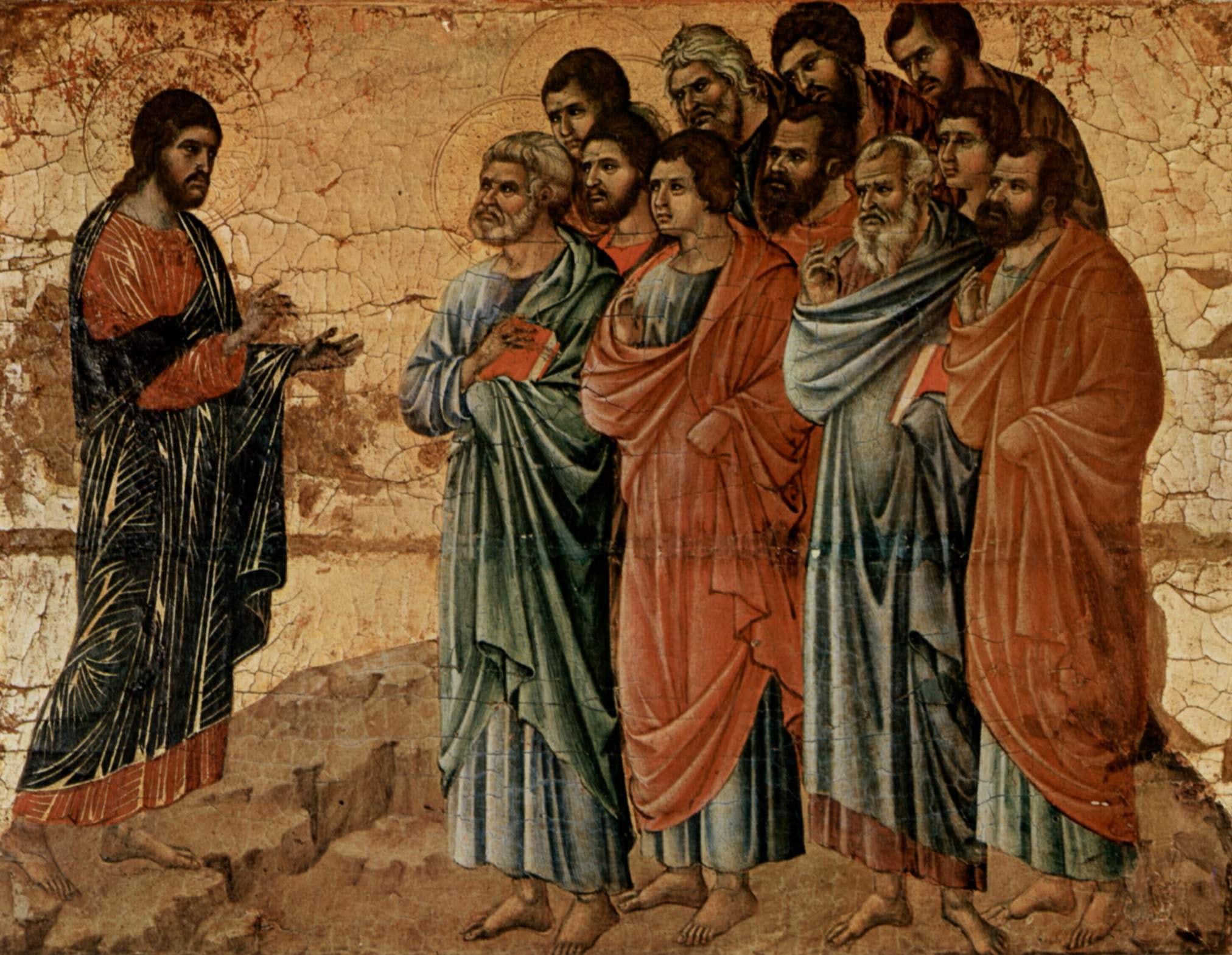
_The risen Christ sends His disciples to teach others "to observe all things that I commanded you" ([Matthew 28:16-20](/codex/matthew-28-16-20/)). Duccio di Buoninsegna, panel from the Maestà, 1308-1311, Museo dell'Opera del Duomo, Siena. Public domain, via [Wikimedia Commons](https://commons.wikimedia.org/wiki/File:Duccio_di_Buoninsegna_016.jpg)._
## What this means today
This section is application, drawn from the texts above.
1. **Following Jesus is knowing Him.** The words "I never knew you" ([Matthew 7:23](/codex/matthew-7-23/)) show that the center is relationship. Prayer, His words, worship and trust are how a branch stays in the vine ([John 15:4-5](/codex/john-15-4-5/)).
2. **Real faith gets its hands dirty.** The wise builder hears and does ([Matthew 7:24](/codex/matthew-7-24/)). Look at the direction of your life: are you, by God's grace, more forgiving, more honest and more generous than you were?
3. **Love is the sign others can see.** Jesus said the world would recognize His disciples by their love for one another ([John 13:35](/codex/john-13-35/)). Ask the people closest to you whether they experience you as more loving over time.
How the traditions hold these together:
- **Reformed:** look first to Christ and His promise; obedience and love confirm that faith is real, and God keeps His own.
- **Wesleyan and Arminian:** trust Christ now, expect the Spirit's witness with your spirit ([Romans 8:16](/codex/romans-8-16/)), and keep walking, since persistent unbelief can lead a person away.
- **Pentecostal:** the Spirit's inner witness and His power for holy living and service are central signs of a living relationship with Jesus.
All three would say the anxious believer should look to Jesus, and the comfortable believer should take His warnings seriously.
## Common misunderstandings
- **"I prayed a prayer once, so how I live does not matter."** Jesus says the house that stands is the one built on hearing and doing ([Matthew 7:24](/codex/matthew-7-24/)). A one-time prayer is a beginning, and following is a road.
- **"I still struggle with sin, so I must not be saved."** The disciples Jesus spoke to in John 15 would deny Him that same night. Struggling against sin is itself a sign of the Spirit's work. The question is which way you are facing.
- **The hard objection: "Making obedience a test turns grace into works."** The concern is real, and Christians have argued over it for centuries. In Jesus' picture, the life that belongs to Him shows up in what it does, like fruit on a living branch ([John 15:5](/codex/john-15-5/), [15:8](/codex/john-15-8/)).
## Put it into practice
1. Today, read [Matthew 5](/codex/matthew-5/) to 7 and underline one command you have been hearing but not doing.
2. This week, take one concrete step of obedience on that command, such as calling the person you need to forgive.
3. Ask a mature believer or pastor you trust, "Where do you see Jesus growing in me, and where do you see me stuck?"
4. Spend ten minutes each day this week simply praying, asking Jesus to help you remain in Him.
## A prayer for today
Lord Jesus, I want to really know You. Search my heart and show me where I hear Your words without doing them. Where I am afraid, remind me that You hold on to me. Where I am careless, wake me up. Help me remain in You, bear fruit, and love the people around me. In Jesus' name, amen.
## Reflect and respond
1. If the storm hit your life today, what would your foundation turn out to be?
2. Which of Jesus' words in the Sermon on the Mount are you hearing but not doing?
3. Who in your life could tell you honestly whether you are growing in love?
## Talk it over
Many readers have asked this same question, some from fear and some from a sense that something is missing. Share in the discussion below what has helped you know Jesus more deeply, or where you still wonder.
## See also
- [Life's Hard Questions](/codex/lifes-hard-questions/), the full series
- [What Does It Mean to Take Up My Cross Daily](/codex/what-does-it-mean-to-take-up-my-cross-daily/), what following Jesus costs
- [Who Am I If My Identity Is Built on What Others Think](/codex/who-am-i-if-my-identity-is-built-on-what-others-think/), finding identity in Christ
- [Assurance of Salvation](/codex/assurance-of-salvation/), the grounds of assurance across traditions
- [Perseverance and Apostasy](/codex/perseverance-and-apostasy/), the debate over falling away
- [Calvinism](/codex/calvinism/) and [Arminianism](/codex/arminianism/), the two main Protestant frameworks
- [Witness of the Holy Spirit](/codex/witness-of-the-holy-spirit/), the Spirit's inner testimony
- [Sanctification](/codex/sanctification/), how God makes His people holy over time
- [Sermon on the Mount](/codex/sermon-on-the-mount/), the teaching these words close
- [Matthew 7.21-23](/codex/matthew-7-21-23/), the warning at the center of this page
## Common questions this page answers
**Q: How do I know if I am really a Christian?**
Jesus points to a living relationship with Him that shows up in hearing and doing His words, remaining in Him, and loving others ([Matthew 7:24](/codex/matthew-7-24/), [John 15:5](/codex/john-15-5/), [John 13:35](/codex/john-13-35/)). Christians across traditions also point to trust in Christ's promise and the inner witness of the Holy Spirit.
**Q: What does "Lord, Lord, I never knew you" mean?**
In [Matthew 7:21-23](/codex/matthew-7-21-23/) Jesus warns that people who used His name and even did religious works can lack a real relationship with Him and real obedience to the Father. The warning calls people to know Him truly.
**Q: Can I lose my salvation?**
Christians differ. Reformed believers hold that God keeps true believers to the end, while Wesleyan and Arminian believers hold that persistent unbelief can lead a person to fall away. Both agree that genuine faith continues and grows.
**Q: I still sin. Does that mean I am not following Jesus?**
Every follower of Jesus still struggles with sin. The sign of real faith is the direction of your life: repenting, getting back up, and growing in love over time.
**Q: Is obedience to Jesus a way of earning salvation?**
Jesus presents obedience as the fruit of a life connected to Him, like fruit on a branch ([John 15:5](/codex/john-15-5/)). Christians agree that salvation is God's gift and that a living faith shows itself in what it does.