Concept
Great Commission
the great commission, what is the great commission, great commission meaning, great commission greek, make disciples of all nations, go and make disciples, great commission in luke, great commission in acts, was the great commission jesus last words, acts 1:8 great commissionIntro
The Great Commission is the job the risen Jesus gave his followers: make disciples of every nation, baptize them, and teach them to obey everything he commanded. The best-known version is at the end of Matthew's Gospel, on a mountain in Galilee. But it is not the only one. Luke records the same mission at the end of his Gospel and again at the start of Acts, and John and Mark have their own versions.
The wording in Matthew is worth slowing down for. In the Greek there is one main command, and it is not "go." It is "make disciples." Going, baptizing, and teaching all hang off that one command. Jesus did not send his followers out to collect decisions or draw crowds. He sent them to make more followers, people who actually learn from him and do what he says. And he backed the job with three things: his authority before the command, his promise to be with them after it, and the power of the Holy Spirit to carry it out.
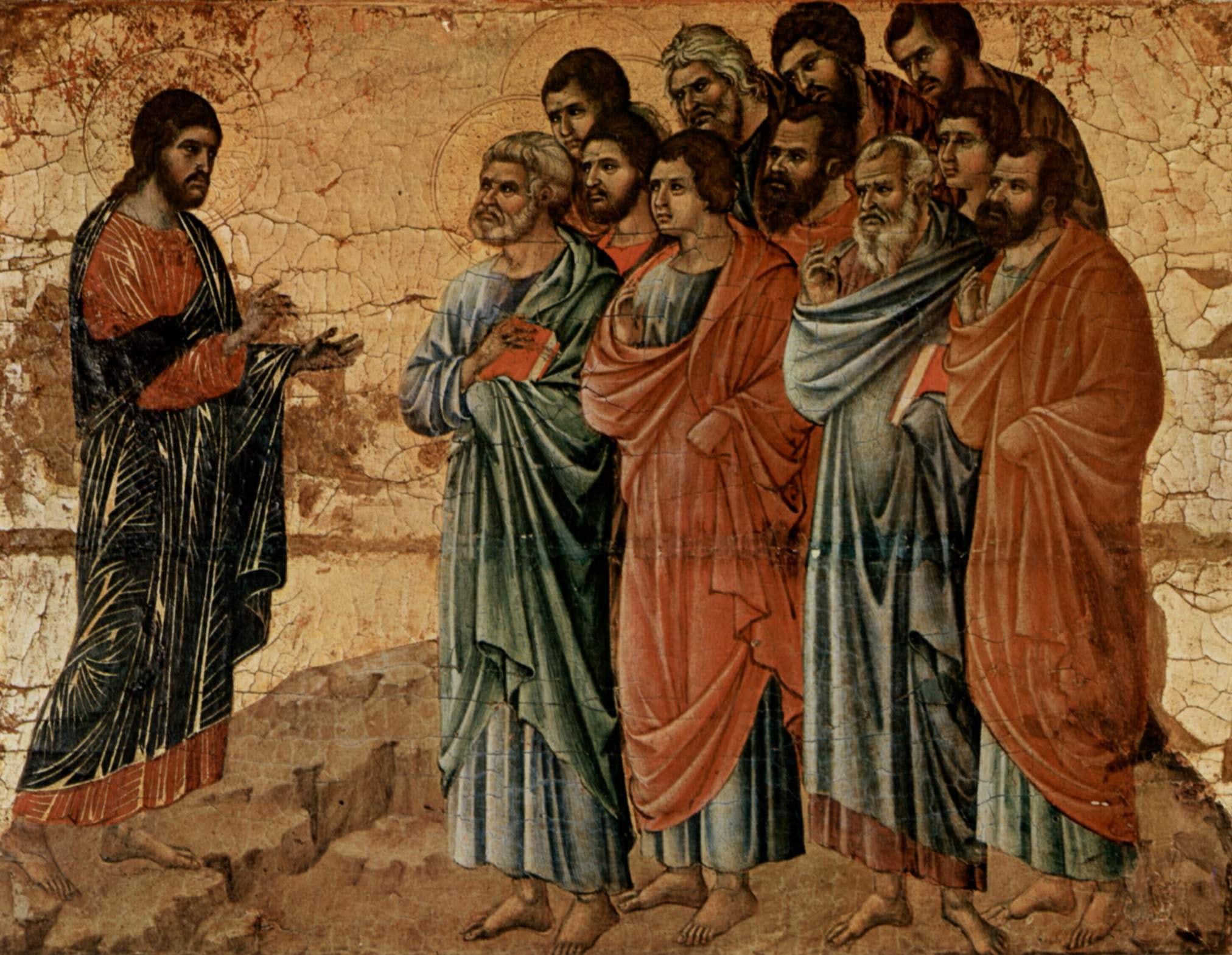
The risen Christ appears to the eleven on the mountain in Galilee (Matthew 28:16-20). Duccio di Buoninsegna, panel from the Maestà, 1308-1311, Museo dell'Opera del Duomo, Siena. Public domain, via Wikimedia Commons.

See this page's graph and discover linked topics
In full
"Great Commission" is a later Christian label, not a biblical phrase, for the mandate the risen Christ gave the eleven in Matthew 28:18-20 and its parallels in Luke 24:46-49, Acts 1:8, John 20:21, and the longer ending of Mark at Mark 16:15. Matthew's form is grammatically a single aorist imperative, mathēteusate ("make disciples"), governing an aorist participle of attendant circumstance, poreuthentes ("having gone", which takes on the imperative's force and is rightly translated "go"), and two present participles of manner, baptizontes and didaskontes, which describe how disciples are made. The commission is bracketed by a claim and a promise: universal authority already given to the Son (edothē moi pasa exousia, an aorist passive, "all authority was given to me") and his abiding presence "all the days" until the consummation of the age. Luke's two-volume work frames the same mandate as witness rather than disciple-making: the disciples are witnesses of the death and resurrection (Luke 24:48), and they will be witnesses when the Spirit's power comes (Acts 1:8, the future indicative esesthe, a promise that assigns a role rather than an imperative). Read together, the accounts give a consistent order: the Father sends the Son, the Son, holding all authority, commissions the apostles, and the Spirit empowers their testimony. The accounts are best harmonized as distinct occasions within the forty days of Acts 1:3, with Matthew's on a mountain in Galilee and Acts 1:8 the last saying before the ascension at the Mount of Olives.
The commissioning texts side by side
| Text | Setting | Form | Core content |
|---|---|---|---|
| Matthew 28:18-20 | A mountain in Galilee (28:16) | Imperative | All authority given; make disciples of all nations; baptize into the one name; teach obedience; "I am with you always" |
| Luke 24:46-49 | Jerusalem, ending near Bethany (Luke 24:50-51) | Indicative and promise | Repentance and remission of sins preached in his name to all nations, beginning from Jerusalem; "ye are witnesses"; wait for power from on high |
| John 20:21-23 | Jerusalem, the evening of resurrection day | Sending formula | "As the Father hath sent me, even so send I you"; he breathes on them and speaks of the Holy Spirit |
| Mark 16:15 | Longer ending of Mark | Imperative | "Go ye into all the world, and preach the gospel to the whole creation" |
| Acts 1:8 | The Mount of Olives (Acts 1:12) | Future indicative (promise) | Power when the Spirit comes; witnesses in Jerusalem, Judaea, Samaria, and to the uttermost part of the earth |
The longer ending of Mark is absent from the two oldest complete Greek manuscripts, so most textual critics treat it as an early addition; the commission does not depend on it, since Matthew, Luke, Acts, and John each carry it independently. See Marks Ending Proves the Resurrection Was Invented Objection Defeater.
What Matthew 28:18-20 literally says
All authority hath been given unto me in heaven and on earth. Go ye therefore, and make disciples of all the nations, baptizing them into the name of the Father and of the Son and of the Holy Spirit: teaching them to observe all things whatsoever I commanded you: and lo, I am with you always, even unto the end of the world. (Matthew 28:18-20, ASV)
A close rendering of the Greek runs: All authority in heaven and on earth was given to me. Having gone, therefore, make disciples of all the nations, baptizing them into the name of the Father and of the Son and of the Holy Spirit, teaching them to keep everything I commanded you. And look, I am with you all the days, until the completion of the age.
| Greek | Form | Force |
|---|---|---|
| edothē | aorist passive indicative of didōmi | "was given": the Son is the recipient of universal authority |
| pasa exousia | "all authority" | exousia is right and jurisdiction, not raw power |
| poreuthentes | aorist participle | "having gone": it stands before the main verb and shares its imperative force, so "go" is a fair translation |
| mathēteusate | aorist active imperative | "make disciples": the one finite command in the sentence |
| panta ta ethnē | "all the nations" | every people group, not Israel alone |
| baptizontes | present participle | how disciples are made: initiation into the triune name |
| didaskontes tērein | present participle with infinitive | "teaching to keep": the goal is obedience, not information |
| pasas tas hēmeras | "all the days" | the promise of presence is daily, not merely final |
Three things follow from the grammar alone.
Daniel B. Wallace's Greek Grammar Beyond the Basics (1996) treats poreuthentes here as a participle of attendant circumstance, the standard classification.
- The center is disciple-making. "Go" is real, and it would be wrong to say Jesus did not command his followers to go. But the sentence is built around mathēteusate. A disciple (mathētēs) is a learner who follows a teacher, so the measure of the mission is followers formed, not announcements made. The KJV renders the verb "teach all nations" and carries a margin note, "or, make disciples."
- Baptism and teaching are the method, not optional extras. The two present participles describe the ongoing manner of the main verb. A commission that stops at a profession of faith has done neither. See Baptism and G0907 - baptizo.
- "Into the name," singular. The Father, the Son, and the Holy Spirit share one name (to onoma). Patristic writers from the fourth century on read the singular as a witness to the unity of the three. See Trinity.
A simple way to hold the passage: Authority (28:18), Assignment (28:19-20a), Assurance (28:20b). The mission rests on his authority, follows his command, and depends on his presence.
Luke's version: witnesses, not only messengers
Luke tells the commission twice, at the end of the Gospel and the start of Acts, and both times the key word is martyres, "witnesses" (see G3144 - martys).
and that repentance and remission of sins should be preached in his name unto all the nations, beginning from Jerusalem. Ye are witnesses of these things. (Luke 24:47-48, ASV)
But ye shall receive power, when the Holy Spirit is come upon you: and ye shall be my witnesses both in Jerusalem, and in all Judæa and Samaria, and unto the uttermost part of the earth. (Acts 1:8, ASV)
- Acts 1:8 is a promise that assigns a role. The verb esesthe, "you shall be," is future indicative, not imperative. Strictly it is Matthew 28:19 that gives the command; Acts 1:8 declares what the Spirit will make of them and how far their testimony will reach. Calling Acts 1:8 "Luke's Great Commission" is fair as long as the difference in form is kept.
- Authority and power are different words. Matthew 28:18 gives Jesus exousia, the right to rule; Acts 1:8 gives the disciples dynamis, the ability to carry the task out. The Son holds the authority; the Spirit supplies the power.
- The witness is to events, not only ideas. When the apostles replace Judas, the qualification is to have been with Jesus from John's baptism to the ascension, so that the new man can "become a witness with us of his resurrection" (Acts 1:22). The commission is grounded in what they saw.
- It echoes Isaiah. "Ye are my witnesses, saith Jehovah" is God's charge to Israel in Isaiah 43:10, 43:12, and 44:8, in the very chapters where he declares there is no God beside him. When Jesus says "ye shall be my witnesses," he takes up the role God assigned Israel and makes himself its object. David W. Pao's Acts and the Isaianic New Exodus (2000) develops the Isaianic frame of Acts at length.
- The geography is a plan. Jerusalem, Judaea, Samaria, and the ends of the earth also maps the book of Acts itself; see Mission Geography (Acts 1-8).
Were these Jesus' last words?
Matthew 28:18-20 are the last words of Jesus in Matthew's Gospel. Matthew ends there and does not narrate the ascension. Acts 1:8 is the last saying before the ascension in Luke's account, since the next verse reads:
And when he had said these things, as they were looking, he was taken up; and a cloud received him out of their sight. (Acts 1:9, ASV)
The two fit together as separate occasions within the forty days in which Jesus appeared to the apostles (Acts 1:3):
- Resurrection and appearances in Jerusalem (Matthew 28:1-10; Luke 24; John 20).
- The eleven meet him on the appointed mountain in Galilee and receive the commission (Matthew 28:16-20).
- Further appearances over forty days (Acts 1:3).
- The last conversation near Jerusalem and the promise of the Spirit (Acts 1:6-8).
- The ascension from the Mount of Olives (Acts 1:9-12). Luke's Gospel places it "over against Bethany" (Luke 24:50-51), and Bethany sits on the eastern slope of the same Mount of Olives, so the two accounts agree on the place.
- The Spirit comes at Pentecost (Acts 2:1-4).
Luke 24 compresses these events into what reads like one evening, and the same author explains in Acts 1:3 that they spanned forty days. A writer who knows both versions because he wrote both is compressing, not contradicting.
Common objections
- "The commission was only for the eleven apostles." It was spoken to the eleven, but its promise outlasts them: "I am with you always, even unto the end of the world." A mission whose guarantee runs to the end of the age was never meant to end with the apostles' deaths. The command to teach "all things whatsoever I commanded you" also includes this command, so every disciple made is taught to make disciples.
- "The Great Commission is just evangelism." Evangelism is its front edge, but the text includes baptism and long-term teaching aimed at obedience. A person who hears the gospel and is never taught to follow Christ has not yet been discipled.
- "Making disciples means forcing conversion." Faith, repentance, and love cannot be coerced, and the apostles never tried: "we persuade men" (2 Corinthians 5:11). The method is proclamation, reasoning, and voluntary response. See Forced Conversion By Sword Objection Defeater.
- "The accounts contradict each other on place and last words." They describe different occasions in a forty-day period, and Luke himself, who places the ascension near Bethany in his Gospel and at Olivet in Acts, shows the two are the same location. Different settings for different sayings is what forty days of appearances would produce.
- "The triune baptismal formula in Matthew 28:19 is a later insertion." Every surviving Greek manuscript that contains the end of Matthew reads the threefold name, and so do the early versions. The Didache (7.1), commonly dated around AD 100, already prescribes baptism "into the name of the Father and of the Son and of the Holy Spirit." The argument for interpolation leans on Eusebius, who sometimes cites the verse in a shorter form, "make disciples of all nations in my name"; but Eusebius also quotes the full form, including in his letter to his church at Caesarea after Nicaea, and a writer's loose allusion is not a manuscript.
- "Jesus came only for Israel." The commission names "all the nations" (panta ta ethnē), and the Abrahamic promise already reached "all the families of the earth" (Genesis 12:3). See Jesus Came Only for Israel Objection Defeater.
Witness and martyr
The English word "martyr" comes straight from the martyres of Acts 1:8. In the New Testament the word still means "witness," but Acts 22:20 already uses it of Stephen at the moment his blood was shed, and Revelation 2:13 of Antipas, "my witness, my faithful one, who was killed." By the second century the word had narrowed to one who dies for the testimony. The commission did not say the witnesses would die; the history of the word records that many of them did. See G3144 - martys, Historical Evidence for the Martyrs, and Justin Martyr.
When were these books written?
- Luke before Acts. Acts opens, "The former treatise I made, O Theophilus" (Acts 1:1), pointing back to the Gospel addressed to the same man (Luke 1:3).
- Mark is usually placed first among the Synoptics because Matthew and Luke share most of Mark's sequence and much of its wording; see Synoptic Problem.
- The date of Acts is debated. Many scholars place Luke and Acts around AD 80-90. Others argued that Acts was finished in the early 60s: Adolf von Harnack in The Date of the Acts and of the Synoptic Gospels (1911), John A. T. Robinson in Redating the New Testament (1976), and Colin Hemer in The Book of Acts in the Setting of Hellenistic History (1989). Their main reason is that Acts ends with Paul under house arrest in Rome for two years (Acts 28:30-31) and says nothing of his death, Nero's persecution, or the fall of Jerusalem in AD 70.
- The commission is older than the books that record it. Paul's letters, written in the 50s, already show a mission to the nations grounded in resurrection appearances (1 Corinthians 15:3-8; Galatians 1:15-19). Whatever the exact dates of Matthew and Acts, the mandate they describe was already being carried out a generation earlier.
Scholarship
Published academic works this page draws on, each matched to a publisher, index or library catalog record.
- Colin J. Hemer, The book of Acts in the setting of Hellenistic history (1989). Open Library
- David W. Pao, Acts and the Isaianic new exodus (2000). Open Library
- John A. T. Robinson, Redating the New Testament (1976). Open Library
- Daniel B. Wallace, Greek grammar beyond the basics (1996). Open Library
Tensions
"Go" or "as you go"? Evangelism glosses Matthew 28:19 as "as you go through your ordinary life, disciple," reading poreuthentes as a circumstance of daily life rather than a command. This page reads it as a participle of attendant circumstance that shares the imperative's force, so that "go" is itself commanded, which is how nearly every English translation renders it. The two agree on the main point, that the one finite command is "make disciples." They differ on whether going is assumed or required. The grammar favors the second, and the setting does too: the eleven were being sent out of Galilee to "all the nations."
See also
- Evangelism, the practice the commission launches
- Baptism, one of the two participles that define disciple-making
- Mission Geography (Acts 1-8), the Jerusalem, Judaea, Samaria, ends-of-the-earth program of Acts 1:8
- G3144 - martys, the witness word behind Luke 24:48 and Acts 1:8
- Jesus Never Founded Christianity Objection Defeater, on whether Jesus meant to found a community at all
- Jesus Came Only for Israel Objection Defeater, the "all nations" question
- Trinity, on the single name of Father, Son, and Holy Spirit
- Pentecost, where the promised power arrives
- The Way, what the first disciples were called before "Christians"
- Apostle, the office first entrusted with the commission
Common questions this page answers
Q: What is the Great Commission in simple terms?
It is the task the risen Jesus gave his followers in Matthew 28:18-20: make disciples of all nations, baptize them into the name of the Father, Son, and Holy Spirit, and teach them to obey everything he commanded, with his promise to be with them always.
Q: What does the Great Commission literally say in Greek?
The one main command is mathēteusate, "make disciples." "Go" is a participle, "having gone," that shares the command's force, and "baptizing" and "teaching" are participles describing how disciples are made. A close rendering is: "Having gone, therefore, make disciples of all the nations, baptizing them into the name of the Father and of the Son and of the Holy Spirit, teaching them to keep everything I commanded you."
Q: Is "go" the main command of the Great Commission?
Not grammatically. The main verb is "make disciples," and "go" is an attendant participle that takes on its command force. So Jesus did command his followers to go, but the point of going is to make disciples.
Q: Does Luke have a Great Commission?
Yes, twice. Luke 24:46-49 has repentance and forgiveness preached in Jesus' name to all nations, beginning from Jerusalem, with the disciples named as witnesses, and Acts 1:8 promises the Spirit's power so they will be his witnesses to the ends of the earth.
Q: Is Acts 1:8 a command?
Strictly, no. "Ye shall be my witnesses" is a future indicative, a promise that assigns a role, while Matthew 28:19 carries the imperative. Acts 1:8 describes the empowerment and the reach of the mission Matthew 28 commands.
Q: Were the Great Commission Jesus' last words?
They are his last words in Matthew's Gospel. The last saying before the ascension is Acts 1:8, followed by "when he had said these things... he was taken up" (Acts 1:9). Matthew's commission was given earlier, on a mountain in Galilee, within the forty days of appearances.
Q: Is the Great Commission for every Christian or only the apostles?
It was spoken to the eleven, but Jesus attached a promise that runs "unto the end of the world," and he told them to teach new disciples everything he had commanded, which includes the commission itself. The church has always read it as a standing mission.
Q: Was the Trinitarian formula in Matthew 28:19 added later?
No manuscript evidence supports that. Every Greek manuscript that preserves the end of Matthew has the threefold name, and the Didache, around AD 100, already uses it for baptism. The shorter form sometimes quoted from Eusebius is a loose citation, and Eusebius also quotes the full form.